

The Orioles telegraphed that Samuel Basallo was their catcher of the future as soon as they signed him, days into his MLB career, to an eight-year contract extension. When the team traded Adley Rutschman ahead of this year’s trading deadline, that elevated Basallo to catcher of the present as well. Unfortunately for Basallo and the Orioles, his rookie season ended up with him like so many other recent young Orioles, where flashes of the potential were regularly present but the whole thing did not
come together into as good of a package as the team needed.
Going into this season, you didn’t have to be living in a delusional, optimistic world to think that Samuel Basallo might end up as a Rookie of the Year contender. The Orioles massaged his arrival carefully last year – same as they did with Dylan Beavers – just to preserve that possibility. They really thought they were getting things lined up to maybe get a bonus draft pick next year. They had managed this once before with Gunnar Henderson.
As it turned out, all of this was pointless, and it didn’t even have anything to do with Basallo, because of a strong AL rookie field. Detroit’s Kevin McGonigle is likely to run away with the race. A pair of Japanese “rookies” in Kazuma Okamoto and Munetaka Murakami had strong American debuts. A number of other American-born players have strong cases to fill out ballots, among them Cleveland’s Chase DeLauter, Chicago’s Tristan Peters, and Kansas City’s Carter Jensen. Basallo could have had a good season and he would have been just another player in this 2nd-5th place pack.
Through the end of May, things were going very well. At the end of May, he had a .283/.345/.516 batting line, with nine home runs already. This turned out to be the high point for Basallo’s 2026 season. He did not have another good month at the plate for the rest of the season, with poor hitting in June and July and incredibly awful hitting in August and September.
Part of the story of the second half struggle was surely injuries. Basallo played in only 29 games after the All-Star break. He missed close to a month due to dealing with shoulder inflammation, and it was after returning that his season numbers really took a swan dive. Unfortunately, one part of the story of Basallo’s injuries was that his manager, first-time skipper Craig Albernaz, spent some of his time with reporters openly questioning Basallo’s toughness.
There was a period of a few days there where it seemed that Albernaz had vindictively benched Basallo over the catcher needing an off day to manage a minor injury. That’s what was implied by both Orioles TV and radio broadcasts at the time, with Hall of Famer Jim Palmer expressing his disagreement with that treatment of the O’s young player. (Maybe that’s why Albernaz didn’t reply to his text that one time.)
I don’t want to hijack this article about Basallo with a rant about the manager being an idiot. Yet it’s hard to avoid wondering how much Albernaz’s attitude affected Basallo in August and September. Did he rush back from that shoulder injury? Was he playing through something else in order to avoid the ire of Albernaz? It’s not certain it was physical. There is always the Adam Jones Theory of Baseball, which he delivered at a time when reporters were asking him if he was playing through an injury: “Sometimes you just suck.”
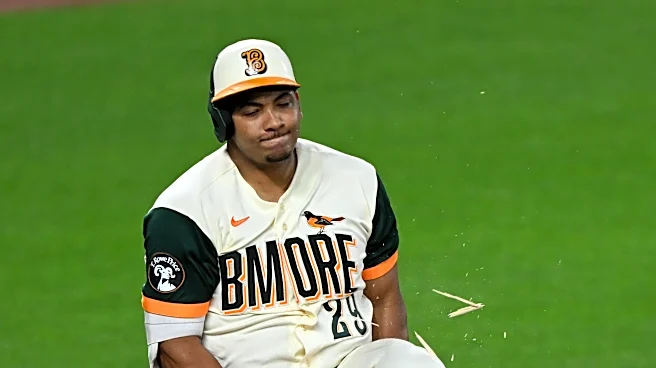
The late-season swoon included a number of moments from Basallo where the frustration bubbled over. The photo accompanying this article, Basallo destroying a bat by snapping it over his thigh, was only one example. I can’t help but bring Albernaz into it again. What was the manager doing while his young player was going through extremely public and obvious challenges? (A similar question could be asked regarding Gunnar Henderson’s visible frustration.) It’s the job of Albernaz and his coaching staff to stop things before they get to that point! What were they doing? Sorry. Okay, I’m not sorry. But I am going to try to get back to Basallo.
More than most of the other positions on the diamond, the value of a catcher is about more than just what he does when he’s hitting. Even as he debuted last year as a much-hyped prospect, there were questions about what level of defense Basallo might be able to develop as time went on. Would he be able to handle some of the technical aspects like pitch blocking and controlling the running game? Would he be able to develop good relationships with his pitchers and carry out productive pitch-calling game plans?
There is enough in the 2026 performance to think that the answer to these questions could, over time, be yes. Basallo graded out well in the Statcast metrics for pitch blocking. He also showed a good pop time and with it, solid ability to control the running game. Regarding game-calling, Basallo emerged as the clear personal catcher for Trevor Rogers, even before Rutschman was ever traded, so it’s clear there was something positive going on there.
Less positive was Basallo on pitch framing. This is a skill whose importance has evolved with the introduction of the ABS challenge system. It’s less final if a catcher is bad at it. You can get the umpire to fix a mistake, theoretically. It’s still worth something to have a good framer of a catcher. It’s better to make the other team have to put one of their challenges at risk to have the umpire overturn a borderline pitch than to have to put one of yours at risk.
As a challenger, as a catcher, Basallo was exactly 50/50. He won 30 and lost 30. That’s actually a higher percentage than I expected, because it felt like there was a lot of “Basallo blows a challenge early and it was a bad idea” going on. There was some of that, and perhaps that’s an influence on why Basallo actually graded poorly as a challenger: He only challenged 19% of eligible mistakes. Maybe he became too conservative after some of the mistakes.
The Orioles were 30th of 30 teams in this category. That is, they were the worst team at using a challenge when pitches in the strike zone were called balls. Basallo wasn’t the only problem, but he was reflective of it. The average team was challenging about a third of the mistakes made when they were on defense. It could be that some early bad challenges by hitters also influenced the catchers. This is an area where the whole 2027 Orioles can stand to improve.
What does all of this add up to for Basallo in 2027? Although he is the team’s most prominent remaining catcher, it’s still not clear how frequently he will, or should, catch behind the dish. The team was already conservative with how often they played Rutschman back there. He’s got stuff to work on: Along with the framing/challenging, he could stand to chase less, and find a way to get productive launch angles more frequently. I don’t know how well the manager will be in his corner for all of this.
Even so, Basallo is the Oriole whose contract is guaranteed the farthest into the future. More than anyone else, he is expected to be a key piece of what happens going forward. There are reasons to be excited. Hopefully by the end of next season, there will be more such reasons.