
There is nothing new to break down from the Seattle Seahawks side. They haven’t played anyone since we last saw them, which was only two weeks ago.
There is new information about the San Francisco 49ers. Some good: Fred Warner potentially returning this weekend and Ricky Pearsall feeling optimistic he’d play. Trent Williams’s upgrade to full shouldn’t be swept under the rug, either.
There is also some bad news: George Kittle tearing his Achilles. Kittle remains one of the most impactful players in the NFL,
regardless of his position.
During the regular season, the 49ers averaged 4.1 yards per carry on designed runs with Kittle on the field, compared to 3.7 when he was off. The 49ers also had rushes of 10+ yard carries 7.3 percent of the time when Kittle was off the field, compared to 10.8 percent with Kittle on the field.
Last week, Kyle Shanahan drew up plays that involved Kittle beating All-Pro cornerback Quinyon Mitchell in 1-on-1 scenarios. In Week 18, one of the few things that went right for the 49ers was a big play to Kittle. He led all tight ends this season in receiving yards over expected at +156. Calling Kittle “good” is selling him short.
Speaking of things that didn’t go right for the 49ers in Week 18, we are going to go through 19 of those. There isn’t much you can hang your hat on offensively when you only muster three points in a game. Being limited to 42 plays and going 2-for-11 on third- and fourth-down conversions probably made it a difficult rewatch for the Niners.
Miscues on offense
Of those 19, eight are on offense. We will give credit to the Seahawks’ front 7. The 49ers didn’t have any negative rushes, but they had a slew of one, two, and three-yard gains. The 49ers’ offensive line was middle of the pack in Week 18, ranking 16th against Seattle in yards before contact. Even understanding Trent Williams’ impact, we’ll act as if the 49ers will struggle once more on the ground.
Let’s start with the offense, and see how variance might be on their side in the Divisional Round:
- On the 49ers’ initial third down of the game, they needed to pick up three yards. There is a receiver on the roster who inherited a nickname for this down-and-distance. It doesn’t happen often, but Brock Purdy and Jauan Jennings weren’t on the same page. Purdy expected Jennings to run an out route. Jennings acted like he was going to, but instead ran a “return” route back to the inside. It was a bad time for the two not to be on the same page on a choice route.
- On a 2nd & 8 play in the first quarter, Purdy ran into a sack. Purdy’s pocket climbing is a skill, but on this play, he didn’t recognize the matchup he had with his checkdown option.

Shanahan drew up a design for Christian McCaffrey to come out of the backfield from the opposite side of the formation. To the bottom of the screen, that’s McCaffrey against Boye Mafe, a pass rusher. So, while they look “even,” it’s a matchup you’ll take every time. The offense punted on this drive. McCaffrey likely picks up a first down on this play.
3. In the second quarter, with just over 11 minutes to play, Shanahan called a play-action pass with a “slide” route, where Jennings runs behind the line of scrimmage. There’s one problem. Tariq Woolen shadowed Jennings for much of the game: Jennings and his 4.7 40-yard dash needed to outrun Woolen, who ran a 4.2. The play never stood a chance, and the Niners lost a yard. This was the drive that ended in a 4th-and-1.
Maybe the offense throws an incomplete pass on first down instead. Perhaps they gain a yard on the ground. Anything other than a yard loss likely creates an opportunity for points.
4. On that 4th & 1, Shanahan gets the exact look that he wants. Seattle was in Cover 2 to the bottom of the screen, and the safety had to pick between the intermediate out route or the go route down the sideline:

Purdy doesn’t get a chance to make the safety pay because McCaffrey whiffed on his block, which is the defender circled in the backfield. Purdy does his best to get rid of the ball and throws it to the first-level route. We’ll never know which player Purdy planned to target.
When the 49ers run into another 4th & 1, maybe they sneak it, use Purdy on a zone read, or give him a run/pass option. The only receiver on the field probably won’t be Skyy Moore. There’s no guarantee the 49ers block Seattle, but the play-call will be different, especially with Trent Williams on the field.
5. With 5:19 remaining in the second quarter, Shanahan called a tight end screen to Kittle. The design required left tackle Austen Pleasants to block rookie phenom Nick Emmanwori. The result went as expected, and Emmanwori made a tackle six yards behind the line of scrimmage.
That’s twice now where Shanahan leaned into Emmanwori’s strengths in the first half. Shanahan did not do that in the Wild Card round. Instead, he forced Cooper DeJean to turn and run. Expect that to happen with Emmanwori this time around, as opposed to letting the speedsters thrive around the line of scrimmage.
6. For much of the game, you could see Purdy was hesitant. He either wasn’t seeing the field well or did not trust the non-Kittle receivers. Seattle’s pressure undoubtedly contributed to that. To begin the third quarter, Purdy ran into a sack and missed Kittle crossing the field for a would-be first down. He felt pressure, but dropped his eyes instead of standing tall and delivering a throw.
7. With 5:22 remaining in the third quarter, Purdy’s throw pulled Demarcus Robinson behind the first down marker on 3rd & 2. It was high and late, leading to a punt.
8. With 10:27 remaining in the fourth quarter, the 49ers had their most promising drive of the game. Purdy threw it to McCaffrey, and the ball took an unfortunate bounce off McCaffrey’s pads and into the hands of a Seattle defender. Instead of a touchdown, the Seahawks escaped without allowing any points.
That’s it for the offense. As you can see, the players they rely on did not play up to their usual standards. Shanahan had a couple of stinkers and wasn’t aggressive until the 49ers were down double-digits. The run game was obsolete without Trent Williams, and the passing game was impacted after needing to chip Pleasants’ defender 48 percent of the time.
A lot happened in Week 18 that is unlikely to carry over into Week 20, yet it is still worth giving credit to the Seahawks for stopping the run and shutting down the 49ers for most of the game.
Onto the defensive side of the ball, where there were 11 plays they’d like to have back. We are only taking away one play from Jaxson Smith-Njigba, and we will even give the Seahawks credit for a handful of coin-flip plays. They moved the ball at will.
Still, the 49ers allowed 272 yards after contact and missed 23 tackles. Slicing that number in half, and we have an entirely new ball game.
- Right off the bat, linebacker Tatum Bethune was hesitant on a screen pass and got caught in between what he wanted to do. He compounded that by missing a tackle, leading to a missed tackle and a 20-yard gain.
- Later in the drive, on 3rd & 4, Saleh is the perfect coverage on to take away the route the Seahawks want, but Bethune overruns the route, and Seattle converts on a 3rd & 4.
- On the next drive, Bethune overpursued on the run play, and Seattle’s running back cuts it back and goes untouched into the end zone.
- We’re still in the first quarter, where Bethune and Dee Winters run themselves out of the play, and Ji’Ayir Brown misses a tackle, leading to a 20-yard gain. To this point, the linebacker play has reached its lowest level of the season.
- To begin the second quarter, on 2nd & 15, JSN was lined up in the backfield. Winters and Bethune both missed a tackle, both well before the first down marker, leading to a gain of 17 yards. These are the plays that sting. You have Seattle behind the sticks, only to let them off the hook.
- On 3rd & 4 with 7:31 remaining in the second quarter, Winters has a free run at Sam Darnold. You couldn’t scheme it up any better. But Winters rushes a little recklessly, Darnold side steps him, and instead of a sack, the Seahawks pick up a first down.
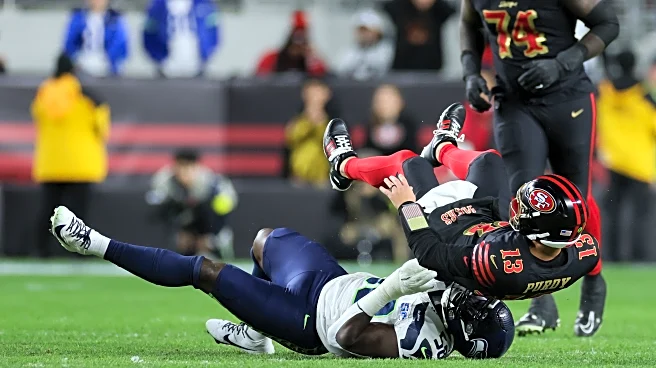
- The score is 10-3 with just over four minutes remaining in the third quarter. Darnold goes full Darnold and trips. The ball is loose and bounces into the face mask of Yetur Gross-Matos. The 49ers get the break they needed, but they cannot corral the fumble. Unequivocally, one of the biggest turning points in Week 18.
- Two plays later, the 49ers get shoddy efforts and angles from Deommodore Lenoir and Ji’Ayir Brown on 3rd & 17, and it feels like the game just ended after the Seahawks picked up a first down.
- During the same drive, with 2:23 remaining in the third quarter, Jason Pinnock inexplicably blitzes. He vacates his zone, leaving the running back wide open in the flat. He gains 12 yards, and it’s another first down for Seattle.
- The game has all but been decided by now, but midway through the fourth quarter, Renardo Green has a prime opportunity to come up with an interception. Instead of dragging his feet, Green was only able to get one foot down in bounds.
- Lastly, with 4:12 remaining in the game, Darnold scrambles, and Garret Wallow couldn’t stick with Cooper Kupp for six seconds, leading to another Seahawks conversion on 3rd & 10.

Football is a game of variance. It’s also a team sport. If one person doesn’t do their job, the odds of you being successful on that play drastically decrease. That was the case for the 49ers on both sides of the ball in Week 18.
The Niners have proven that they can beat anybody in the NFL. However, with the current roster, they cannot afford their quarterback to miss throws or their running back to miss blocks. Nor can they get away with multiple missed tackles on a play.
We know the 49ers are coming into the Divisional Round short-handed. It’s why they are the biggest underdogs that they’ve been all season. It’s wishful thinking to expect a mistake and penalty-free outing on Saturday night. But if the Niners can turn the number of miscues from 19 to 9, the dog has a chance to bark in Seattle