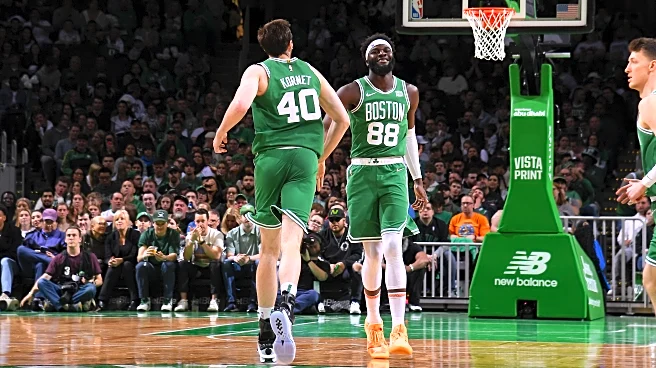




The Celtics’ recent success has not only been built on stars and shot creation, but also on a quieter, more structural dominance inside. Over the last two seasons, Boston has found ways to maximize the impact of big men who were once considered marginal NBA players.
Over the last few years since Brad Stevens took over as general manager, the Celtics have seen a lot of talented big men: Robert Williams, Al Horford, Kristaps Porzingis, Daniel Theis, or Blake Griffin. Yet, the last two seasons have shown
that the Celtics are also able to turn less skillful big men into highly impactful players. But how do we measure impact when it comes to interior big men?
Defensively, the center’s most important job is to protect the rim and limit the volume of free throws for opponents, as these are the two most efficient ways to score points. Offensively, if they can’t shoot, they need to bring vertical spacing, offensive rebounding, good screening, and some passing to stay connected to the ball.
With that in mind, it’s hard not to think about Luke Kornet and Neemias Queta. Looking at the numbers, after joining the Celtics, both players seem to have turned their careers around after minimum contracts and back-and-forth trips to the G League. The first took a direction that completely reshaped his game and dramatically increased his value, while the second is following a path that could turn him into a starting center on a title contender.
Luke Kornet: finding a way
In his first four years, Kornet took more than half of his shots from beyond the three-point line. In his last four seasons as a Celtic, he has taken only 21 attempts from deep. Instead of using him on the perimeter, the Celtics turned him into a beast inside the paint offensively:
2019/20 offensive stats:
⇢ 33% of his shots at the rim (30th percentile among bigs)
⇢ 79% field goal efficiency at the rim (93rd)
⇢ Fouled on 5.9% of his shot attempts (13th)
⇢ Rebounded on 3.4% of Celtics missed FGAs (17th)
2024/25 offensive stats:
⇢ 83% of his shots at the rim (97th)
⇢ 74% field goal efficiency at the rim (81st)
⇢ Fouled on 16.1% of his shot attempts (81st)
⇢ Rebounded on 13.6% of Celtics missed FGAs (91st)
The numbers make me dizzy. The big man went from a non-impact player who couldn’t find a stable role in the NBA to one of the most impactful players on a championship-caliber team. Offensively, the Celtics also noticed that, even early in his career, Kornet had the ability to pass the ball more than the average center, ranking in the 76th percentile in playmaking ratio among big men during his rookie season.
Last year, the coaching staff built much more offense around “Luke the Kornector,” and his playmaking ratio jumped to the 88th percentile. By shooting less, impacting the glass far more, and passing the ball as a hub, Kornet became a modern offensive big man nobody thought he could be. But his defensive upside might be even more impressive.
Protector of the realm
Despite playing on the same teams as Kristaps Porzingis or Robert Williams, Luke Kornet might have been the best rim protector of the Brad Stevens era. When he was on the court, the Celtics were the best team at limiting both the volume of rim attempts and free throws — even better than when Porzingis or the Timelord were on the floor.
Individually, Kornet’s numbers defending shots within six feet of the rim were astonishing last season. He ranked among the top ten players at reducing opponents’ field-goal percentage in that zone. When you’re in the same ballpark as Victor Wembanyama, Anthony Davis, Rudy Gobert, or Jaren Jackson Jr., you’ve reached the top tier of rim protectors.
In three seasons, Kornet — thanks to Celtics management and the coaching staff — went from a center no one wanted to sign to the most underrated signing of the 2025 free-agency. For the first time in his career, he signed a contract longer than two years. And while this was happening, few realized that the organization was already paving the way for another drastic evolution among its centers. Neemias Queta’s rise was underway before we knew it.
Neemias Queta: from waived for JaVale McGee to a starting center
After 20 games, the Sacramento Kings decided they had seen enough of Queta and waived him to make room for JaVale McGee. A few years later, the Portuguese big man is an NBA champion and a starter on one of the best teams in the league. And yet, that isn’t what matters most today. “Starting center” or “NBA champion” are labels that don’t fully capture the significance of Neemias Queta’s evolution.
After two seasons spent at the back of the rotation behind an established big men, Queta was given the opportunity to achieve what Kornet had done before him: turn himself into an impactful player after years of being overlooked. It’s safe to say he delivered.
Like Kornet, he developed into an interior force, finishing with 75% efficiency at the rim (79th percentile among bigs) and making a major impact on the offensive glass. With offensive rebounds on 12.7% of Celtics missed shots, he ranks among the best offensive rebounders in the NBA (83rd percentile). While his passing hasn’t reached Kornet’s level, he has clearly improved this season, taking on more responsibility as a hub and connector.
His biggest improvement, and the reason Celtics ball-handlers enjoy playing with him so much, comes from the quality of his screens. Queta generates 18.7 points per 48 minutes through screening actions, ranking fourth among players with more than 400 minutes this season. And the leader in that category? You guessed it: Luke Kornet.

Defensively, his rim impact is slightly less elite than the Celtics’ former number 40, but his defensive playmaking is stronger, helping Boston create more transition opportunities — a perfect fit for the team’s evolving style. Only two players in the league post a similar or better combination of steal rate and block rate: Goga Bitadze and Victor Wembanyama.
Queta doesn’t have Kornet’s comfort level in drop coverage, but he can switch far more and apply greater pressure on the ball. As a result, the Celtics are a significantly better defensive team when he’s on the floor. So far this season, Boston posts a +14.1 net rating with Queta on the court, a figure that would rank second in the NBA, trailing only the Oklahoma City Thunder.
Ultimately, both Kornet and Queta adapted their games to an NBA where rim protection and the possession battle matter more than ever. They don’t do anything flashy, but they rebound, screen, protect the paint, and consistently apply pressure inside. Surrounded by elite talent, that’s exactly what the Celtics need — and after letting Kornet walk for financial reasons, Boston may not make the same mistake with Neemias Queta, who will soon be eligible for an extension.