






Scouts love a guy who looks like a ballplayer – six-foot-tall, lean build, broad shoulders. Moneyball famously lampooned traditional scouts for obsessing over a prospect’s physical appearance, illustrated by Billy Beane’s memorable line, “We’re not selling jeans here.”
Drew Burress doesn’t sell jeans. But the kid can ball.
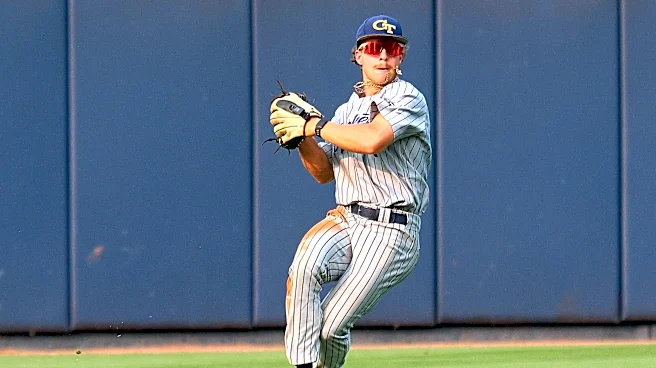
Standing at just 5’9”, the Georgia Tech outfielder lacks the size teams typically covet. Yet after three seasons of obliterating college pitching, Burress has forced evaluators to focus
less on what he looks like and more on what he does. Entering the 2026 MLB Draft, he is considered one of the best college bats available and should be a top ten pick.
Drew Burress, Georgia Tech
Bats: Right
Throws: Right
Draft rankings:
- The Athletic: #7
- Baseball America: #8
- ESPN: #7
- MLB Pipeline: #7
- Perfect Game: #10
The kid from Warner Robins, Georgia made an impact immediately at Georgia Tech when he launched nine home runs in his first eight collegiate games. He finished his freshman season with 25 home runs, setting the Yellow Jackets’ freshman record while earning National Freshman of the Year honors and becoming just the 10th freshman position player ever named a Baseball America First-Team All-American.
In 2026, Burress surpassed Georgia Tech legend Jason Varitek to become the school’s all-time home run leader, reaching 58 career home runs in just three seasons compared to Varitek’s four. For the season, he hit .358/.473/.657 with 16 home runs and 49 walks to just 43 strikeouts in 61 games.
Burress pairs power with one of the most disciplined offensive approaches in college baseball. Keith Law notes he has finished all three collegiate seasons with more walks than strikeouts while chasing fewer than 20 percent of pitches outside the strike zone. His contact rate on strikes is also well above the Division I average, giving him one of the strongest combinations of power, patience, and bat-to-ball ability in the draft.
Despite his modest frame, Burress generates legitimate plus power through exceptional bat speed and strength. His 90th-percentile exit velocity of 109.1 mph ranked in the top three percent of all qualified Division I hitters during the regular season. Law projects him as a future 20-plus home run hitter in the major leagues.
Burress features a compact, explosive right-handed stroke with excellent bat speed and natural loft that allows him to drive the ball without overswinging. While he stumbled early in 2026 after trying to lift and pull everything, he returned to the balanced approach that made him one of the nation’s most feared hitters, finishing the season much stronger during ACC play.
There are still questions scouts would like answered before draft day. Baseball America notes that Burress employs a pull-heavy approach with a sizable leg kick, and his swing can get long at times. Evaluators also wonder whether his home run production will translate quite as seamlessly with a wood bat, particularly against professional pitchers capable of consistently attacking him with quality breaking balls down and away. He hit just .125 in the wood bat Cape Code League in 2024, after his freshman year.
Defensively, Burress offers valuable versatility. He has spent his college career in center field, and his above average speed allows him to cover plenty of ground. Opinions differ on whether he’ll remain there as a professional. Keith Law believes he has less than an even chance to stick in center, while MLB Pipeline is more optimistic that he can stay at the position. Even if he ultimately shifts to right field, his plus throwing arm and offensive profile should allow him to remain an impact regular.
Scouts also rave about Burress’ makeup. MLB Pipeline cites his work ethic, athleticism, and baseball instincts as significant strengths, traits that helped him quickly adjust after mechanical issues caused a slow start to his junior season.
There will always be skepticism surrounding undersized hitters, particularly those expected to provide middle-of-the-order power. Burress has spent three years proving those concerns don’t apply to him. His combination of elite production, advanced plate discipline, plus power, and defensive value gives him one of the highest floors among college position players in the draft.
Burress could be a quick riser, which could play into whether the Royals select him. In his latest mock draft, Baseball America’s Carlos Collazo writes that he “wouldn’t have expected a quick-moving college player for the Royals in this year’s draft, but it sounds like the current poor play of the major league team could become a real factor in who gets picked here. Burress would make sense if the organization feels the need to add a fast-mover.” MLB Pipeline doesn’t mock Burress to the Royals, but they write “there’s a small chance that it could be Drew Burress from Georgia Tech if they went for the high floor versus ceiling pick.”
College hitters tend to be safer picks than prep players, but there is still a chance for bust. The Royals selected Gavin Cross out of Virginia Tech thinking he would soon be in the big leagues, only to see his career get derailed. Burress has a similar profile as a patient hitter with above-average power, who can play all over the outfield. If selected, the Royals hope he can soon add to a lineup that sorely needs more quality hitters.