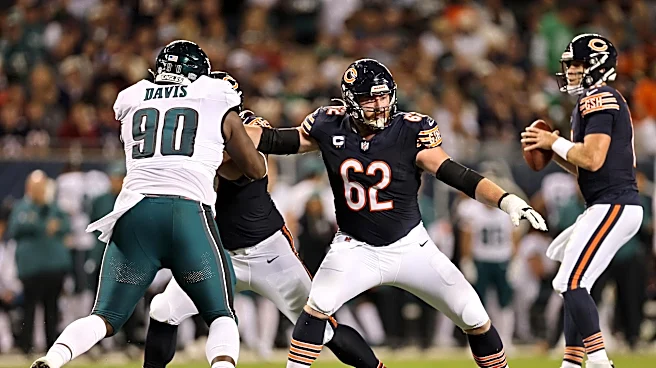


Note: You may notice another new name included in my QB grades/metrics. This may explain why…
Well, when I said last week that whoever started against the Philadelphia Eagles would get the same treatment here, I partially didn’t expect that quarterback to be Case Keenum.
The Bears entered Week 3 with about as much uncertainty at quarterback as you could ask for. Caleb Williams was ruled out with the hamstring injury he suffered against Minnesota, while Tyson Bagent spent most of the week in concussion
protocol. Bagent ultimately cleared on Sunday, but with Keenum receiving the full week of preparation, Ben Johnson stuck with the 38-year-old veteran for Monday Night Football.
It would be Keenum’s first NFL start in 1,009 days.
Against an undefeated Philadelphia Eagles team.
What could possibly go wrong?
Apparently, not much.
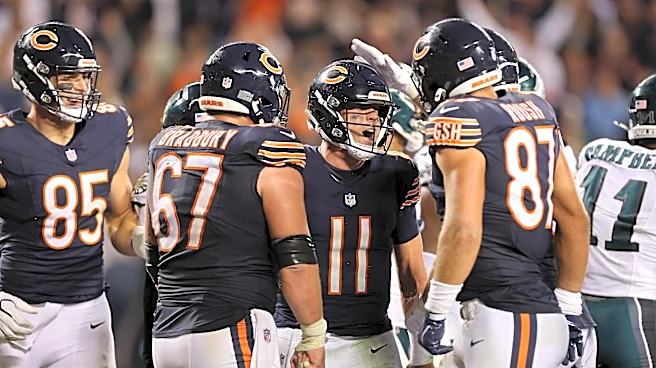
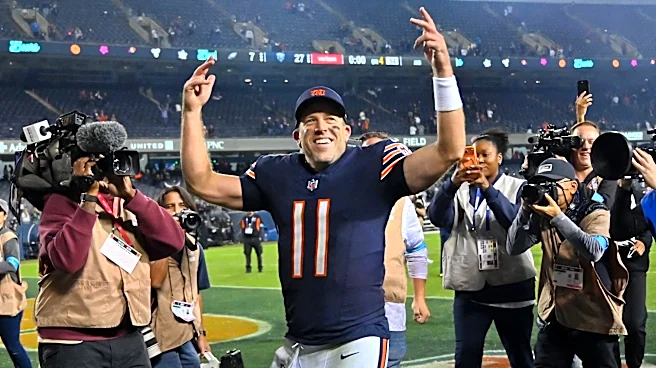
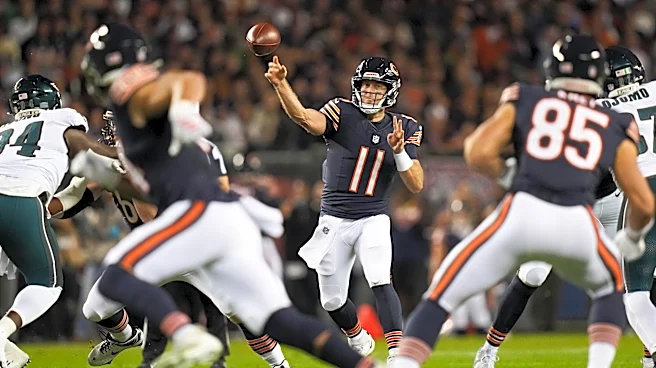
Keenum completed 24 of 34 passes for 247 yards and two touchdowns, added another score on the ground and finished with a 110.8 passer rating, and a very solid 122.0 True Passer Rating as Chicago cruised to a 27-7 win. The Bears finished with 375 yards of offense, controlled the ball for nearly 37 minutes and, maybe most importantly, didn’t turn it over once.
But what stood out to me most wasn’t necessarily the production. It was how different the offense looked getting there.
Keenum obviously isn’t Caleb Williams, and Ben Johnson didn’t ask him to be.
With Williams, there is always an element of controlled chaos available to the offense. His arm talent allows Chicago to attack areas of the field that most quarterbacks simply can’t, while his mobility and creativity can turn a broken play into something completely different. We’ve already seen plenty of that through the first two years with Williams under center.
Keenum’s game was almost the opposite.
The ball came out quickly. owning just a 2.19s time to throw Monday night, as the Bears opted to (mostly) work the underneath, with just 7 aimed passing attempts traveling more than 10 yards downfield and a 6.1 ADoT overall for the outing. And when the Eagles did Blitz, Keenum made the Eagles pay.
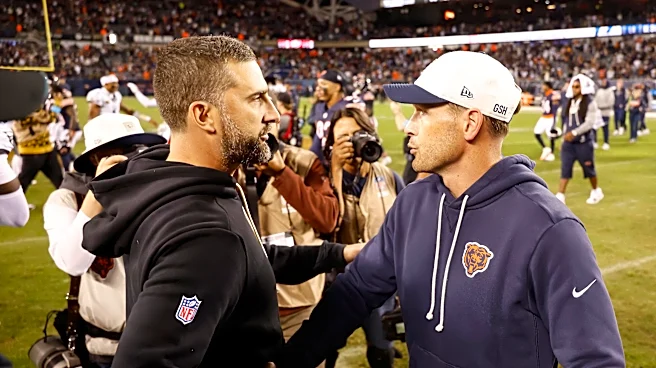
Johnson summed it up pretty well during the post game presser, praising Keenum for getting the ball to “the right guy in time,” taking care of the football and making good decisions.
And against Vic Fangio’s defense, that approach made a lot of sense.
Before the game, Bears offensive coordinator Press Taylor talked about how Philadelphia’s defensive structure forces quarterbacks to remain patient. Fangio wants to limit explosive plays, keep everything in front of the defense and force an offense to methodically work its way down the field.
Keenum was perfectly content doing exactly that.
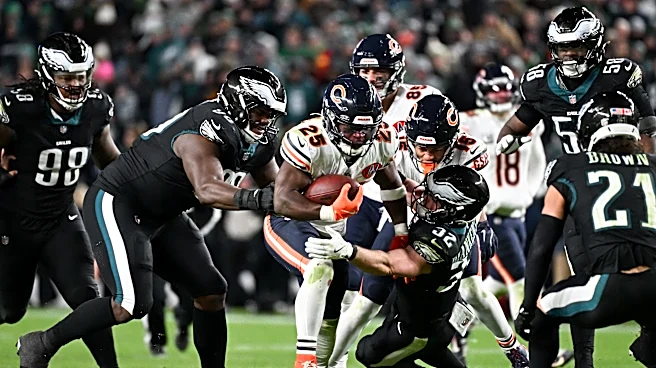
Chicago ran 35 times and threw it 34, despite averaging just 3.7 yards a carry, staying almost perfectly balanced while Keenum played point guard. He took the available completions, kept the offense on schedule and allowed Ben Johnson’s scheme to manufacture opportunities rather than trying to create them himself. And despite some of the early issues with the run, Keenum was sharp on play action passing, throwing just 1 incompletion from play action.
But all that’s not necessarily a criticism of Caleb Williams, either.
In fact, there are things Williams can do within this offense that Keenum simply cannot. The ability to create outside structure, attack vertically and turn pressure into explosive plays is a massive part of what makes Williams special.
But Keenum’s performance was a great example of what the other end of the spectrum looks like.
Sometimes the answer doesn’t need to be spectacular. Sometimes it’s identifying the coverage, trusting the concept and getting the football out.
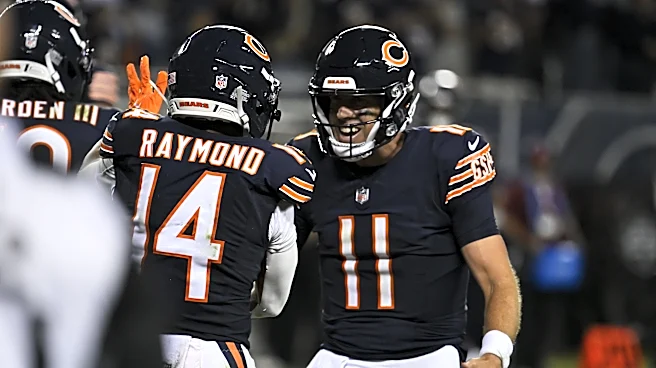
And when Philadelphia finally gave Chicago an opportunity for an explosive play, Keenum took it, hitting Kalif Raymond for a 41-yard touchdown in the third quarter that helped turn a 13-7 game into a comfortable Bears lead. Keenum did an excellent job on the play identifying busted coverage and getting the ball to Raymond.
There are certainly lessons Williams can take from that performance when he returns. Not because the Bears suddenly discovered they are better off with Case Keenum, but because Keenum showed just how efficient Ben Johnson’s offense can be when the quarterback consistently operates within its timing and structure.
For one night, that was more than enough.
Now let’s see how Keenum’s performance actually graded.
Benchmarks
Stat Formatting Key: This week we will be comparing Keenum’s week 3 start against Williams’ Season Totals and Averages.
(Season totals are underlined, Season Averages in Italics, and this week’s stats appear in regular text.)
C/A: 36/55 (65.5%) | 18/27.5 (65.5%) | 24/34 70.6%
Yards: 407 | 203.5 | 247
Touchdowns: 4 | 2 | 3
Turnovers: 1 | 0.5 | 0
QB at Fault Sacks: 0 | 0 | 0
aDOT: 7.7 | 6.1
Passer Rating: 92.0 | 110.8
True Passer Rating: 113.4 | 122.0
Time to Throw: 3.34s | 2.19s
Time to Pressure: 2.75s | 2.27s
Pressure Rate: 41.57% | 23.68%
On-Target Rate: 83.3% | 63.6%
Poor Play Rate / Big Play Rate: 7.5% PPR / 5.0% BRP | 0.0% PPR / 7.3% BRP
EPA per dropback: +0.31 | +0.18
ANY/A: 6.2 | 8.4
Game Scorecard

The full grading sheet for each play can be foundhere.
Game Notes
Note: Last year, I included PFF grades in these breakdowns. With PFF continuing to expand its use of AI across its platform, and with my confidence in how accurately its grades reflect quarterback performance declining, I’ve decided to move away from them this season. In their place, I’ll be using PFN’s Impact Score, which will be notated as PFN on grading sheets moving forward.
- NFL Passer Rating / True Passer Rating / PFN Impact Score: 110.8 / 122.0 / 79.1
- The NFL’s average passer rating through Week 2 sat at 93.5, making Keenum’s 110.8 against the Eagles a very good start, especially considering the circumstances.
- A 122.0 TPR represents an upper-level “Good” game in my model, where 100 serves as the baseline for “Average.”
- For comparison’s sake, that would have put Keenum around 11th in the league in average TPR during the 2025 season, one spot ahead of Joe Burrow and one behind Jared Goff.
- On the PFN scale, where 75 represents an average qualifying starter and 90 is elite territory, Keenum finished Week 3 with a 79.1 Impact Score, ranking 12th of 31 qualifying quarterbacks.
- Not bad for a QB who had not made an NFL start in over 1000 days!
- On-Target Throws: 2026 Average: 83.3% | Week 3: 63.6%
- Reminder: Completion percentage ≠ On-Target Percentage. I only chart aimed passes, meaning throwaways, spikes and passes deflected at the line are excluded. Drops can still be credited as on-target.
- Short-Level Passing (Behind LOS–9 yards): 17/26 | 69.2% On-Target
- Deep-Level Passing (10–20+ yards): 4/7 | 57.1% On-Target
- There was perhaps a little live-game rust despite an otherwise solid performance. Keenum notably misfired on a handful of Out routes, with several misses coming behind his intended receiver, about the last place you want to miss on an Out. More on those in the play review.
- Poor Play Rate / Big Play Rate: 0.0% PPR / 5.7% BPR
- Keenum played a clean game essentially from start to finish. And while he did miss on some Out route throws that can lead to dangerous turnovers, none of them were egregious enough to warrant grading them Poor or Turnover Worthy.
- He did make three “Great” graded plays on the night, all three coming on the Bears’ final drive of the first half. We’ll break down two of them further:
- 1.) A fantastic throw with pressure in his face, dropping the ball over the mid-level defenders for a 25-yard gain to Luther Burden.
- 2.) A great anticipation throw into a hole in the zone to Rome Odunze for 22 yards.
- 3.) Finally, a 12-yard completion to Kalif Raymond with Jalyx Hunt bearing down on him.
- He did make three “Great” graded plays on the night, all three coming on the Bears’ final drive of the first half. We’ll break down two of them further:
- Keenum played a clean game essentially from start to finish. And while he did miss on some Out route throws that can lead to dangerous turnovers, none of them were egregious enough to warrant grading them Poor or Turnover Worthy.
- Time to Throw: 2.19 seconds
- Case was quick with the ball, and due to lack of play extension (just 1 play graded with a time to throw above 4 seconds) from his style of play, and perhaps, his age, his time to throw came in at just barely above 2 seconds. This grades faster than Jordan Love’s season mark, who has famously had to get rid of the ball at a very quick rate due to the struggles of the Green Bay offensive line. Who says you need 3 seconds of throw time to be successful? 😉
- EPA per Dropback:+0.18
- This mark ranked 13th among 31 qualifying quarterbacks in Week 3. The passing game wasn’t built around explosives against the Eagles, but Keenum consistently kept the offense on schedule, completed 70.6% of his passes and accounted for all three of Chicago’s offensive touchdowns.
- For reference, +0.15 EPA per dropback would have tied for ninth in the league in 2025 with Daniel Jones, slotting between Josh Allen and Sam Darnold.
- Under Pressure: 26.68%
- This goes hand in hand with the difference in play styles. Caleb Williams is more prone to extend plays and hunt opportunities deeper downfield as the defense breaks down. Keenum is more comfortable getting the ball out and working within the structure of the play.
- Some credit also belongs to Ben Johnson. He catered the offense to the quarterback he had under center rather than trying to fit a square peg into a round hole.
- The result was zero official sacks, the first sack-free performance by the Bears this season. The only time Keenum went down behind the line came on a play wiped out by an Eagles penalty.
Play Reviews
The plays we’ll be reviewing are presented in the order they occurred in the game.
As a brief review, let’s recap the colors of the routes on these plays for those new to the process:
- Blue: Indicates pre-snap motion or post-snap blocking.
- Yellow: Routes other receivers run on the play.
- Red: Route the targeted receiver runs.
Situation: 1st Quarter, 4th and 1 PHI32 10:52
Play Grade: Average
Result: 16-yard completion to Sam Roush
Notes: (+) Short Level Accuracy/Completion
Analysis: We start on the offense’s opening drive, facing 4th-and-1 after the Bears have methodically moved the ball down the field against the Eagles’ defense. It’s a pretty simple 1-2 read off play action, with the Bears showing a power look out of 13 personnel.
Case is reading Eagles linebacker #53. If he bites on the play action, Case dumps it into the flat to #87 Sam Roush for the easy first down. If #53 immediately follows Roush into the flat, Case comes back to Luther Burden III on the stick route.
Case diagnoses the play perfectly. #53 takes the bait causing enough hesitation for Roush to slip into the flat, and Case gets him the ball for an easy 16 yards and a first down. Roush has had a rough start to the 2026 season, but this was a nice contribution from him on Monday night.
Situation: 2nd Quarter, 1st and 10 CHI20 06:14
Play Grade: Great
Result: 25-yard completion to Luther Burden III
Notes: (+) Medium Level Accuracy/Completion, (+) Difficulty of Throw, (+) Explosive Play, (+) Overcoming Considerate Pressure
Analysis: This one got some buzz for the creativity behind it. After Burden goes in motion and the ball is snapped, Kalif Raymond and Burden both exit the formation through the C-gap (the space between the offensive tackle and tight end), with Burden trailing Raymond. Both run shallow in-breaking routes as part of a simple Levels concept, while Rome Odunze runs a clear-out route at the bottom of the screen.
The design works exceptionally well because the corner is locked in man coverage with Rome, creating space underneath. With pressure bearing down, Case lofts the ball over the intermediate defenders dropping into coverage and into the waiting hands of Burden, who does what he does best and turns it into a huge chunk of YAC.
In all honesty, Case probably doesn’t have a great view of Burden when he begins his throwing motion. He’s trusting his read of the defense, the design of the play, and Burden to be exactly where he’s supposed to be. That anticipation is what makes the throw work.
Situation: 2nd Quarter, 1st and 10 CHI45 05:40
Play Grade: Great
Result: 22-yard completion to Rome Odunze
Notes: (+) Mid Level Accuracy/Completion, (+) Explosive Play, (++) Anticipation
Analysis: This is a really nice example of Case of recognizing a blitz package then working a designed shot off play-action. The Eagles show a two-high shell before the snap, but have nine defenders in the box. Case audibles into max protect, and run a two man route, a deep in from Burden at the bottom of the screen with a corner route from Odunze at the top. The idea is pretty simple, stress those deep defenders vertically and force them to make a decision, while giving your quarterback enough time to throw it to them. The play-action does its job holding the second level, and the extra help blocking holds up. The In forces the defense to respect the middle of the field and creates a window for Odunze breaking towards the sideline.
What I really like from Case here is the anticipation. He comes out of the fake, gets his eyes downfield and doesn’t wait for Odunze to be completely open before letting the ball go. At the point Case begins his throwing motion, Odunze is still working through the intermediate defenders with the secondary closing over the top. Case trusts the route, throws him into the open space and puts the ball out in front where the defense has very little chance to make a play on it. It’s a really good example of throwing with anticipation rather than waiting for the receiver to uncover, and recognizing a defense and shifting into a play to attack it.
Situation: 3rd Quarter, 1st and 10 PHI47 12:21
Play Grade: Good
Result: 12-yard Completion to Kalif Raymond
Notes: (+) Short Level Completion/Accuracy, (++) Overcoming Immense Pressure
Analysis: This is a nice example of how the routes working downfield can create a completion underneath. At the top of the screen, the Bears appear to be running a variation of Dagger with a switch release (the two receivers exchanging positions as they release into their routes). The outside receiver works inside and pushes vertically, while the inside receiver loops outside before breaking back toward the middle on a dig. Meanwhile, Kalif Raymond comes across from the bottom of the screen at a shallower depth.
The idea is to stretch the coverage vertically and give Case options at different levels. The defenders at the top carry the two deeper routes downfield, leaving room underneath for Raymond to work across. There’s still a defender trailing him and another underneath, so this isn’t simply a receiver running completely uncovered, but there is a window for Case to attack.
What I really like here is Case hanging in with pressure bearing down. He gets the ball away before being taken to the ground, finding #14 as he works into that space near the far-side numbers. The completion gives him room to turn upfield and add yards before the defense closes. In all honesty, the part that stands out most is Case getting the throw off with the pocket collapsing around him and giving his receiver a chance to finish the play.
Situation: 3rd Quarter, 2nd and 9 PHI34 11:05
Play Grade: Ungraded
Result: 4-yard Completion to Luther Burden III
Notes: (-) Short Level Accuracy, (+) Short Level Completion
Analysis: This is one where the completion looks better on the stat sheet than the throw does on film. At the bottom of the screen, the Bears send the outside receiver vertically while Burden breaks toward the sideline on a short out, essentially a shallow Sail concept. Colston Loveland settles underneath on a stick. The vertical carries its defender downfield and gives Burden some space to work, but the defender over Burden is still in position to close on the throw, requiring an accurate throw to allow an opportunity for YAC.
Case gets the ball out as Burden comes out of his break, but the placement is high and behind him. Burden has to reach back toward the ball and gather himself to secure it, giving the defender time to arrive and finish the tackle. With a player whose biggest strength is what he can do after the catch, you want this ball placed where he can keep moving and have a chance to make that first defender miss. So while the play did result in a positive 4-yard gain, the inaccuracy eliminated what could have been a much larger play, thus earning a 0 score “Ungraded” grade.
Situation: 3rd Quarter, 3rd and 5 PHI30 10:26
Play Grade: Bad
Result: Incomplete pass intended for Rome Odunze
Notes: (+) Anticipation, (-) Relative Danger of Throw. (—-) Short Level Accuracy and Ball Placement
Analysis: This one gets a positive for anticipation, but the placement really lets Case down. At the top of the screen, Rome pushes vertically before breaking toward the sideline on an out route beyond the sticks. The inside receiver (Kalif Raymond) pushes vertically downfield, to occupy any other underneath defenders while Colston Loveland works underneath first chipping the edge then releases on shallow out of his own. Case begins his throwing motion before Rome has fully completed his break, trusting him to come out of the route where he expects.
The problem is where the ball ends up. Rule #1 when it comes to an Out route: If you miss on an out route, miss outside. Put the ball toward the sideline, away from the defender’s inside leverage. Leaving it inside or behind the receiver gives the defender a chance to undercut it. Rome has created some separation toward the sideline, but the throw doesn’t take advantage of it. Instead, the defender is able to undercut the route and dive across the ball’s path, leaving Rome with very little chance to complete the catch, causing a very easy pass break up.
Summary
Williams finishes Week 2 with final grades of 1st Half (1.70) / 2nd Half (0.35 / Game (2.05), earning an “Above Average” game grade against the Eagles.
For a quarterback making his first start in 1,009 days, there was a lot to like. Keenum wasn’t asked to create offense the same way Williams typically is, but that ended up being part of what made the performance so effective. He played on time, consistently found the right answer, protected the football and allowed Ben Johnson’s offense to work within its structure.
That doesn’t mean the Bears suddenly have a quarterback controversy when Williams is healthy. The talent level alone with Williams will never make this a real discussion point, but Keenum simply gave us a good example of what this offense can look like when the quarterback consistently takes what the defense gives him and keeps the unit on schedule.
Of the five quarterbacks I’ll be grading throughout this season, Keenum finished 1st in Week 3. For a look at how all five quarterbacks graded side-by-side including some quick notes on them, you can see that here.
So, the question now becomes whether I’ll be grading Keenum again next week.
Despite Monday night’s performance, Ben Johnson has remained intentionally vague about who will start against the Jets. Tyson Bagent has cleared concussion protocol and entered the season as Chicago’s No. 2 quarterback, while Williams continues working his way back from the hamstring injury. When asked about the Week 4 quarterback situation Tuesday, Johnson offered little more than, “We’ll see how it plays out all week.”
So, once again, we wait.
Whether it’s Keenum getting another opportunity, Bagent reclaiming the backup job or Williams making a quicker-than-expected return, whoever Ben Johnson puts under center against New York will get the same treatment here.
Until then, Bear Down!
Gary Baugher Jr. is a second year contributor to WCG, bringing football insight backed by over 16 years of experience in organized football and more than 30 years as a passionate fan of the game. You can follow him on Twitter at @iamcogs.