



After attending over a thousand games and writing many thousands of words about the football club, I reckon I had a pretty good handle on what happens in and around our club on a daily basis.
I thought the modern-day footballer had a relatively easy life. They get paid handsomely for turning up for training, eating well, kicking a ball and going home. We all think that, to varying degrees.
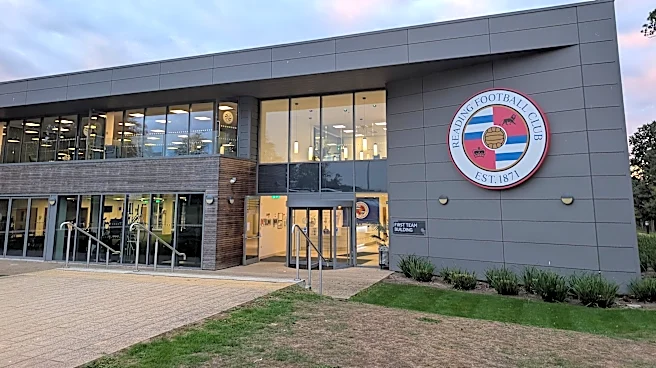
But what Tuesday’s visit to Bearwood – put on for Elite and Plus subscribers to One Royal – outlined in its distinct,
informative chunks blew away that myth and mystery.
We arrived at Bearwood and were thrust straight into the cafeteria, where the amassed group of players were waiting to greet us. Having come in late for training to accommodate the fans turning up in late afternoon, I mingled and sought out those that appeared to have less of a queue.
To a man, they were all very pleasant and easy to talk to. No airs and graces, no superiority complexes – just normal men.
It’s odd when you meet them in the flesh; some seem taller or wider than you think, others are slightly smaller. When you’re used to seeing them on the pitch, your perception changes somewhat. That thinking might be just mine, though!
Four in-depth talks
Once the meet-and-greet was over, the players could finally depart and go home. The visitors were split into groups and assigned locations for their next part of the experience.
And for me, this is where the magic happened. The order for our group was thus…
- Player identification and recruitment
- Performance, strength and conditioning and nutrition
- Performance and opposition analysis
- First-team coaching
The player identification and recruitment session was with Jackson Bowen (Yes, the son of Mark). He, with his data analyst assistant, explained how geographically players are scouted and who is assigned to those areas.
Bowen also displayed the vast array of tools they use to find players and how they gauge them in comparison to others. A case in point was George Earthy vs Kamari Doyle.
This was visualised by a green bar chart. Although the labels were too small to read, you got the gist of it.
Bowen further explained the entire process from merely identifying a player, right through to the eventual signing. I asked how long this would take typically, from identification to signing and his answer was “around two months”.

Some more metrics were explained about how they evaluate whether a player is a good fit for the club, topped off by the most sought-after attribute of all: no d*ckheads!
Once that session was over, we were directed to visit Mat Bramhall to go over strength and conditioning. This is where it really started to get interesting.
Bramhall explained in great detail how the players are monitored, measured and supported throughout their own season. Every player is different, with different physical attributes, as you would expect, but it became apparent that nothing is left to chance or guessed.
Everything about their performance is analysed to the nth degree. They know what a player needs more of, or less of, what will benefit them or not.
When a player is injured, the key goal is to get them healed and to be fully ready to play, in a state close to or equal of the state they were in before the injury.
This is where it started to sink in for me that it’s not a ‘one size fits all’ approach for the entire squad. I knew every player had a programme that was tailored to them, but I did not appreciate how much detail was included and how often and accurately they are measured.
There is nothing they don’t know about the physical specimens that Bramhall and the rest of his team look after.
Bramhall explained that the general assessment of the squad this season is they are much better equipped to handle the physical rigours of the season. Training sessions match the intensity of actual matches; otherwise, the players can’t reach the physical requirements that are required.
It seems simple, but I had not considered how strenuous training could be.
When I spoke to a player (I think it might have been Kyreece Lisbie), he said today’s session was particularly hard. Another said sometimes they do two sessions that are of the same intensity.
Another interesting thing to note is that, on Fridays, the players can do their own thing. They look after themselves how they see fit. Not exactly free time, just a case of “you do you”.
Also, Bramhall mentioned that extra sessions of strength training have been introduced after games this season, in order to maintain the level across the full campaign.
Next stop was performance and opposition analysis with Alex Forsey.
Now, initially this was a bit more akin to seeing statistics you may have spotted in games like FIFA or Football Manager. This was a bit more obvious and relatable, to me anyway.
Forsey explained how reports are compiled and given to the management team based on the recent performances of the opposition. This included who played where, their age, height, footedness and so forth.
There was a lot more detail besides, including video footage of what the opposition liked to do and when. The reports went deep as to how our team would combat the opposition strengths and how we could expose their weaknesses.
More video, although not shown to us, would be provided to players of themselves in action to explain where they were positioned and how they could improve or what they might need to do differently for the next opponent, etc.
The thinking here is that a player would be more invested in seeing themselves in action as opposed to seeing the opposition who they can’t obviously relate to.
I felt this section had a lot more under the hood than was really explained, but I understand that not all the internal secrets can be given away. Still, it was a very good insight into how prepared the team is, going into a game via this kind of analysis.

An interesting side note is that they even analyse the refereeing team for the upcoming fixture! They know if he likes to give out cards like confetti or will be more measured. Who they can get in the ear of, or not. Nothing is left to chance!
Last but by no means least, and my personal favourite, was the first-team coaching presentation by Danny Schofield.
This part blew my mind. I’m sure I wasn’t alone. Now, we don’t see a lot of Schofield, but he’s usually the one in the stands observing from above, relaying what he sees to the dugout below.
Schofield guided us through the ethos of what the club is trying to achieve on the pitch, all underpinned by certain philosophies and guidelines. I equate these to the “non negotiables” Ruben Selles used to espouse. Essentially, it was: “This is us. This is how we play. This is who we are.”
Schofield showed us footage of the win against Notts County of how we exposed their flaws and the positions the players took on the field. Akin to what you see on TV when the play is paused. It was fascinating to see how a player will process where he needs to be at any given point in time for a certain scenario.
He explained how the players are set when, for example, Paudie O’Connor wins the ball in defence from an opposition goal-kick. We’re positioned so we have a numerical advantage to receive the second ball and then potentially spring an attack of our own.
The freeze frame showed this and it all just made sense!
Then we were shown Jack Marriott’s second goal against County. Obviously, it’s mainly about Lisbie’s cross and Marriott’s movement to be able to score the goal, but what about what we don’t obviously pick up on?
I said the quiet bit out loud when I noticed it. Paddy Lane’s central run towards goal occupied a defender so well that Marriott had all the time in the world, so to speak.
A humbling experience
This is where the psychology of being a footballer for Reading FC really shone through. As I mentioned at the outset, what I understood a professional footballer to be is not what a professional footballer is. It’s much, much more than that.
A player can’t just turn up with their fancy washbag and do a few drills and go home. They have to – obviously – be physically fit, they have to look after themselves, and if not, it’ll be noted in how they are measured for every stat imaginable.
They have to understand their position and their roles within that position and they have to take on board a huge amount of information – not only about their own performance, but also within their own unit on the field and the wider squad itself.
Game on game, they have to learn, adapt, improve and be able to take criticism if something goes horribly wrong, which it undoubtedly will.
But there’s a support system that underpins all of this. This is where no man is left behind. They win as a team and lose as one. Everything is a learning experience. Everything is reviewed, analysed and improvements sought out.
There’s so much detail going into how a game can be controlled in our favour, how mentally we can overpower the opposition and how repeatable actions by all the players foster positivity when it all works out. All to control a little white ball and put it in the net. Incredible, in honesty.
Overall, it felt like a humbling experience. I thought I knew football. I thought I had a good idea about what it took to be a “professional”, but this experience was an eye-opener.
We all think we can judge a player solely on what they do in front of our eyes, but there’s so much more going on than we could ever think.
The amount of information, guidance and support they receive from all the departments is, frankly, staggering. The amount of input they have to digest and put into action for each and every game, I massively underestimated.
It’s not enough to be naturally gifted with the ball or physically strong and capable. You have to be mentally able to accept all this information and act upon it, all game, every game for the entire season.
The set-up we have at Reading is incredible. The level of detail that goes into running the footballing operation in itself is mind-blowing. Whatever I thought goes on day to day is not the reality. It’s not even close.
Thanks to Jack from the ticket office and Manny Oliveira for running the event. It was an amazing learning experience that I hope can be repeated so fans can truly appreciate what goes into making this club a success again.