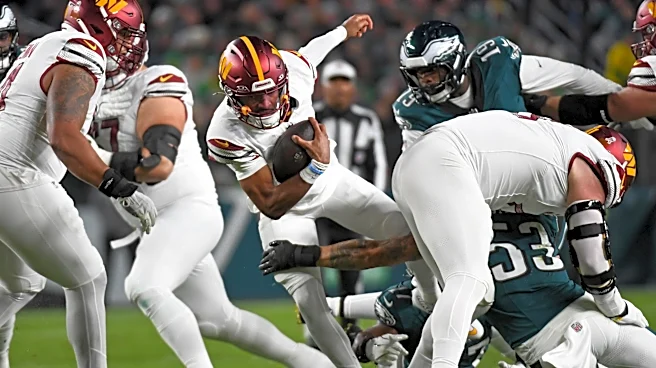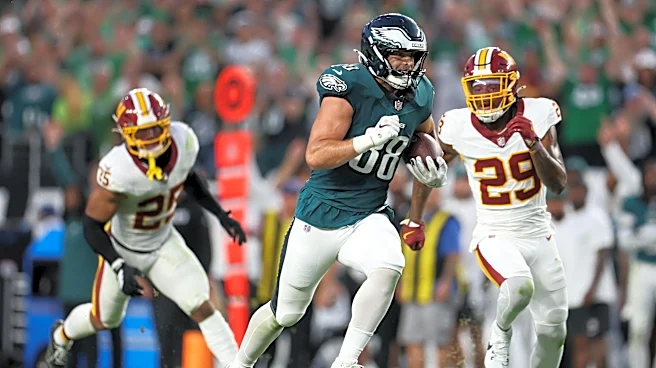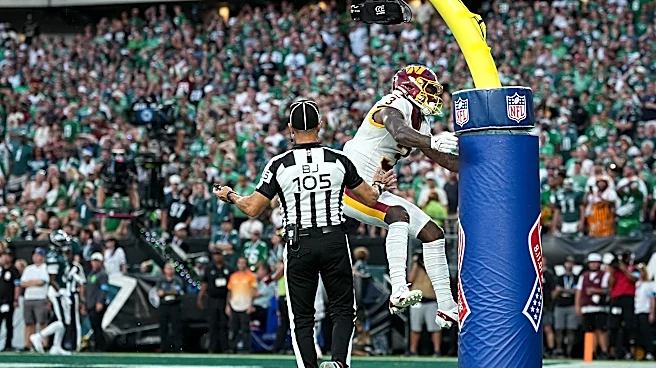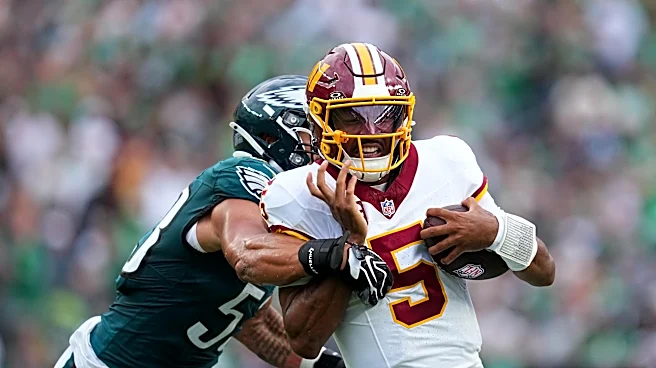


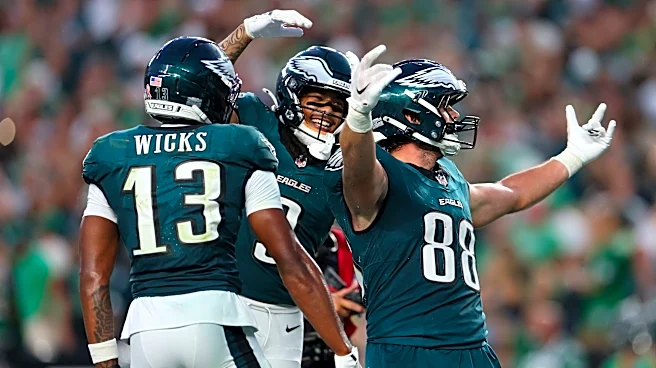
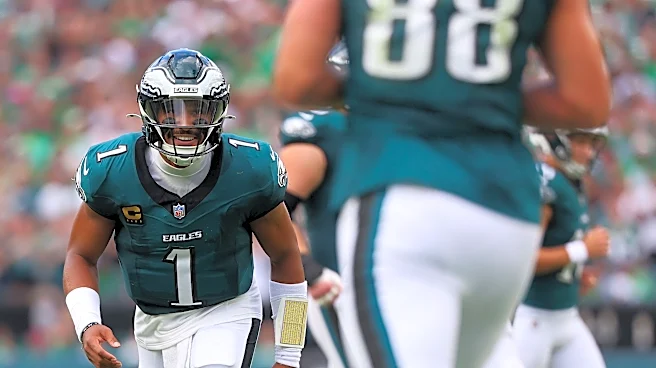
The Eagles’ defense was very good against the Washington Commanders. It wasn’t an elite performance, and the final two drives left a slightly sour taste, but the unit held Jayden Daniels to 18 completions on 34 attempts for 164 yards and limited Washington to 4.4 yards per play. Given the number of new pieces in the secondary and how difficult Daniels was to defend, I came away impressed.
However, this defense has an offense problem. The Eagles’ defense played 67 snaps while the offense ran only 53
and gained just 10 first downs. Washington possessed the ball for 10:02 in the fourth quarter alone and put together touchdown drives of 67 and 63 yards. You could see the defense tiring. Jalen Carter looked exhausted by the end, and the pass rush dropped off. This is becoming a familiar problem. The defense can play exceptionally well for long stretches, but asking it to keep returning to the field eventually has consequences.
The advanced numbers tell an interesting story. The Eagles generated pressure on 47.4% of Washington’s dropbacks despite blitzing on only 23.7%, but Daniels was sacked just once. That matches up to the film. The rush affected him and remained disciplined, but it rarely arrived quickly. I think the Eagles were deliberately cautious because they did not want to create huge escape lanes for Daniels.
Defense
Jordan Davis picked up exactly where he left off last season. The Eagles did not completely dominate Washington’s running game, the Commanders finished with 132 yards on 32 carries, but Davis was consistently difficult to move. This is an excellent rep against a double team. He absorbs the initial contact, stays balanced, and then uses his quickness to work around the lineman and finish the play. That combination of size and movement is what makes Davis such a unique player. He is no longer simply occupying blockers as he was a couple of years ago. He is defeating them and making plays himself.
Marcus Epps’ return to the starting lineup was important to watch because the Eagles are relying on him to replace Reed Blankenship’s downhill presence. Vic Fangio asks his safeties to trigger quickly, fit the run and tackle in space. Epps reads this immediately, arrives in the backfield under control, and finishes the play cleanly. His timing is excellent.
Communication issues will inevitably come in a secondary with new combinations, and we will get to that later, but Epps looked comfortable with the physical parts of the role. Nothing from this game made me think he cannot do what the Eagles need him to do. Which is a big positive!
Phew. Tariq Woolen’s Eagles debut was awesome. I knew he was good, but he played better than I expected. Washington tries to create a one-on-one deep shot to Dyami Brown here. Michael Carter does a good job from safety of pointing out the running back in the flat before helping against the crossing route, which leaves Woolen isolated outside, which is exactly what the Commanders want. Fangio is often seen as a passive coach, but he leaves his outside corners one-on-one routinely. It’s a big part of the scheme.
Woolen makes it look easy. He stays balanced through the release, turns and runs without panicking (or looking stressed, at all), and then gets his head back toward the football. Corners with Woolen’s speed do not need to grab or play desperately when the ball goes downfield. He knows he can run with anyone. That athletic confidence showed up throughout the game. It was a huge upgrade on what we have seen in recent years at CB2.
I would love to see the Eagles’ short-yardage numbers since Vic Fangio arrived because this six-man front routinely wins on 3rd/4th and 1. The structure is simple but effective. The defensive line occupies every gap and prevents the offensive line from climbing cleanly to the second level. That keeps Zack Baun free, and few linebackers would be better suited to attack downhill in this situation. He was so so good in this game
This might be my favorite Woolen rep from the game. The Eagles rotate into Cover 3, and Washington runs Dagger, a concept that uses a vertical route to clear space for a deep in-breaker behind it. Terry McLaurin is supposed to find the window between the underneath defenders and Woolen’s deep third. The receiver has the leverage advantage here, so this is a win for the offense on the whiteboard. However, Woolen recognizes the concept before McLaurin has even completed the route. You can see how eager he is to jump the route, even before McLaurin breaks inside.
This is not simply an athletic win. It is preparation, awareness, and outstanding film study. Woolen was targeted five times and allowed one completion for one yard, although that completion was a touchdown attributed to him in coverage, which is very debatable.
The pass rush was the most difficult part of this performance to evaluate. The numbers look fantastic. Nolan Smith led the defense with six pressures, while Jalen Carter, Jalyx Hunt, and Moro Ojomo recorded four each. The overall pressure rate was 47.4%, which sounds unbelievably good. Yet Daniels was sacked only once for a 1-yard loss, and the pocket didn’t consistently collapse around him. It’s hard to evaluate because Daniels held on to the ball and moves around a lot.
I think some of the slow pass rush was intentional. Rushing Daniels is different from rushing a stationary quarterback. If every defender flies upfield searching for a sack, Daniels will step through the middle and is a huge rushing threat. The Eagles appeared focused on maintaining rush-lane integrity and forcing him to remain a passer. Daniels still escaped a few times, but holding him to five carries for 31 yards is a reasonable result.
This play also shows why Fangio likes dropping an edge defender. Hunt falls into coverage while Baun rushes, which manipulates the protection and gives Carter a one-on-one against the center. Carter wins and appears to be held as Daniels escapes. This won’t show up as a sack, but the design creates the matchup Fangio wants. Jihaad Campbell also flashed as a blitzer throughout the game. His physicality was obvious when he attacked running backs in protection, and he recorded the Eagles’ only sack. His overall performance was uneven, but his potential as a pressure player is exciting. Overall, I would say it was a 6/10 pass rush performance from the unit. Solid, but not great.
Zack Baun is a superstar. I am not sure what else there is to say at this point. He finished with 12 tackles and two pass breakups, but even those numbers don’t capture how much he affected the game. On Washington’s six targets into his coverage, Baun allowed three completions for minus-two yards and forced three incompletions. Those are ridiculous numbers for an off-ball linebacker. And he was as good as ever against the run, too.
This rep contains everything that makes him special. He recognizes the concept instantly, has the athleticism to get where he needs to be, and then makes a textbook tackle in space. There are bigger names on this defense who receive more attention, but I am not convinced any defender is more important than Baun. He makes Fangio’s entire structure work because he can fit the run, blitz, carry routes, and tackle in space without needing to leave the field.
This play is an excellent example of how rush and coverage work together. Daniels bails from a relatively clean pocket because the rush is disciplined and he does not immediately like what he sees downfield. Nobody recklessly runs beyond him. The defense stays connected, the secondary passes routes off correctly, and Daniels has nowhere obvious to go. For Week 1, I’m impressed by the level of communication here.
The Eagles played a lot of Cover 6 in this game, which combines Cover 4 principles to one side with Cover 2 to the other. Against a mobile quarterback, that lets Fangio protect the deep areas while keeping 4 underneath defenders with vision on the quarterback. It is a sensible approach against Daniels.
Oh, baby. This is fun. The Eagles’ overall blitz rate was below league average, which isn’t a surprise. But sometimes Fangio brings out the Cover 0 blitz in a big moment.
This is a perfectly timed Cover 0 blitz. With no deep safety, every eligible receiver is matched man-to-man, and the Eagles are betting the free rusher will force an immediate decision. Washington does not appear to have a clear answer, as they were not expecting this call. Daniels has to get rid of the ball quickly and ends up forcing a throw to McLaurin, who is covered by Woolen. When a coordinator rarely calls this pressure, it becomes much harder for an offense to anticipate it.
This is where the performance began to deteriorate. Washington faces 3rd-and-14 early in the fourth quarter and hits a deep crossing route for 33 yards. I cannot be certain of the exact coverage rules, but it looks like a standard Cover 3. Epps probably needs to communicate the crossing route more clearly or help Campbell pass it off, but if it’s just standard Cover 3, then Campbell is probably at fault. He has to do a better job gaining depth and staying connected to the receiver.
The lack of pass rush compounds the coverage error. Daniels has time to wait for the route to develop and deliver the ball downfield. This conversion extended a nine-play, 67-yard touchdown drive that lasted 5:45. Washington then followed it with a 12-play, 63-yard touchdown drive lasting another 5:01. The defense allowed eight first downs in the fourth quarter, while the Eagles possessed the ball for only 4:58. At some point, fatigue has to kick in.
This is the problem with looking only at the pressure rate. The Eagles affected Daniels throughout the game, but not always quickly.
Cooper DeJean had a terrible game. There is no point pretending otherwise. I’ve noticed he is missing practice today, which might explain why. I could have selected several clips of him being beaten, and the statistics match the film. DeJean was targeted nine times and allowed seven catches for 83 yards and a touchdown. Washington repeatedly attacked his area of the field.
His eyes and technique were all over the place on this rep. He loses control of the route too easily and does not look like the calm, technically reliable defender we are used to watching. He also played some safety, so I do wonder whether learning multiple positions has affected his cornerback technique or added too much to his mental workload. That is only speculation, though. It’s probably a physical issue.
Whatever the explanation, the Eagles need a lot more from him. DeJean is too important to this defense to have this many poor coverage reps in one game.
Back to Baun, because of course. Before the snap, he points out the running back releasing into the flat and alerts Campbell to the threat. He then gets himself into the quarterback’s throwing window and breaks up a pass that could have resulted in a touchdown. This is elite linebacker play before and after the snap.
The communication is as impressive as the athleticism. Baun sees the entire concept, helps a young teammate understand what is developing and still handles his own responsibility. Phew.
The secondary was not perfect. Woolen and Epps have barely played together, and this is what a lack of shared reps can look like. The coverage breaks down at the goal line because the communication is not clean enough, and Washington takes advantage.
This is also the kind of error that can happen when a secondary is working with two new starters. Get it on film in Week 1, establish who is responsible for the route, and make sure it does not happen again. It happens.
The final clip sums up both this defense’s quality and my biggest concern. Carter looks exhausted. Sam Cosmi is an excellent guard and gave Carter some difficult snaps throughout the game, but Carter was no longer exploding off the ball late. We have seen this before. He is an exceptional player, but I worry about how many snaps and high-effort rushes the Eagles ask him to play. The defense needs to find a way to keep him fresher, and the offense needs to stop sending him straight back onto the field.
Thankfully, Ojomo makes an outstanding play on the two-point conversion. He avoids the block, recognizes the shovel pass, and closes on the tight end before the play can develop. Campbell also does brilliantly to avoid the guard and use his athleticism to help finish the tackle. Washington had scored touchdowns on consecutive fourth-quarter drives and appeared to have all the momentum, but Ojomo and Campbell produced one final stop to preserve the lead.
Ojomo quietly had an excellent game. When Carter is tired, the Eagles desperately need their other interior defenders to produce. Ojomo did exactly that.
Final Thoughts
This was a very good defensive performance, not an elite one. The Eagles held Washington to 295 total yards, 4.4 yards per play, and a 33% third-down conversion rate. There were still issues. The Eagles did not record a takeaway, the rush produced only one sack, the run fits were not always gap-sound, and DeJean had one of his worst games. Campbell’s debut contained both exciting flashes and clear mistakes. The late communication errors cannot simply be blamed on fatigue, either. This defense has things to clean up.
But the fourth-quarter decline cannot be separated from what happened on the other side of the ball. Washington ran 67 plays, won 20 first downs, and possessed the ball for more than 33 minutes. The Eagles’ offense managed 10 first downs and repeatedly put the defense back on the field.
The defense was good enough to win this game, and Ojomo’s final stop ensured that it did. If the offense can sustain drives and keep this group fresh, I think the defense has the talent and coaching to be outstanding. If it cannot, we might have to keep watching a very good defense fade late in games through no fault of its own.
Thank you for reading! I’d love to hear your thoughts, so feel free to comment below and ask any questions. If you would like to support me further, please check out my Patreon here!