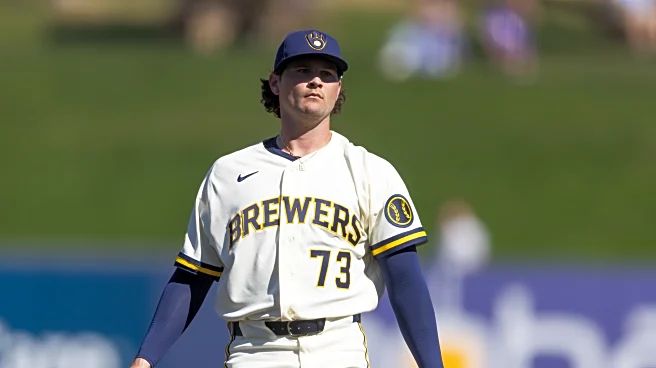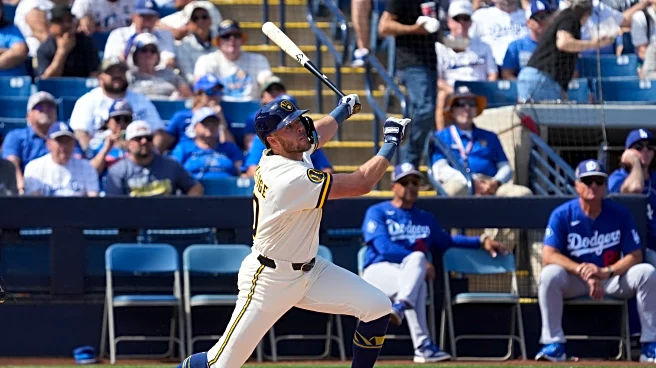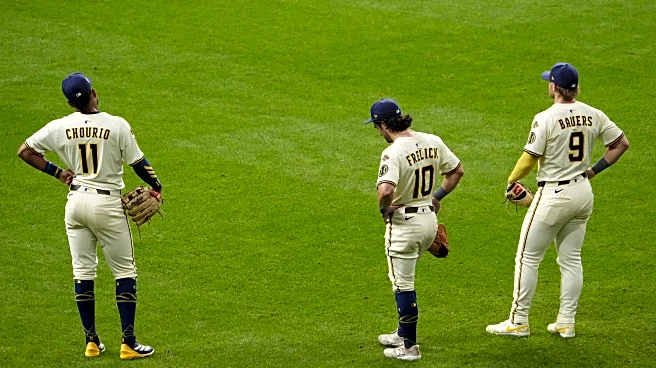

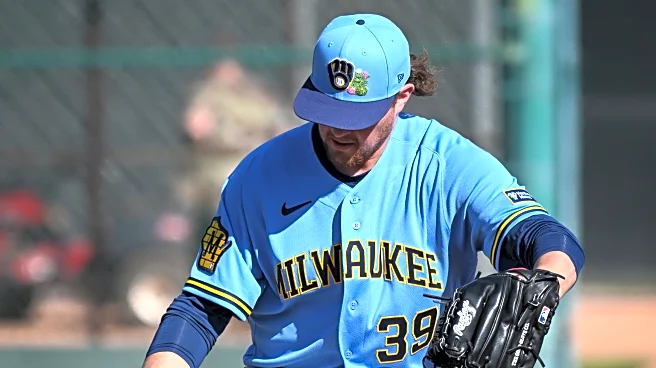
We continue our series previewing each position on the Brewers by looking at the outfield, and we’ll also discuss the designated hitter spot, as Christian Yelich’s transition into full-time designated hitting continues. As for the actual outfield, two of these three spots are firmly spoken for. But the third outfield spot is, if not necessarily in flux, a position where there’s likely to be a decent amount of rotation throughout the season. Let’s take a look.
Jackson Chourio
There is something worth remembering about
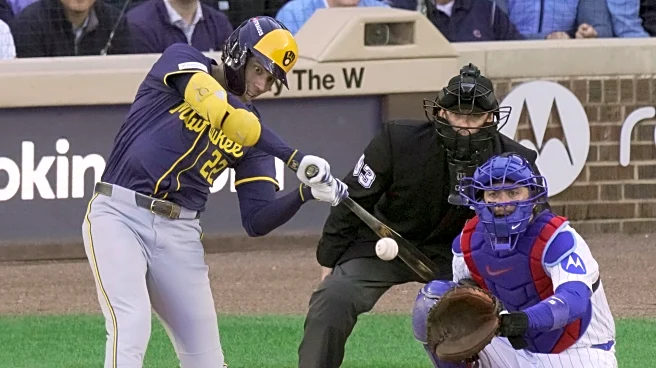
Jackson Chourio: he only just turned 22 last Wednesday. Anyone hinting at the idea that Chourio’s first two seasons in the big leagues were disappointing would be, in a word, wrong. While some were perhaps hoping for a bigger leap in his second season, Chourio has still put together two productive seasons, back-to-back 20/20 seasons in which he’s averaged about three WAR per season. That makes him one of the most productive Brewers, and to bring it back to where we started, I want to re-stress that he has not yet played a regular-season game over the age of 21.
All of that said, it would be great to see Chourio level up in 2026. There have been times, including in the postseason, when Chourio looked pretty clearly like the best hitter on the team. The defense has been a bit up and down, but there have been encouraging signs. You’d like to see him lower his caught-stealing rate, but he’s very fast and clearly has some base-stealing ability. And, most encouragingly, after starting last season with an alarmingly bad walk rate, his plate discipline has looked rather good this spring.
Chourio can hit a baseball. He has extremely quick hands, and he can get to pitches that maybe he shouldn’t be able to get to. Simply improving his plate discipline — which improved quite a bit over the course of last season — and making modest gains in his consistency in the field and on the basepaths would make him a borderline All-Star.
But we can all kind of feel that he’s going to make gains, one of these days, in batting average (he’s hit .275 and .270 in his first two seasons) and homers (21 in both years). Who knows? Maybe we’ll get a 30/30 season.
Sal Frelick
Frelick almost feels like a solid, we-know-what-we’ll-get veteran at this point in his career, even though he’s not quite 26 yet and he’s only played two full seasons in the big leagues. It’s also worth remembering that Frelick improved quite a bit last season — his OPS went up by over 100 points, he hit six times as many homers as in 2024, and his wRC+ went from 87 to 114. Defensively, Frelick didn’t quite perform at the level he did when he won a Gold Glove in 2024, but he was still one of the better corner outfielders in the league.
What can we expect from Frelick in 2026? It seems unlikely that his power is going to creep up a whole lot more, and he did benefit from a solid .317 BABIP (though that was at .306 the year before, and Frelick, because he’s fast and hits a lot of weird little ground balls, might just be a guy who always has a pretty good BABIP). There seems to be a feeling that Frelick, with that 114 wRC+ in 2025, was pretty close to his ceiling.
I’m not completely sure. Frelick hit only 20 doubles last year, and he seems like a guy who could be a classic doubles hitter. Even if he plateaus near his .288 batting average and 12 homers from 2025, there’s a lot of room for improvement in the doubles category, and his 2021 college season and 2022 minor league season both make him look like a guy who could easily hit 30 doubles in the majors.
Beyond that, the Brewers just need Frelick to keep doing Frelick things — run hard, crash (safely) into walls, play good defense — and he should be one of the more reliable contributors on the 2026 squad.
Christian Yelich
We’re going to put Yelich here because he used to be an outfielder once. He isn’t anymore, really. Yelich played left field 19 times last season, and it’ll almost certainly be less than that in 2026.
But Yelich will be the Brewers’ most-used designated hitter, and even at age 34 with a balky back, he will probably be one of their best offensive contributors when he’s available. It was a rough end to the 2025 season, but Yelich still finished with an OPS near .800 (121 OPS+) and team-high 29 homers while playing in the most games he’s appeared in since 2022.
There’s some real concern about the back, though. Yelich missed a week at the beginning of September to rest that back, and upon returning, he hit .233/.291/.370, and then he went 6-for-33 (.182) with five singles and a double in the postseason. The optimist would say that Yelich was just tired and needs more rest — reasonable, given that he turned 34 in December.
It seems reasonable to limit Yelich to about 135 games next year, even if he’s more-or-less healthy the whole year. They could certainly find ways to put him in an at least occasional platoon situation; Yelich last season was a legitimate stud against right-handed pitching (.274/.356/504, 25 homers in 438 plate appearances) and struggled against lefties (.242/.316/.344, four homers in 206 plate appearances, an OPS 200 points lower than against RHP).
Either way, I’m not out on Yelich, no matter how rough it looked at the end of last season. While I’m hoping that Chourio is ready to become the team’s best hitter, there is absolutely no denying that when he was feeling good, that title still firmly belongs with the former MVP.
Blake Perkins and Brandon Lockridge
I’m going to group Perkins and Lockridge because there’s a lot of overlap in skillset, here, and whichever of them is in the big leagues at any given time, they’re going to fill a similar role.
That role is to play great defense and run fast.
Neither will hit a whole lot (though Lockridge, surprisingly, has three homers this spring), but both should be able to play Gold-Glove-level defense when they’re on the field. Brewers fans are probably hoping that they won’t be on the field all that much, but right now it looks like one of them — probably Perkins, who has a lot more big league experience — will be in the lineup on Opening Day.
Perkins seems to be a favorite of manager Pat Murphy, and it’s not difficult to see why. Murphy loves a guy who doesn’t make mistakes in the field, and Perkins is one of the smoothest fielders in the league. Offensively, though, Perkins has never had an OPS+ above 85, and his offensive shortcomings were laid especially bare in the postseason, when the Brewers probably asked too much of him.
Lockridge doesn’t have a lot in his profile to suggest that he can be much better than Perkins at the plate, but what if the power he’s showcased this spring is somewhat real? Perkins has just 13 homers in almost 800 career plate appearances. And while Lockridge has only one in his major league career (79 plate appearances), he did hit 13 and 14 homers in less than 110 games in each of the 2021 and 2022 seasons in the minors.
There’s probably not room on Milwaukee’s roster for both of these guys, and Perkins should have the inside track on the big-league roster spot. But I’m sure we’ll see Lockridge in Milwaukee at some point this season, and if he’s swinging for the fences, it might be an interesting wrinkle as the Brewers look for just a little bit of offense out of this defensive duo.
Garrett Mitchell
The assumption is that Garrett Mitchell will start the season on the Brewers’ roster. His pedigree and previous flashes have probably earned him that.
More than anything, Mitchell needs to prove that he can stay healthy. I don’t need to elaborate much here. As much promise as he has shown, it doesn’t matter — this is a good place to drop in the painful cliché that the greatest ability is availability.
But… Mitchell also needs to prove that he’s a good baseball player after all the injuries he’s been through. It was only 25 games, but Mitchell struggled in 2025 with a .206/.286/.294 batting line in 78 plate appearances before his season-ending injury last year. This spring, Mitchell has hit the ball hard when he has hit it, and he’s been patient, but he’s also struck out an alarming 10 times in 22 plate appearances (an unsustainable 45.5% strikeout rate, 12 points higher than his career regular season rate).
Mitchell is probably still pretty good, but he’s 27 now, and he’s really got something to prove. If this season doesn’t go well, either because of injury or because of a lack of production, he may not have a place with the team by the end of the summer.
Who else?
It looks like Jake Bauers: left fielder is going to be a thing. (See more about Bauers in our first base preview.) He appeared in left field 21 times last season (compared to 40 at first base), and it seems extremely likely that he’ll appear in the outfield more than Yelich will this season. Is he a good left fielder? No, I don’t think so. But if they limit his exposure and don’t need to rely too much on him, he’ll probably be okay.
I’ve already talked about him extensively a couple of times in this series, but if I were a betting man, I’d say that the most likely place that Jett Williams gets playing time with the Brewers this season is in the outfield. That might mean center field, but we’ll have to see how the Brewers choose to align from the outset; if Bauers is playing a lot of left field this season, that likely means Chourio plays a lot of center, and if Milwaukee thinks Chourio is a better center fielder than Williams, then Williams — who has played mostly shortstop and center in the minors — could conceivably move to a corner.
In a somewhat similar boat to Williams is Tyler Black, who seems not to have a real position. The general consensus is that if he’s going to play in the field for the Brewers, it will be in an outfield corner — he’s only played four games with the Brewers this spring because he’s been away with Team Canada, and he played three games at first base and one in left field. Black could conceivably slide into the Bauers’ role (a left-handed hitter who plays mostly first base and a little left field) if Bauers gets hurt, but the most likely route to playing time for Black might be at designated hitter in the event that Yelich misses time. Black still has time, but he’s quickly moving to the outside of the Brewers’ prospect situation, and it’s going to take one or more injuries to get him time in Milwaukee this summer.
The Brewers signed Akil Baddoo to a small major league contract this season, but it’s difficult for me to see how he gets into the mix here. Baddoo also injured his quad late last week and won’t be ready for the beginning of the season. He should be back in April, but being behind schedule doesn’t exactly help a guy who didn’t have an obvious route to playing time anyway.
Steward Berroa is also still on the Brewers’ 40-man roster, but he hasn’t played in the Cactus League and is reportedly nursing a shoulder injury.
Beyond that, there aren’t many options near the top of the minors, and the outfield is one of the few places where the Brewers lack prospect depth. (This is why I think Williams most likely ends up in the outfield.) If Lockridge and/or Perkins weren’t with the team, Luis Lara could conceivably be a late-season defense-only option, but he’d be worse — possibly much worse — than either of those guys at the plate. There are no other real outfield prospects close to the big leagues in the system.