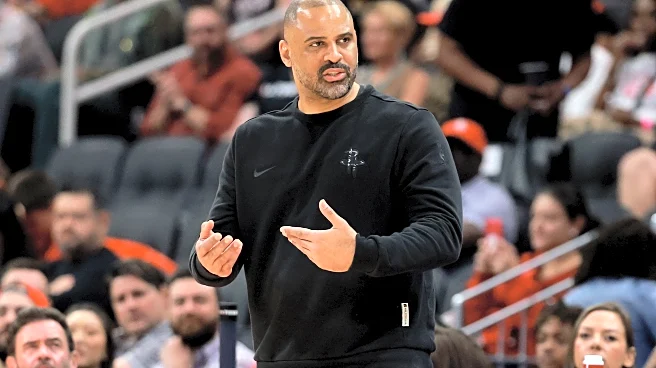

Just how much have the Rockets improved under Ime Udoka?
This seems a very silly question at first glance, and maybe at second, but join me in taking a look at just what has been accomplished, and perhaps not accomplished, under Udoka’s tenure as head coach of the Rockets. I’ll set the groundwork here with a recap of the past four seasons, including this one. I believe we’re close enough to the end of this season for that to be reasonable.
TLDR: This is a brief recap of the past four seasons. It think
it’s worthwhile to refresh memory before getting to the heart of this piece.
I think most of us would agree that the Rockets are a far better team now than they were in the 2022-2023 season. That was the last season of the Stephen Silas coached Rockets, and the main “veteran” Rockets were Eric Gordon, Jalen Green, Kevin Porter Jr., and Alperen Sengun. The team also added rookies Jabari Smith Jr., and Tari “Peso” Eason. Others getting substantial minutes were JaeSean Tate, Garrison Matthews and of course, Daishen Nix and Bruno Fernando. Not exactly an inspiring lineup, and the results confirmed it. That team won 22 games and lost 60. That number speaks for itself. There are some other numbers, though, that have remained silent that might surprise you as we move along.
In the grand Rockets tradition of playing out the contract of a coach ownership and management no longer wants, to avoid the no doubt devastating expense of paying two coaches at once, Stephen Silas was not brought back the next season. A delightful and unquestionably useful cost savings that is still paying dividends in uneven, at best, player development to this day. The Rockets roster of relic coaches, who were mostly friends of Silas’ late father (by all accounts a good person, but by no means a basketball innovator a couple of decades ago) instilled, well it’s hard to know what exactly they instilled, in the young Rockets.
Instead we got a widely lauded hiring in Ime Udoka, after he spent a whole year in the basketball wilderness after getting fired, for cause, by Boston. The details of that firing have not been revealed to the public, but some who might have inside information on the situation reported it was ugly. In any case, he was if not precisely fresh from leading Boston to the Finals, he was at least in marketable condition.
A discussion of the pros and cons in hindsight can await the datapoint of the postseason. What I want to deal with now is how much has changed, and where we might offer credit or place blame for that change. This is by no means a definitive look at the whole situation. It’s designed to spark some conversation, and perhaps provide a different perspective.
In Udoka’s first season the Rockets added a great deal of talent. First they brought in Fred VanVleet, and Dillon Brooks. Many complained about the amount paid to VanVleet, while seemingly ignoring the ramifications of the NBA salary floor and a limited number of roster spots. In any case, Rafael Stone’s many regrettable seeming moves to clear the Rockets cap sheet for the 2023-24 season allowed this to happen.
The Rockets also drafted Amen Thompson and Cam Whitmore, as Victor Wembanyama went to the Spurs, as if guided by some great Franco-South Texan basketball destiny. This was quite an injection of talent, and also a great improvement in coaching. It would be hard not to improve from Stephen Silas’ tenure.
The Rockets went 41-41, as some late season losses, and blown leads in crucial games (which will become a theme) kept them just outside the play in. Still, that was a 20 win improvement, and deserved all the good vibes it got. The Rockets were transformed overall, playing hard, if not especially adeptly, all the time. Brooks and VanVleet brought an edge to the team it was sorely lacking. The Rockets identity as fast, big, athletic, defensive monster was set.
The next season brought Reed Sheppard to the fold with an unexpectedly high #3 pick in a widely derided draft. The corral is where he would largely remain, with the flock of other Rockets not really playing basketball. The Rockets had also added Steven Adams the previous year, but he didn’t play due to injury. When he finally did, he was the same overwhelming force in the paint, on the boards, and setting picks. The Rockets tough edge only got sharper. The only other addition of note was Aaron Holiday, who saw a vastly expanded role to what he had in previous stops. The Rockets surprised most non Rockets fans by finishing with 52 wins, good for second in the Western Conference in a very crowded playoff seeding picture, apart from OKC’s dominant first place.
The Rockets, of course, would go on the play a lackluster Golden State Warrior team in the playoffs, where they’d lose in seven games. They lost not because of their defense, which was generally excellent, but their offense, which was generally horrible. Also, the Rockets were felled by the greatest game Buddy Hield ever played, and will ever play, in game 7 of that first round series.
The conclusion of that season seemed to be that the problem with the offense was an inability to score with the pressure on, and the blame fell mostly on the shoulders of Jalen Green, whether or not that was entirely fair is actually an open question, as we’ll see.
The off season was busy. It saw the trade of a lottery pick, Jalen Green, and Dillon Brooks to Phoenix for Kevin Durant. It also featured signings of Dorian Finney-Smith, Clint Capela and Josh Okogie, as well as two way PG JD Davison. The signing of Durant, currently number 5 in all time scoring, ahead of Michael Jordan was meant to fix all the woes that Jalen Green brought to the Rockets offense. Dorian Finney-Smith seemed as though he might be a one for one replacement for Dillon Brooks, and Clint Capela seemed meant to be injury insurance against Steven Adams frequently injured status.
Kevin Durant has been largely as advertised, and has had a great scoring season by almost any measure. Steven Adams, alas, did get a season ending injury, and Dorian Finney-Smith turned out to be hurt, and when he came back was considerably worse than afterthought signing Josh Okogie. Fred VanVleet was injured in training camp activities, and has not played a minute this season. The Rockets, in large part due to blowing an astonishing 17 fourth quarter or overtime leads this season (so far), will most likely not surpass their 52 win total of the previous season. They currently stand at 45-29, with 8 games remaining. 52 wins might yet be reached, but it’s probably not the way to bet.
That’s the stage set. Let’s look at the numbers.
First, though, I’ll mention that with rare exception over the past twenty seasons of NBA basketball, teams reaching the Finals have been top 5 in either offense or defense, and top 8 in either offense or defense. There are, again, very few exceptions to this. This should worry Rockets fans.
These numbers are telling. The Rockets are a far better team on defense than they were under Stephen Silas. Nothing unexpected there. The Rockets on defense, despite this year feeling worse than the past two seasons, has seen their ranking climb from 14th, to 6th, to 4th overall. This is in large part due to NBA scoring increasing, while the Rockets maintained their points allowed number at the same level as in the 2024-25 season.
That’s the sort of defense that can win a title. Unfortunately, the offense is nowhere close to contention. In fact, the offense, despite replacing Stephen Silas, despite an a huge influx of talent, has improved by exactly four points per game from whatever it was the Silas Rockets were doing.
Four. Points. Four points over three seasons with the same coach. The Rockets offense, in fact, has gotten worse relative to the rest of the NBA this season.
Let me say that again. The Rockets offense has not improved, at all, in Udoka’s three seasons as head coach, in terms of points per game. It has worsened this season, relative to the league.
Over three seasons the Rocket have added Fred VanVleet, Dillon Brooks, Amen Thompson, Reed Sheppard, Tari Eason, Cam Whitmore, Steven Adams, Clint Capela, Aaron Holiday, and oh, yeah, Kevin Durant. They removed Kevin Porter Jr, and Jalen Green, among others. In that time they have gone from scoring 114.3, to 114.3, to 114.4 points per game. As NBA scoring has gone up, that has become not just a static performance, but a worse one, as in Udoka’s first season that scoring ranked 16th, then 14th, and finally, this season, 20th.
Adding the 5th best scorer in NBA history in Kevin Durant has done effectively nothing to improve the Rockets points per game output. Durant is having a very good scoring season by his own lofty standards, and has missed almost no games. He’s among the top NBA players in terms of minutes played.
Nonetheless, the Rockets offense is worse than the two prior seasons. Is this a talent issue? If it’s a talent issue, why is the scoring exactly the same? Is Kevin Durant not talented enough? What, exactly, could improve an Ime Udoka offense, if Kevin Durant isn’t sufficient? How can the offense be actually worse relative to the NBA after three seasons with Ime at the helm? It indisputably is worse, though, by those measures.
This isn’t a contending offense by the standards of the previous 20 seasons. This is not a contending team. Historically, neither great defense, nor great offense, wins championships if the other side of the ball isn’t at least top 10. The Rockets defense is up to the job. The offense is a sad joke, barely top 20. With Kevin Durant. The answer isn’t more defense.