




Baseball is a game about second chances. And third chances. And fourth chances.
Back in the 2017 MLB Draft, with the 28th pick of the first round, the Toronto Blue Jays selected right-handed pitcher Nate Pearson.
It was easy to see why. After leaving Florida International for the College of Central Florida, Pearson burst into the draft scene. According to Baseball America’s draft report on him, “[h]is fastball shows late running or sinking movement and he made tremendous growth with his command. His
changeup now projects as a plus pitch, showing late fade when he locates it down in the zone. He throws both a slider and a curveball, and scouts see his slider as a more prominent part of his future. The pitch shows slurvy shape and sits in the low 80s. Pearson’s athleticism and rapid growth could lead him to come off the board as high as the back of the first round.”
He peaked as the Blue Jays No. 1 prospect in 2020 while ranking No. 2 in both 2021 and 2022. In 2020, Baseball America ranked him as the No. 7 prospect in all of baseball.
Debuting in that strange season of 2020, he started four games while appearing in another. That’s the most starts he’s made in a season in his career. Since, he’s started only two other games, pitching primarily as a reliever as he’s bounced between the Blue Jays, Cubs, Astros, and Royals.
Why?
Why else: injuries. He’s battled multiple elbow injuries while also suffering groin, shoulder, and lat injuries, as well as illness. It’s why, despite his tantalizing stuff, he’s bounced around four different clubs since 2024.
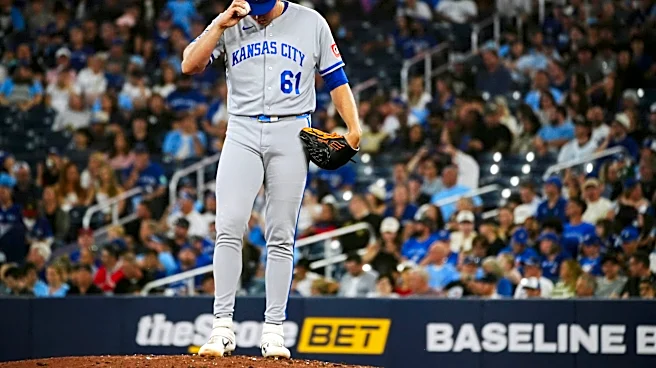
He began 2026 with the Astros. After 16 appearances with decent results, Houston designated him for assignment on July 19. Three days later, the Royals traded for him. He made his first appearance as a Royal on July 26.
Focus for a minute on Pearson’s first 20 outings for the Royals. It tells the story of a reliever who could very well help anchor the Royals bullpen in 2027:
21 innings pitched, 20 strikeouts, 7 walks, 11 hits (zero of which left the yard), 0.43 ERA, 2.62 FIP, .212 batting average on balls in play, 3 saves, 1 blown save, 11 holds, 4 doubles allowed.
Pearson became ineffective starting around September 13. Over his final six appearances, his numbers cratered – 5 innings pitched, 5 strikeouts, 7 walks, 10 hits (including 1 home run), 21.60 ERA (!), 9.10 FIP (!!), .474 batting average on balls in play, 0 saves, 1 blown save, 0 holds, 3 doubles allowed. By then, the Royals were out of it, but his spiral meant one less reliable option in a bullpen that didn’t have many reliable options with which to begin.
Pearson remains arbitration-eligible for one more season. Will the Royals bring him back or non-tender him? He’s due for a raise from the $1.35 million he signed for last offseason with the Astros.
I wouldn’t mind bringing him back. There’s still something so intriguing about him, especially when considering his first 20 appearances with the Royals.