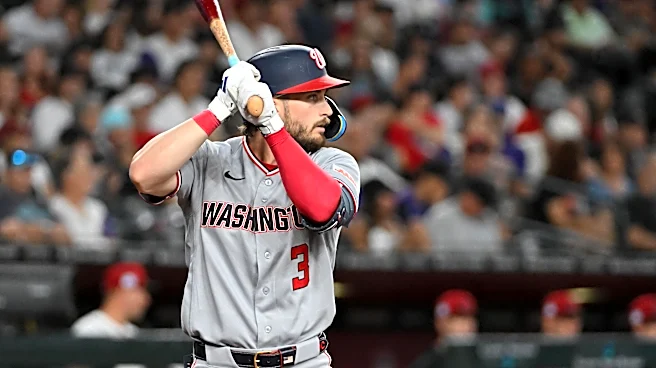








After spending the first month and a half of the 2026 season in Triple A, Dylan Crews has now played 16 games at the big league level this season. In that time, the results haven’t quite shown up for him, with a .197 batting average, 1.5% walk rate, and 58 wRC+, but it hasn’t been all bad either. Let’s take a look at everything going right, and wrong, for Dylan Crews since he returned to the majors.
Starting with the good, Crews has torn the cover off the ball since his return to the bigs, with an
average exit velocity of 90.8 MPH, ranking in the 83rd percentile of all big league hitters. He had been roasting the ball in Triple A, with a 99th percentile average exit velocity of 94.7 MPH up in Rochester, so it’s great to see that part of his game still translating.
Crews has also cut down his strikeout rate 5.1% from 2025 to 2026, down from 23.6%, in the 49th percentile, to 18.5%, in the 75th percentile. While his chase rate has gone up from 29% to 38%, he has cut down his whiff rate from 30% to 24%, meaning he’s getting the result he wants more often when he swings the bat. While he’s been more aggressive on pitches outside the zone in 2026, Crews has also been more aggressive on pitches inside the zone, taking his Z-Swing% from 66%, the 45th percentile, to 69%, in the 71st percentile.
Crews has been hitting the ball harder, making more contact when he does swing, and has been more aggressive on swinging at good pitches to hit, so what has been going wrong for him that his numbers are still lacking? The primary issue for him at the moment is his chase rate, which, as mentioned before, is in the 38th percentile, ranking in the 11th percentile in MLB. The free-swinging approach has led to a lot of hard contact so Crews so far, but it has also put him behind in a lot of counts, as he goes fishing for breaking balls out of the zone.
Crews has also continued to struggle to pull his flyballs in the air consistently, an issue that has plagued his power potential for a few years now. His 8.7% pulled flyball rate is in the 13th percentile of big league hitters, and plays a large role in why his slugging percentage of .322 is .145 points under his expected slugging percentage of .467. Crews’ exit velocities are encouraging enough to suggest he could hit 20+ home runs per year eventually, but not if he is limiting his ability to get the ball over the wall by hitting it to center and right field.
Crews has also not been taking many walks in his return to the bigs, with 1 walk in 65 plate appearances, resulting in a 1.5% walk rate. Crews hasn’t struggled drawing walks in his first 2 big league stints, so his low walk rate shouldn’t be too much of a concern yet with such a limited sample size, but it is interesting how much of a point Crews has made it to be aggressive in the box, swinging early and often in counts looking to do damage.
Overall, the surface numbers don’t look great for Crews in what is now his 3rd big league season, but the under-the-hood metrics suggest he is making some improvements, which could result in success in the near future. He needs to make some adjustments, such as cutting down on the chase rate and lifting the ball more to the pull side, and he may never be elite in those categories, but Crews certainly has the tools to be a productive big league hitter over a large sample size one day.