

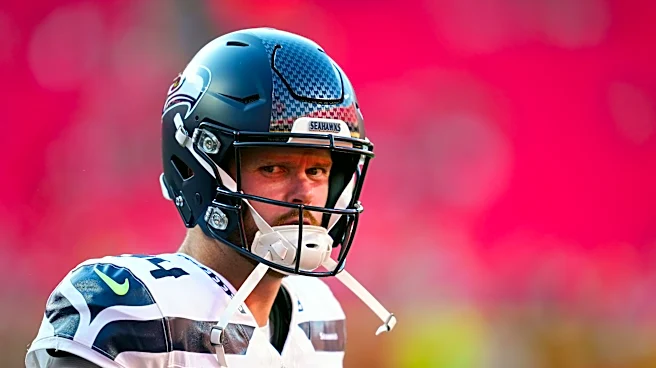

The Jets didn’t quite get Geno Smith for free this offseason, but it was darned close. Gang Green reacquired its once-second round Draft pick in a trade that involved swapping a sixth round pick for a seventh round pick and tacking a $3 million sweetener onto Smith’s contract.
It was a long fall for a quarterback who just one offseason earlier had been traded for a third round pick. Smith’s year with the Las Vegas Raiders was ugly, and his value fell accordingly. It speaks volumes about how low the regard
was for Geno’s Smith’s level of play that the fact the acquisitions required even the seven pick swap and the $3 million contract boost were mild surprises. The Raiders are picking up the tab for most of Smith’s salary.
You read that right. When the Raiders take the field to face the Jets at MetLife Stadium on November 1, they for all intents and purposes will be paying Geno Smith to play against them.
In this sense, it doesn’t seem like Aaron Glenn and Darren Mougey have much riding on Smith’s play this season. If he bounces back and refinds his Seattle form, the Jets got competency at the quarterback position for the NFL equivalent of pocket change. In the event he fails, few resources were spent. The Jets are sitting on three first round picks in the 2027 NFL Draft and should be in great position to land a top quarterback prospect.
I do believe quite a bit rides on Smith’s play this season, however, and it has to do both with the past and future of the franchise.
A year ago the Jets gave Justin Fields a two year contract with $30 million in guarantees to leave the Pittsburgh Steelers. To say the deal aged poorly would be an understatement. Fields posted a QBR of 38.7 and was benched midseason. Smith himself was the only qualifying quarterback to post a lower QBR in 2025. The Jets dealt Fields to the Kansas City Chiefs in the offseason, and the roles were reversed. The Jets had to accept a late round pick swap and absorb most of the salary to get out of a quarterback mistake.
My take on all of this is a bit nuanced so I hope you will stay with me.
I don’t blame the Jets for signing Fields. Their options after the Aaron Rodgers experiment failed were limited. Fields was a former first round pick who had shown flashes of high end play. The only other option available to the team who fit that description was Daniel Jones, who likely had no interest in returning to New York after an unsuccessful tenure with the Giants at the start of his career.
To an extent, I don’t even blame the Jets for giving Fields the money. Unless you are taking a quarterback off the scrap heap like Smith, a $20 million salary for a veteran quarterback is on the extreme low end in the NFL of today. The $30 million in guarantees were certainly rich for a player with as thin of a resume as Fields. But according to ESPN’s Jeremy Fowler, the Steelers made a push to keep Fields that was in the ballpark of what the Jets offered so it isn’t like they bid against themselves.
And contracts are always forward looking. You should never pay a player for what he did in the past. The pay should be for what a player is going to do in the future.
This is where it falls apart for me. As we know, Fields failed in New York. Most of the blame has to go to Fields. There is a reason he is now on his fourth team in four years. He simply hasn’t been consistent enough as an NFL quarterback.
With that said, I’m not sure how the Jets thought Fields would grow into a $30 million player putting him into the system they eventually ran.
At the time of the signing, I figured there was a plan to run an unconventional offense based on Fields’ skills. Fields has been a work in progress as a passer since he stepped onto an NFL field, but he was always one of the most dynamic running quarterbacks in the league. My guess was that they would lean into that, calling designed quarterback runs at a league leading rate. They could also simplify concepts by giving Fields a heavy diet of run pass options and screens. With resources limited, finding quality receivers to put around Garrett Wilson was always going to be a heavy lift. Still maybe they could find some upside plays in free agency, particularly quick separators since Fields is averse to tight window passes. And maybe the coaching staff could get Fields to improve just a little bit playing from the pocket.
The odds were never great, but that would have been a legitimate plan to turn Fields into a $30 million quarterback.
Instead, we got the opposite. The Jets had Fields run at a lower rate than his previous teams, Chicago and Pittsburgh. They didn’t lean into simplified concepts. And their wide receiver group after Garrett Wilson contained journeymen with no upside like Josh Reynolds, Allen Lazard, and Tyler Johnson. The only young receiver added was Arian Smith, who even at the point he was selected looked like a massive reach in the fourth round. Smith has done little to change that perception.
Justin Fields probably wouldn’t have panned out either way. His game as currently constructed is too flawed to have success as an NFL quarterback for the long haul. The suggested steps I mentioned are band aids. There’s only so much you can do to try and work around a quarterback who is fundamentally flawed as a pocket passer.
The thing is the Jets didn’t even try to work around Fields’ limitations to get a better result. They took a guy who couldn’t play in a conventional NFL offense and guaranteed him $30 million to play in a conventional NFL offense.
If the Jets had given Fields that money and tried to tailor something to him, it probably wouldn’t have worked. It probably would have still been too much money. But there at least would have been some coherence to what they were trying.
Fields was never good enough to be a quality starting quarterback in the NFL. Unsurprisingly he regressed under those conditions.
This was a massive organizational whiff from top to bottom. Nobody can escape blame from Aaron Glenn to Darren Mougey to Tanner Engstrand (who ultimately did pay for it with his job).
A team needs to be able to know what traits are needed from a quarterback to run its system, which quarterbacks have those traits, and how much those traits are worth.
The Jets may not have paid much for Geno Smith, but it was clear from the outset of the offseason that he was their top choice. This wasn’t a case of Geno being the last quarterback available when the music stopped. They aggressively pursued him when free agency began, and there was probably a reason for that. The team’s decision makers made it clear to friendly reporters that Smith was definitively their top option.
Looking into the not too distant future, the Jets have those three first round picks in 2027. One of those picks is likely to be used on a quarterback.
When the Jets make that pick, the ability of their primary decision makers will be tested. Can they find a prospect who has the tools they need?
Geno Smith doesn’t need to be great this year. In fact, even a reversion to something resembling his 2024 campaign would give the Jets one of their top quarterback seasons in the last decade and a half.
There’s something else on the line. It would be nice to have some evidence going into that 2027 Draft that the people running the Jets actually know how to target a quarterback. What happened with Fields from top to bottom has to provide pause.
Smith himself is coming off an awful season in Las Vegas. That’s why he was available at such a cheap price. If the Jets correctly identified that Geno’s 2025 struggles were a matter of infrastructure, and he bounces back it would be very encouraging.
If Smith continues on the trajectory of decline he showed with the Raiders, we’re really going to have to question whether the right people are in place to make a franchise changing decision at quarterback. I can forgive one massive error, but two would be stretching things too far.