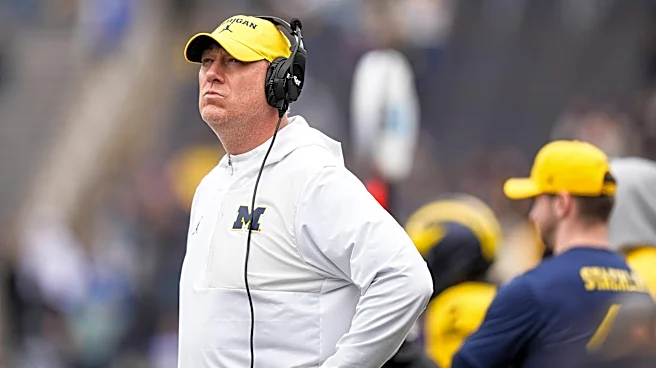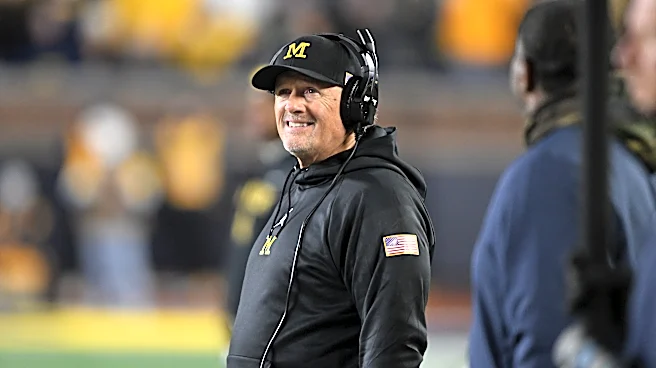


Finally, on Sunday evening, white smoke was released from Schembechler Hall. Offensive coordinator Jason Beck had been fired. It is the first time this century Michigan has fired a coordinator midseason for performance, and it’s safe to say Beck has earned the precedent. Beck inherited an offense that could not pass the ball and left behind an offense that cannot run or pass the ball.
Currently Michigan’s offense ranks:
- 126 in scoring
- 109 in rushing
- 125 in passing
- 132 in total offense
- 123 in yards-per-play
- 122 in first downs
- 49 in third-down conversions
- 13 in fourth-down conversions
- 110 in red zone opportunities
- 91 in red zone touchdown conversions
- 129 in total red zone scoring
- 132 in turnover margin
Furthermore, Michigan has failed to score a single point in 14-of-36 quarters (39
percent) this season. But his most recent failure was his magnum opus.
With most disappointing Michigan losses (2025 Ohio State, 2024 Texas, 2019 Wisconsin, or 2017 Penn State), it’s clear Michigan is simply not the better team. In most cases, the Wolverines were outclassed, regrouped, and found a way to salvage the season. That’s just football. Even soulless performances like the 2024 loss at Illinois or the 2017 loss to Michigan State; at least those were good opponents — both those teams won 10 games and finished ranked inside the top-16 — despite an ability to argue Michigan was still better.
Saturday’s loss was something different.
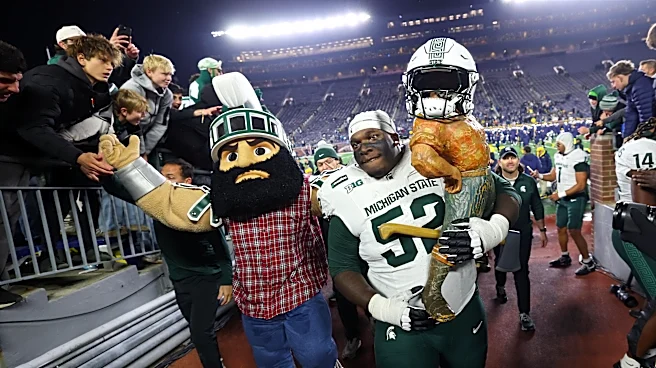
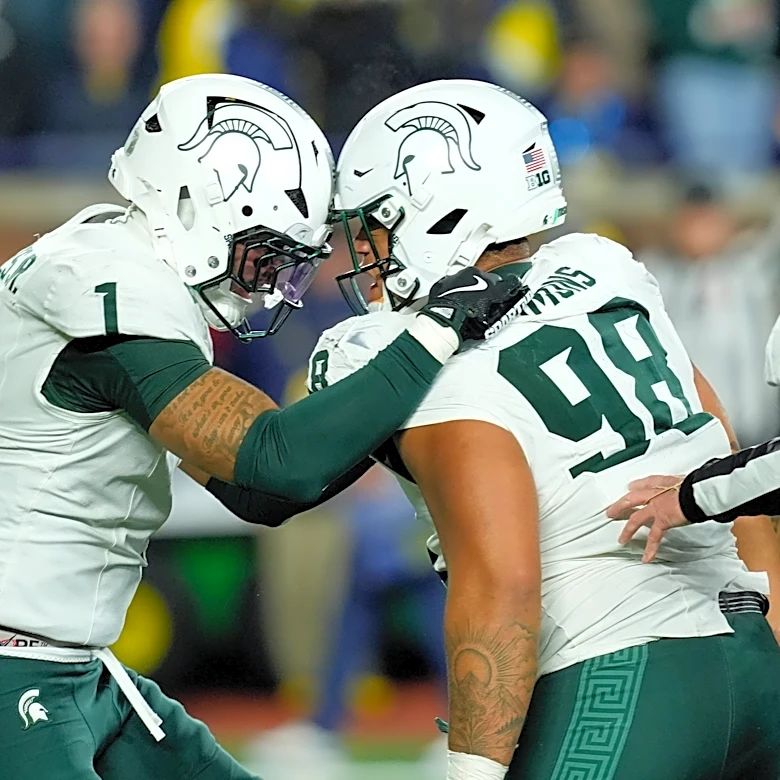
The 15-6 loss to Michigan State was one of the most miserable Michigan performances you’ll ever see. Funerals have seemed more joyful. This seldom-visited rung of Michigan football hell is reserved for the 31-0 loss to an average Notre Dame team in 2014. Or 2009’s 38-13 loss to a three-win Illinois team. Fortunately, Beck was fired before we could challenge the high-flying 1889 squad and its 66-0 defeat to Cornell for the worst in program history. But he certainly took a swing at it.
Michigan State is not a good team by any definition, entering as losers of four in a row and six overall. The Spartans were down to their fifth-string running back, a quarterback playing with a hand brace, and were missing starters on both sides of the ball for a team that, on paper, is at the bottom of the Big Ten in terms of roster talent when completely healthy.
And it still didn’t matter – Michigan lost by nine, its worst defeat of the season, and it might as well have been 50. Outside of two drives, Michigan’s offense was completely incompetent in every facet of the operation. Beck, who has coached from the booth all season, didn’t have a clear enough view of his malpractice masterpiece, so he moved down to the sidelines at halftime to bear witness to his own demise.
The film was so bad that, before watching it, Whittingham was going to wait and evaluate his entire staff after the season. After viewing the film, he was so blown away by the level of incompetence that he couldn’t stand Beck’s presence another day. Don’t shed any tears — Beck’s due $10.1 million to not work at Michigan anymore.
Michigan’s defense won’t tell their grandkids about this performance, but the unit gave up a whopping 15 points. And now, per AP’s Josh Dubow, Michigan is the 15th team in the last 15 seasons to allow 21 points or fewer in each of the first 9 games of a season. The other 14 went a combined 119-7 in those games. Michigan is 5-4. A move had to be made.
Ironically, the Beck postmortem leaves us with more questions than answers. Beck wasn’t the one pass-blocking who allowed five sacks to a team that only had 12 through the first eight games of the season. Beck wasn’t fumbling the football or chucking it into double coverage. There’s a chance Beck is just the fall guy for larger systemic issues.
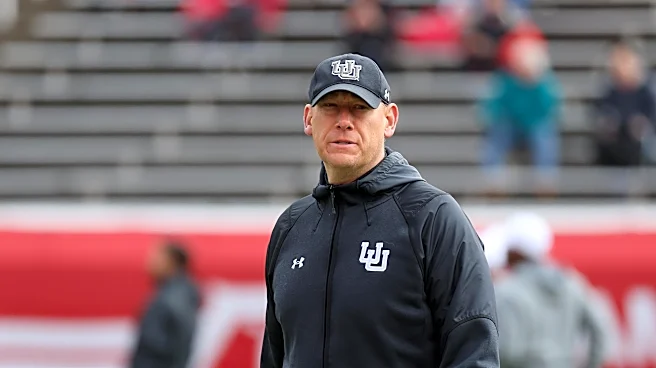
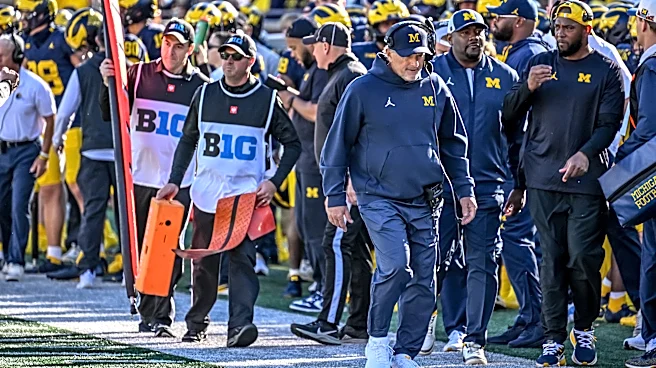
Head coach Kyle Whittingham now turns to offensive line coach Jim Harding for philosophical salvation. The choice of Harding is slightly precarious, given his lack of play-calling experience and his unit — a group that’s underperformed as much as any single unit on the team — coming off its worst performance of the season. Although he has never solely called plays, he has served as co-offensive coordinator at Wyoming (2013) and Utah (2015-16). Think Sherrone Moore in 2021, working with primary play caller Josh Gattis. His objective: run the damn ball.
Stay with me here. The rest of the season is still going to be 90 percent Beck’s scheme and plays. Michigan is not going to implement a new system before traveling to Eugene or before Ohio State, for that matter. However, the game-plan-specific plays introduced over the next three weeks will be Harding’s, so by the time Thanksgiving rolls around, Harding should have a reliable subset of plays of his own incorporated into the scheme.
During his stint with the Utes, Harding worked alongside Aaron Roderick, who has been the offensive coordinator at BYU since 2021. Expect to see similarities to the modern BYU attack and, most importantly, expect Harding to try to run the ball aggressively.
In his two years co-coordinating in Salt Lake City, Utah averaged 44 rush attempts and 199 yards per game. In 2016, specifically, the Utes’ season-low rushing output was 138 yards in the opener against Southern Utah. Currently, Michigan is averaging 36 carries and 129 rushing yards per game. And although those Utah teams were average scoring the ball per national ranks, “average” translates to 30 points per game.
Going through 10-year-old tape, Utah favored running the football with lighter personnel. Goodbye Rhino package! It’s often 10, 11, or 12 personnel at most, which lightens the box and makes reads easier for the quarterback. On the ground, Utah would balance zone/gap schemes, but the gap schemes seemed to be Harding’s preference. Roderick’s scheme at BYU is founded upon wide-zone and while it has its place in this Utah offense, it is only a fractional part of the attack. Utah was at its best in 2016 when attacking space with moving linemen on Counter variations, RPOs, and our dearly beloved Power play.
12-Personnel Power vs. Washington
Trailing deep into the second quarter, Utah began a drive with the best play in football. For this look, the Utes attached a tight end to either side and lined up in the Pistol formation to allow the running back to build momentum downhill. Washington is showing a single-high look pre-snap, although I have no idea what the nickel is doing here.

At the snap, the timing here is brilliant. The quarterback reverses out to give his running back time to take a lateral step before exploding into the hole. It also allows the guard a chance to track over without rushing. The guard takes his time shuffling into the far C gap and is afforded extra time due to the alignment of the play-side tight end, who immediately kicks out the edge, and the left tackle going to work.

The left tackle works up to the second level, fakes the block on the MIKE linebacker, and launches into the WILL linebacker to seal the backside. It’s almost like he bluffs the first block before darting into another defender. This detail freezes the MIKE, prevents the play from being blown up, and allows the pulling guard to pummel the MIKE. The running back escapes a half-assed arm tackle from the box safety and gets into the secondary for a big gain.
Utah lost this game by seven, but managed to rush for 213 yards against a College Football Playoff team that only allowed 133 rushing yards per game with defensive tackle Vita Vea anchoring the interior.
12-Personnel G/H Counter vs. UCLA
Turn the lights down low for this one. In a classic styles clash, it was Utah’s ground-and-pound vs UCLA’s aerial assault. After rushing out to an early 14-0 lead, the Bruins were clinging to a one-point lead, 28-27, early in the second half. But the momentum was already shifting.
Utah comes out with 12-personnel again except both tight ends are on the same side with one aligned in-line and the other as a wing over the C gap. UCLA is expecting run and counters with a five-man Bear front to load eight in the box.
At the snap, the guard gets on his horse to kick out the edge before he can blow up the play. The pulling tight end is able to shuffle similar to the Power play and allows the running back to take a true counter step before taking the reverse-out hand-off.
Now, from right to left, let’s appreciate the detail. The in-line tight end prevents the play from being blown up back-side. The right tackle secures the vacated B gap with a double team from the center before working back as insurance for the tight end. The left guard walls off the nose guard and the left tackle dominates his 1-on-1.

The running back is patient without decelerating and the way he presses the line of scrimmage slows the backside linebackers. Once the pulling H-back gets through, the running back plants his foot on the 50-yard line and cuts through the hole for a big play.
Utah won this Rose Bowl shootout, 52-45 and running back Joe Williams set a program record with 332 yards and four touchdowns on 29 carries. The second-best mark in Utah history is only 254 yards.
11-Personnel Inside Zone RPO vs. BYU
BYU was the 10th-best run defense in the country in 2016, allowing only 113 yards per game. Utah rushed for 169 yards by combining unpredictability and leverage advantages. To keep the Cougars off balance, Utah mixed up zone and gap schemes more than any other game and utilized a heavy dose of RPOs. But compared to Beck’s RPOs, Utah got the job done with lighter personnel to create more space to attack.
This 3×1 look spaces out the defense and gives the quarterback an easy read. BYU makes it even easier by dropping both linebackers into coverage at the snap, but the formation forces them to cover all the open grass. As soon as they begin to back pedal, the ball is handed-off. Up front, BYU runs a twist to the boundary, but no one sets the edge. The running back sees the perimeter and bounces the ball with a decisive jump cut to exploit the space. If there is a Rhino involved, the spacing is thrown off and another defender has to be accounted for in the box for this play to be successful.

Michigan’s offense will not look like this. The offensive line is imperative to reach this level of success in this scheme, and Michigan’s offensive line can be trusted about as much as NVIDIA’s CEO.

Moreover, there is also no Garrett Boles playing center for Michigan. But what Harding can give this offense simply by play calling is an identity. Something they haven’t had all season.
The first step to building a successful program in any sport is to “hire the right people.” A bad coordinator hire, specifically, can derail an entire organization. Just ask Jim Harbaugh and the Chargers. For Harding, it’s hard to be much worse than Beck. He’s not exactly replacing Ben Johnson here. Frankly, Harding doesn’t have to be great, good or even average to be successful. If Michigan’s offense scores 25 points per game down the stretch – which would place them among teams in the 90s nationally – the Wolverines will have a shot at winning every single game. A long shot, but a shot nonetheless if the offense develops an identity.
An identity built in the trenches that doesn’t force a true freshman quarterback’s improvisation to be the focal point of the attack. An identity that doesn’t give Jordan Marshall seven carries for four yards in a two-week span. An identity built on body blows in the first half to keep the defense fresh and allow the offense to turn three-yard gains into six-yard gains in the fourth quarter. An identity supported more by who is not calling the plays anymore than by who is taking over.
Will it work? That’s the $10.1 million question. But when both the Little Brown Jug and the Paul Bunyan Trophy leave Ann Arbor for the first time in 12 years, it’s worth a shot.