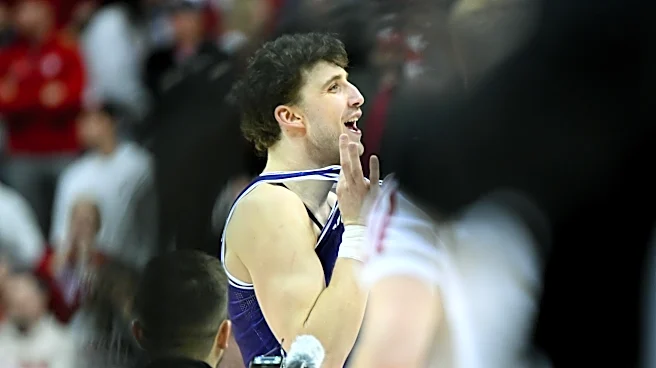






The floaters, the left-hand bias, the unorthodox release, the unique basketball IQ and the genuine will to win were all cornerstones of Nick Martinelli’s game in his career as a Wildcat. Another program legend will deservedly enter the biggest stage no matter what, whether that be through a selection or as an UDFA. For more details on his draft profile, our very-own Drew Christmann does a great job breaking it all down here. What follows is about fit: which organizations genuinely make sense for
a player like Martinelli, and why, based on what each team is currently and what they need going into 2026-27 beyond.
The brief version of the case for Martinelli: he is a 6-foot-7, 223-pound forward who spent four years at Welsh-Ryan Arena turning an unconventional skill set into something specific and real. He led the Big Ten in scoring for the second straight year as a senior, averaging 23 points on 51/41.7/80.9 splits, and set a new Northwestern single-season record with 759 points. His improved three-point numbers are the ones that matter most for his draft case. He shot 32.2% from deep across his first three seasons, then jumped to 41.7% on 108 attempts, including 39.7% on guarded catch-and-shoot looks. Whether those numbers survive against athletes who close faster and contest higher is the central question every evaluator has about him. His release is not textbook, and it is not quick. The shot falls because of elite touch and a high release point, which tend to translate better than mechanics that rely on creating separation. The honest answer is that nobody knows for certain how it holds up, which is part of why he is in the second round at all.
The case against him is equally specific. Martinelli is not going to beat anybody off the dribble at the next level, and he will be targeted on switches. His combine athleticism measurements backed that up, posting a 26.5-inch no-step vertical. He is not a four and not quite a three, and whatever organization selects him Wednesday is betting that his scoring craft and IQ cover that gap. Given what his former Northwestern teammate Brooks Barnhizer did last year, going to the then-reigning-champion Thunder at pick 44 and earning legitimate two-way trust in a system built around second-round culture, the precedent for that kind of outcome exists at this exact stage of the draft. On Wednesday, somewhere between picks 31 and 60, the hope is that someone is going to make the same bet on Martinelli.
Here are the landing spots that make the most sense:
Minnesota Timberwolves, Picks No. 33 and No. 59
At the combine, Martinelli publicly named the Timberwolves as a team he had already spoken with, the first organization he confirmed by name and that was widely reported across outlets. In draft terms, that kind of acknowledgment usually means something was genuinely said between both parties, not just a formality.
Minnesota’s offseason is defined entirely by the recently-executed Julius Randle move. On the eve of the draft, the Wolves sent Randle and pick No. 28 to Brooklyn in exchange for pick No. 33, then immediately locked up Ayo Dosunmu on a long term deal. They arrive Wednesday night owning the third pick of the second round and the penultimate selection of the entire draft at No. 59. Timberwolves president Tim Connelly walked away from Tuesday’s first round visibly frustrated, saying the night was “not the action or activity we were hoping for.” The framework for 2026-27 is now built around Anthony Edwards with Jaden McDaniels, Naz Reid and Dosunmu redistributing the offensive load Randle carried. Connelly said both McDaniels and Reid “have been clamoring for more opportunities and more responsibility and I think they’re going to get it.”
Martinelli does not solve Minnesota’s most pressing need, which is a legitimate point guard. Donte DiVincenzo’s injury status is uncertain, Mike Conley is a free agent at 38, and finding a ball-handler who can take pressure off Edwards is the organization’s most clearly identified roster hole heading into Wednesday. That said, at pick 33, you are not neccesarily drafting for immediate need so much as long-term value. Martinelli’s maturity and sponge-like learning ability makes him one of the higher-floor prospects available in general for a team that has repeatedly found useful players in unexpected places. Jaden McDaniels himself came at No. 28. Terrence Shannon Jr. was an undrafted add. The Wolves have shown they can identify players who make sense structurally even when the profile looks weird on paper. A forward who is physically ready, shoots at a real rate and plays without demanding touches is a sensible supporting piece for a team built around Edwards.
At pick 59, nearly the last selection in the draft, expectations are essentially nothing. This is the more likely slot between the two of them. But Martinelli is a more credible lottery ticket at 59 than most players available there. The combination of confirmed organizational contact and a specific skill set that fits next to Edwards’ star-centered offense gives both Minnesota picks some logic. The former might be a reach, but the latter would be considered a home-run considering the high-IQ and work ethic that coaches rave about with Martinelli. If he’s considered at 33, he could realistically still be there 26 spots later.
Miami Heat, Pick No. 41
This is the most contextually fascinating landing spot on the list, and it arrives slightly earlier in the second round than most boards project Martinelli.
The Heat just acquired Giannis Antetokounmpo and Bobby Portis from Milwaukee in exchange for Tyler Herro, Kel’el Ware, Jaime Jaquez Jr., Kasparas Jakucionis, three first-round picks and pick swaps. Miami is now hard-capped at the first apron, with roughly $18 million in space and up to five roster spots to fill heading into free agency. Pick 41 via Golden State is the only draft capital they have, and it comes at one of the more interesting points of the board, right before Martinelli’s consensus range begins.
Here is where organizational history matters. The Heat traditionally do not draft at this range because they are usually trading picks to chase stars. Pat Riley has made only 14 first-round picks in 26 drafts as team president, with three of those traded on draft night, and has made significantly less second-round picks compared to the average franchise as well. The way the Heat have stayed functional through those years of sacrificed draft capital is by developing players nobody else wanted. Udonis Haslem went undrafted and played in France before making the roster. Duncan Robinson started his career at Division III Williams College, went undrafted, and eventually signed a five-year, $90 million contract as one of the sharpest perimeter shooters in the league. Gabe Vincent, Caleb Martin, Max Strus and Haywood Highsmith were all undrafted contributors who became rotation staples during Miami’s Finals runs. Back in 2022, Spoelstra described the organization’s search criteria plainly. All they want are “people that are committed to the work and [the] process,” and draft position is irrelevant to that simple standard.
The Heat’s talent identification pipeline does not run through lottery picks. It runs through the combine, the G League, summer league, and exactly the kinds of pre-draft workouts that teams conduct for second-round candidates like Martinelli. When Miami has a pick in this range, which is rare, they use it the same way they use undrafted signings: find a ready-now contributor with a specific skill, plug them into Spoelstra’s system, and let the development infrastructure do the rest.
The roster Miami is building around Giannis and Bam Adebayo also has a very specific problem. Analysis after the trade immediately flagged the projected starting lineup as relatively light on shooting, noting Adebayo shot only 32% from three last season. Antetokounmpo himself, despite everything else he does, has never been a reliable perimeter shooter. The Heat are going to win games through defense, transition and physicality, which is exactly the identity Spoelstra has built. But they need players on the floor who can catch, decide quickly and make the open look when Giannis draws help. Norman Powell, assumed to re-sign, projects as the roster’s primary perimeter scoring option, and beyond him the shooting depth is thin. Martinelli is specifically the missing piece: he does not need creation, does not demand touches, catches in the corners and midrange, makes the right read, and shot 41.7% from three in his final college season on real volume.
The skeptic’s argument is that the slot is too early relative to his board position, and that Miami with Giannis on the roster has no patience for a developmental second-round forward. Both points are fair. But the organizational track record says the Heat have always found ways to integrate ready-now contributors regardless of draft profile, and Martinelli at 22 with an NBA-ready body, a proven shooting leap and four years of growth at the peak of Northwestern basketball history is almost precisely the profile Spoelstra’s program has turned into rotation players for decades. The Heat do not reach for upside. They find specific, useful, hardworking players and deploy them correctly. Martinelli fits that description better than almost anyone available at pick 41.
San Antonio Spurs, Picks No. 42 and No. 44
Of any organization in the draft, the Spurs have the clearest structural argument for taking Martinelli, and two chances to do it.
Built almost entirely through the draft, with Wembanyama, Stephon Castle and Dylan Harper all taken as consecutive top-four picks, the Spurs went 62-20 in the 2026 regular season. They then took down the reigning champion Thunder to make the NBA Finals before falling to the Knicks in five games. It was an extraordinary rebuild for a historic brand. But the franchise’s history of identifying value at the back of the draft predates this current core by decades. Manu Ginobili was drafted 57th overall in the second round of the 1999 draft and went on to win four championships, a Sixth Man of the Year award, two All-Star selections and eventually a Hall of Fame induction. Tony Parker went 28th in 2001 and became a Hall of Famer and Finals MVP. The 2011 draft, when the Spurs traded George Hill to Indiana for the 15th and 42nd picks, yielded Kawhi Leonard at 15. The point is that San Antonio’s draft identity is not just about hitting on lottery picks. It is a franchise that has consistently found useful contributors in the lower portions of the board and trusted them with real minutes.
That said though, in that final series versus the Knicks they shot a very poor 33.9% from three: Wembanyama 27.3%, Castle 30%, Harper 28%, Fox 25%. Only Vassell and Champagnie shot above 40%. That is a historically poor shooting performance from a team with that many talent advantages, and it exposes a very specific depth problem. When those two reliable shooters were off the floor, San Antonio had no reliable third option who could keep the spacing functional. Martinelli just shot 41.7% from three in his final college season, gets to the line at a high rate, and does not need touches to be useful. The profile is almost tailor-made for what the Spurs were missing in June.
Harrison Barnes, Kelly Olynyk and Mason Plumlee are all entering free agency, meaning forward depth has to come from somewhere. With picks 42 and 44, San Antonio can allocate one slot to a ready-now contributor and one to a raw developmental player. The Thunder built their dynasty in significant part on second-rounders: Aaron Wiggins, Isaiah Joe, Ajay Mitchell and Jaylin Williams all became genuine rotation contributors from that tier. San Antonio has watched that model closely and tried to replicate it. A franchise that turned Ginobili at 57 and Parker at 28 into Hall of Famers is not going to be shy about betting on a player whose profile looks unconventional. The cool part is that those two slots average out to the exact range they are drafting in 2026. Of course, correlation is not causation, and nobody is expecting Martinelli to be a hybrid of the two. Equally, nobody would complain if the Spurs take a player who is already 22, physically complete, and basketball-smart. It is the lower-risk version of the second-round bet, not a concession. There is not much to develop here. There is just a role to deploy him into correctly.
Orlando Magic, Pick No. 46
The Magic put their build-through-the-draft blueprint on hold when they traded multiple future first-round picks for Desmond Bane last summer, a logical decision after assembling one of the league’s best young cores. The reward has not yet arrived.
They blew a 3-1 lead to Detroit, for the second time this century, flailing out of the first round for a second straight year which directly led to the firing of head coach Jamahl Mosley.
Orlando are also without their own first-round pick in 2028 and 2030, both unprotected to Memphis, and their 2029 pick is top-two protected with a swap favoring the Grizzlies. For the first time since 2011, they entered a draft without a first-round selection. Magic President Jeff Weltman’s track record of identifying players who fit the system is real: Tristan da Silva at No. 18 in 2024 drew skepticism on draft night and has carved out a rotation role with his shooting and feel. Jase Richardson at No. 25 in 2025 was a value selection whose stock had slid after the combine but fit Orlando’s backcourt need precisely. Both picks reflected an organization that evaluates systematically rather than chasing athleticism.
The specific problem it needs to address now is not subtle. The Magic ranked 27th in three-point accuracy at 34.3% as a team despite Bane’s 39.1% leading the roster. Banchero, Wagner, Suggs, Anthony Black and Carter Jr. all shot between 30.5 and 34.5% from three. That is a full starting lineup of players who do not shoot the ball well from deep, plus one imported shooter who did not change the team’s playoff fate.
Orlando is still developing Anthony Black, along with previously mentioned da Silva and Richardson, all of whom are roughly the same age as incoming rookies, which tells you the organization is comfortable adding young pieces and letting them develop in the background.
This team is built entirely on defense and physical dominance at the rim, and they have now failed twice in the first round because they cannot score in a half-court game when it gets late and tight. Adding Desmond Bane was supposed to change that. It did not change it enough. Pick 46 is everything they have to work with on Wednesday, and it lands squarely in Martinelli’s consensus range. He is not going to fix the spacing problem. He is one 22-year-old second-rounder who will likely start next year in the G League. But he represents the right kind of thinking at a position in the draft where there are not many options available, and the Magic are a team that should be thinking about every conceivable way to add shooters to a roster that, even after adding a legitimate 40% three-point shooter at considerable cost, still ranks near the bottom of the league from deep.
New York Knicks, Picks No. 31, 47 and No. 55
The defending champion Knicks walked out of Tuesday’s first round without taking a player, executing a series of trades through the Lakers, Mavericks and Suns to accumulate picks at 31, 47 and 55. With Landry Shamet and Mitchell Robinson both heading to free agency and James Dolan treating the second apron as an absolute ceiling, the three second-round slots represent essentially the only avenue New York has to replenish depth.
The Knicks’ championship is worth understanding because of what it was, not just what it accomplished. The Knicks did not draft a single starter on their championship roster. Their build started with a point guard drafted 33rd overall by Dallas, available in free agency only because the Mavericks declined to offer him an extension. Miles McBride, the one homegrown drafted player who contributed meaningfully in the run, was taken 36th overall in 2021, spent years bouncing between Westchester and 12-minute bench cameos, and eventually became their sixth man before injury. The organization’s track record with second-round picks is not glamorous, but McBride’s path tells you exactly what the Knicks believe is possible when they identify the right player, put him in Westchester, and let the situation develop. He didn’t force his way into the rotation. The moments came, and he was ready.
Jalen Brunson himself, the champion’s centerpiece and Finals MVP, was a Villanova two-time national champion who fell to the second round in 2018, went 33rd to Dallas, and spent two seasons coming off the bench before his breakout. The irony is not lost on Mavericks fans, but the lesson is: the Knicks know better than most franchises that second-round picks can become franchise cornerstones when the system is right.
It helps that the Northwestern connection in this building is real and documented. Boo Buie, the program’s all-time leading scorer who played with Martinelli for two seasons, signed a two-way contract with New York in November 2024. He was waived on December 24 after playing exclusively with Westchester, and was eventually traded to the G-League’s Capitanes the following August. Buie’s path did not work out, but his presence in the organization signals that the Knicks were at minimum comfortable enough with Northwestern’s program to put that trust into a roster spot. Martinelli is a considerably different player physically: heavier, stronger and more equipped to handle contact from NBA-level bodies. And the specific shooting profile the Knicks would be drafting, a pick-and-pop forward who catches and shoots, plays off others’ creation and does not need the ball in his hands, fits naturally behind the championship core’s existing structure. At pick 47 or 55, in the middle of his realistic range, a team like the Knicks could do considerably worse.
Dallas Mavericks, Pick No. 48
Martinelli confirmed both an interview with the Mavericks and a formal pre-draft workout with the organization, making Dallas one of a small number of teams with documented hands-on evaluation time. After taking Morez Johnson Jr. ninth overall on Tuesday and trading the No. 30 pick to the Knicks for stash prospect Sergio De Larrea, pick 48 is Dallas’s final live selection and lands one slot after Martinelli’s most commonly mocked projection.
The Mavericks are in a transitional state that is simultaneously exciting and uncertain. Cooper Flagg won Rookie of the Year and looks like a genuine franchise cornerstone. He shot just 29.5% from three as a 19-year-old last season, which means defenses are still not fully respecting his perimeter shot, and the Mavericks need off-ball players who can punish that, catch the corner kick-outs he generates with his drives and make defenses pay for collapsing. Kyrie Irving is 34 and coming off a torn ACL, and Dallas has essentially no solidified guard depth beyond Ryan Nembhard if Irving misses significant time. A forward who plays off others, does not demand creation, gets to the line and spaces the floor is a reasonable complementary add in that environment.
The workout history with the organization is what elevates Dallas from theoretical to credible. Teams do not put prospects through formal workouts without moving them up the internal board, and the fact that Dallas as a team has plenty room to grow would allow for Martinelli to simultaneously grow at his own pace.
Toronto Raptors, Pick No. 50
Toronto is the most underrated team on this list, and pick 50 lands almost exactly in the middle of Martinelli’s consensus range.
The Raptors finished 46-36 in 2025-26, returned to the playoffs for the first time since 2022, and pushed the Cleveland Cavaliers to a deciding Game 7 in the first round. The foundation for what comes next is a genuine two-way frontcourt in Scottie Barnes and Collin Murray-Boyles, who helped Toronto finish fifth in defensive rating. The problem is everything else offensively. The Raptors finished 26th in made threes, 26th in three-point attempts and 21st in three-point percentage at 35.4%. Barnes himself is not a reliable shooter. He hit just 27.1% from deep in his final season before making the All-Star team, and that weakness has been a structural limitation on everything Toronto tries to do offensively.
The organizational track record on pick development is relevant. Immanuel Quickley himself was the 25th overall pick in 2020, developed under the Raptors’ infrastructure into a reliable starting guard, and became one of the more important pieces in their playoff push. General manager Bobby Webster has shown a consistent willingness to identify players who fit the system and trust the environment to develop them rather than expecting instant contribution from second-rounders. Ja’Kobe Walter, taken 19th in 2024, started the year averaging 7.5 points before growing into one of Toronto’s most reliable perimeter threats by season’s end, finishing at 40% from three on over three attempts per game, the only Raptor consistently meeting that volume and efficiency.
Walter is the most important reference point here. He was the only reliable shooter on a playoff team, and the Raptors’ entire offensive ceiling ran through whether he was making threes. Adding another player who can do that job, even in a bench role, even in the G League initially, directly addresses the single most glaring offensive deficiency on the roster. Martinelli at pick 50 on a cheap second-round deal is the specific answer to a specific problem for a team that has demonstrated it can develop players into that role when the fit is right.
Chicago Bulls, Picks No. 38 and No. 56
The Bulls are the wild card on this list, and Martinelli is the most locally resonant name they could possibly call with their second-round picks. As a Chicago-native myself, my fingers are crossed for this outcome, and the story has plenty of reason to root for it regardless.
Martinelli grew up in Glenview, Illinois, attended Glenbrook South High School, and spent four years at Northwestern just down the road in Evanston. As he described it himself, Evanston became an extension of Glenview over those years, his brother Jimmy having moved back to the area, his parents at every home game. Glenbrook South is roughly 20 miles from the United Center. Evanston is closer still. If the Bulls choose him at either of their two slots, his name would span across the digital boards at Barclays Center as a representation of the most Chicago-adjacent player in this entire draft class.
The basketball argument is real too, if complicated. Chicago selected Caleb Wilson fourth overall, then took Texas standout Dailyn Swain at 15, adding size and athleticism to a core already featuring Matas Buzelis, Josh Giddey and the recently-added Nic Claxton. Media covering the pick immediately flagged the looming shooting question: despite drafting multiple wings, the Bulls have assembled a roster full of players whose jumpers need work, and spacing is now a significant concern heading into 2026-27. Wing depth with shooting is explicitly identified as one of Chicago’s two main remaining roster needs heading into the second round. Martinelli is specifically that. He does not attack off the dribble. He does not need creation. He catches, he makes the right read, and he shoots at a legitimate rate that none of the players drafted above him in Chicago can match.
Pick 38 is early for where most boards have him, and the Bulls under new GM Bryson Graham have shown a strong preference for length and athleticism in their selections. Martinelli is the opposite of that profile on paper. But he worked out for Chicago, and the narrative of a Glenview kid walking into the United Center as a Bull rather than a visitor is the kind of thing that occasionally moves front offices in ways analytics do not fully capture. If Graham saw enough in his evaluation process to either reach or let him fall to them at 56, the story writes itself: the kid who grew up going to Bulls games, played his college ball 12 miles north, and never needed anyone else’s blueprint to become good enough could extend his Glenview bubble yet again. This time to the Madhouse on Madison.