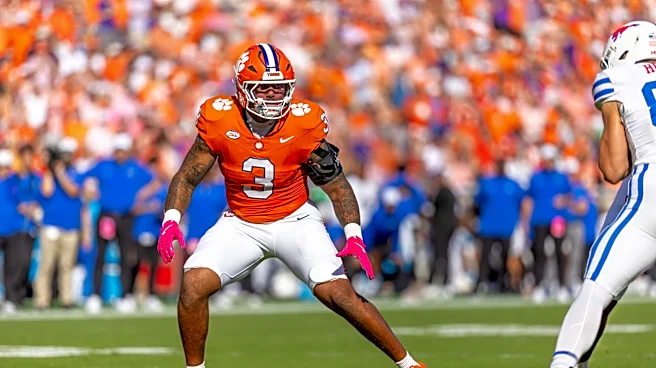




The Buffalo Bills picked Clemson EDGE T.J. Parker with 35th pick in the 2026 NFL Draft, after three trade backs moved them completely out of the first round for the second time in three years.
As a massive draft nerd and longtime draft analyst that even pre-dates by past job dedicated to the NFL Draft from January – May every year, I figure it’s sensible for me to provide you, dedicated Rumblings reader, with my draft thoughts on all of the Bills’ 10 picks in the 2026 draft. Actually, may only be
nine articles because I did not watch/evaluate punter Tommy Doman Jr.
Without further ado, here’s the premier piece in my Bills’ 2026 rookie profile series, starting naturally with Buffalo’s first selection of T.J. Parker. Be sure to check back during the week (and maybe into next week) for each rookie profile.
T.J. Parker rookie profile
NFL comparison: Rashan Gary
Big Board rank: No. 52 overall (selected: No. 35 overall)
Positional rank: EDGE10 (EDGE6)
My pre-draft scouting report on Parker:
T.J. Parker is a prototypical, pro-sized EDGE with ideal height, weight, and length, checking every physical box for the position. His length consistently shows up at the point of attack, making it tough for tackles to control his frame, and when engaged, he flashes the torque and lower-body strength to shed or continue collapsing the pocket. He moves with impressive fluidity for his size, changing direction smoothly and carrying his mass with tight end–like ease.
As a pass rusher, Parker is a power-based athlete with developing polish. His bull rush is a clear strength, and he flashes enough flexibility to corner despite not being a true bend-first threat. He has shown effective use of rip and cross-chop moves, though his usage and sequencing can improve, particularly when countering off his long-arm. While not explosive off the snap, his closing speed, balance, and ability to stay active through contact help him finish plays.
Against the run, Parker plays with strength and urgency, consistently holding his ground and overpowering tight ends. He stays engaged, works off blocks, and finishes. Overall, he projects as a high-floor, three-down EDGE with upside tied to his pass-rush development, thanks to his blend of size, length, and functional power.
T.J. Parker relevant stats at Clemson

Career snaps at Clemson: 1,653
Career pressure rate: 13.0%
Career run stop rate: 13.8%
I list pressure rate instead of sacks because pressures are more predictive of future sacks than past sacks themselves. And for reference, after scouting the NFL Draft for almost 15 years now, 15% is the pressure rate I use as a reference point — it’s a darn good figure. When an EDGE prospect dips close to 10%, that’s concerning, if he approaches 20%, that’s like Myles Garrett/Micah Parsons elite-level pass-rushing production.
Final thoughts on Bills second-round pick of EDGE T.J. Parker
Strictly based on my pre-draft evaluations and grades, which of course are meant from a league-wide perspective and not tailored to specific teams, there were three EDGEs I would’ve picked for the 3-4 rush outside linebacker role ahead of Parker — Cashius Howell, Derrick Moore, and Keyron Craword (the latter of which had a 0.1+ grade edge on Parker).
But Parker probably was the “safest” selection of the three.
Let me explain.
Howell had arm length in the 0 percentile. Not 1st percentile… 0 percentile. His wingspan of 74 1/4 inches was in the 1st percentile. That’s a big red flag on profile.
Crawford was dealing with a hamstring injury and didn’t workout pre-draft. While of course we can’t blame him for an injury, many teams shy away from early-round selections on prospects without workout figures because they can’t compare them, in a quantifiable way, to historical data. I certainly can agree with that.
It would’ve been a toss-up between Moore and Parker if I was making the decision at No. 35 overall — very comparable stylistically with similar physiques — but we only got a 30-inch vertical (14th percentile, yikes) and 115-inch broad (44th percentile, not amazing) from Moore at the Michigan Pro Day. Those aren’t early Round 2 figures.
With Parker, the Bills got, as Maxwell Owens put it, a “thudding” three-year full-time player at a premier program who flashed serious pass-rush capabilities early in his career — a good indicator of NFL success — and settled into more of a three-down role in his final season at Clemson. He comes with a desirable blend of NFL-readiness and upside, particularly due to his ascending yet not totally loaded pass-rush move arsenal.