


Last week in this series, we discussed the story of Hideki Irabu, the first Japanese player to sign with the Yankees. Irabu never fully adjusted to pitching stateside despite flashes of high-end talent and was castigated by fans, media, and ownership alike. Despite this, it would not take long for the team to return to the international free agent market, and bring over another star player from Japan. He’d even have the same first name.
The first players to come over from NPB were pitchers like Irabu;
Hideo Nomo, of course, being the first. But there was more doubt that position players—hitters—could translate their skills to Major League Baseball. That doubt was effectively dispelled by the arrival and immediate success of Ichiro Suzuki, whose legendary rookie campaign with the Mariners in 2001 helped carry them to the greatest regular season in MLB history.
After that, teams around the league started seeking offensive impact from their international signings as well. And in the years following Ichiro’s arrival, you could find few resumes more sparkling than that of Hideki Matsui. In 2003, this decorated hitter would come to the Bronx and begin a highly successful stint in pinstripes which culminated in a World Series MVP Award and championship ring.
Hideki Matsui
Signing Date: December 19, 2002
Contract: Three years, $21 million
Matsui was born on June 12, 1974 in Ishakawa Prefecture, where he would quickly emerge as a top high school talent. After a controversial game his senior year in which he was intentionally walked five times in a loss, Matsui reached the pros in 1993 when the most prestigious franchise in Japan, the Yomiuri Giants, drafted him in the first round.
By 1994, Matsui had become a consistent presence in the Giants’ lineup, reaching the 20-home run mark for the first time as a pro and getting his first taste of championship glory as Yomiuri won that year’s Japan Series (with a bit of an extra spotlight from the United States since MLB’s World Series was cancelled). But the outfielder’s true star turn would come in 1996, his age-22 season. That year, he hit .314/.401/.622 with 38 home runs and won his first of three Central League MVP awards.
From there, Matsui established himself as one of Japan’s premier sluggers, averaging approximately 40 homers a year across his seven-season peak from 1996 to 2002. The Giants won another championship in 2000—that year, Matsui not only won Central League MVP, but was also the MVP of the Japan Series, hitting .381 with three homers and eight RBI.
Matsui’s greatest season in Japan came in 2002, his final year with Yomiuri. He hit 50 home runs and slashed .334/.461/.692 for a 1.153 OPS. After a third MVP and Japan Series ring, it was clear the lefty slugger had nothing left to prove in his home country. He had turned down a lucrative offer from the Giants to pursue a deal in MLB. He wouldn’t have to wait long. In December, Matsui and the Yankees agreed to terms on a three-year, $21 million deal. “The Yankees have a great baseball tradition and great players,” Matsui said in a press conference. “It’s the ballclub that would most challenge me. That’s where I wanted to show my abilities.”
While the Yankees were coming off a 103-win season, ALDS loss notwithstanding, they were thin in the outfield corners. Raúl Mondesi and Rondell White, the club’s primary options in those spots, had uninspiring seasons at the plate, and GM Brian Cashman was looking for an upgrade. Matsui promised a much higher ceiling, though concerns existed due to an unimpressive performance in a recent exhibition series against MLB pitching.
Matsui made his MLB debut on March 31, 2003 at the SkyDome in Toronto, going 1-for-4 with an RBI single. He had a humble opening road trip at the dish before making his Yankee Stadium debut on April 8th. In the fifth inning, the new prize acquisition came up with the bases loaded. He worked the count full, then ripped the payoff pitch from Joe Mays into the bleachers in right for a grand slam, his first MLB home run.
Matsui quickly assuaged fears that he would not be able to hang with MLB pitching, reaching the All-Star Game as a 29-year old rookie and appearing in all 162—er, 163—games for the Yankees that season. (He would not miss a game in pinstripes until May 2006, a streak of 1,768 consecutive between the end of his NPB career and the first few years of his MLB tenure.) While New York lost that year’s World Series to the Marlins, Matsui played well in the playoffs and would take another step forward the following season.
In 2004, Matsui reached his second straight All-Star Game and reached the 30-homer plateau for the first and only time in his MLB career. The Yankees would infamously collapse to the Red Sox in the ALCS, though not without a herculean effort on Matsui’s part. He hit .412 in the postseason and got the Bombers off to a tremendous start in that ALCS with five RBI in Game 1, then five more RBI on five hits in Game 3. Unsurprisingly, the man who already had three championship rings proved himself immune to postseason jitters.
Matsui finished out his initial three-year deal with another outstanding season in 2005. Across the life of that contract, he never missed a game, hitting .297/.370/.484 with 70 home runs and triple-digit RBIs all three years. Unsurprisingly, the Yankees rewarded Hideki with another contract: a four-year $52 million deal signed shortly after the end of the 2005 season, which made him the highest-paid Japanese player in MLB. While he was nearing the end of his prime and began shifting from corner outfielder to designated hitter, his metronomic consistency at the dish made the reunion a no-brainer.
Matsui did not produce at that same consistent level throughout the life of that second contract, thanks to injuries which took out substantial chunks of his 2006 and 2008 seasons. But Matsui was largely healthy in 2007, smashing 24 home runs and once again eclipsing 100 RBI. By that point, however, the aging Yankees had begun to stagnate. That ’07 campaign marked their third straight ALDS exit.
The 2009 season figured to be Matsui’s final year in New York. Now a full-time DH to preserve his ailing knees, Matsui smashed 28 home runs at the new Yankee Stadium for a high-powered Yankee lineup which easily claimed the AL East crown, and dispatched the Twins and Angels to win the AL pennant. Then, of course, came the World Series.
While Cliff Lee and the Phillies shut down the Bombers in Game 1, Matsui’s bat would be heard from in Game 2. He broke a 1-1 tie in the bottom of the sixth by taking longtime Yankee nemesis Pedro Martinez deep for a go-ahead home run.
That homer gave New York their first lead of the series, and they held on for a critical 3-1 win as the battle shifted to Philadelphia. Without the DH spot, Matsui was forced to come off the bench, but still popped a pinch-hit homer off Brett Myers in the eighth inning of Game 3 to provide some late insurance as the Yankees took the series lead. They won Game 4 to climb to the threshold of title number 27, but the Phillies’ held off a late rally in Game 5 to force the series back to the Bronx, where Matsui would cement his name in Yankee lore forever.
Once again, Pedro Martinez would be the one to fall victim to Hideki’s smooth stroke. In the second inning, with Alex Rodriguez on first, Matsui smoked a 3-2 fastball just inside the foul pole and into the second deck for his third home run of the series.
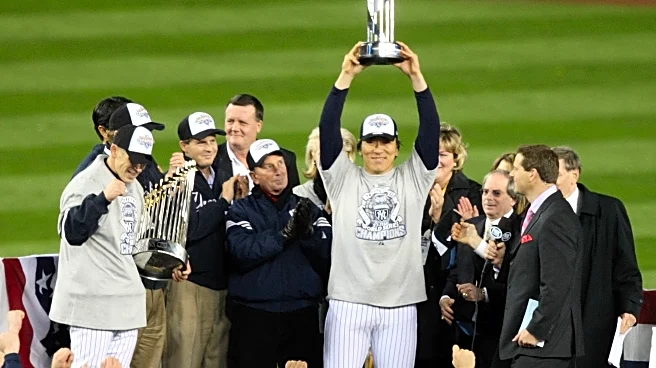
The Yankees then loaded the bases against their longtime nemesis in the third inning, and once again it was Matsui to supply the backbreaking blow. He smoked a line drive to center which found green grass in front of Shane Victorino and drove in two more runs. Finally, with two more aboard in the fifth, Hideki provided the coup de grace. J.A. Happ tried to climb back into the strike zone on a 3-1 pitch, and the slugger smashed a double to the right field wall, plating another pair for six RBIs. Matsui’s final hit in a Yankee uniform provided all the insurance the team would need to raise the Commissioner’s Trophy for the 27th time.
Matsui’s numbers in this Fall Classic were eerily similar to his Japan Series performance in 2000, with three homers and eight RBI in a six-game series. Like in 2000, Matsui earned series MVP honors. He became the first player from Asia to win World Series MVP. It was the perfect note on which to depart.
Matsui spent 2010, his last truly productive MLB season, with the Angels in Anaheim. After a full year with the Oakland A’s in 2011 and a 34-game cameo with the Rays in 2012, Matsui signed a one-day contract with the Yankees to retire with them. Between 20 years in Japan and America, Matsui hit 507 home runs and collected 2,643 hits, with 1,649 runs batted in. He was inducted into the Japanese Baseball Hall of Fame in 2018.
In retirement, Matsui has remained close to the Yankees organization, appearing at many alumni events. In 2016, he took David Cone deep during the Old-Timers’ Game, hitting the ball in almost the exact spot where his Game 6 home run had landed seven years before.
In 2018, Matsui appeared before an MLB vs. NPB exhibition series wearing a full Yankee uniform, and threw a terrific ceremonial first pitch. He has repeated that honor during each of the previous two Yankee postseason runs, including during the 2024 World Series. Matsui has been beloved by fans ever since he signed that initial deal back in 2003, one of the most successful signings the Yankees have made in the 21st century. Matsui’s steadiness and consistency, particularly across his first few years in the Bronx, made him a star. But his World Series performance at the end of his time in pinstripes made him a legend.
See more of the “50 Most Notable Yankees Free Agent Signings in 50 Years” series here.