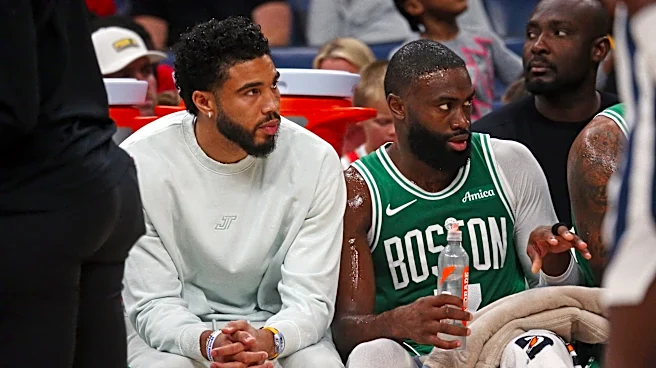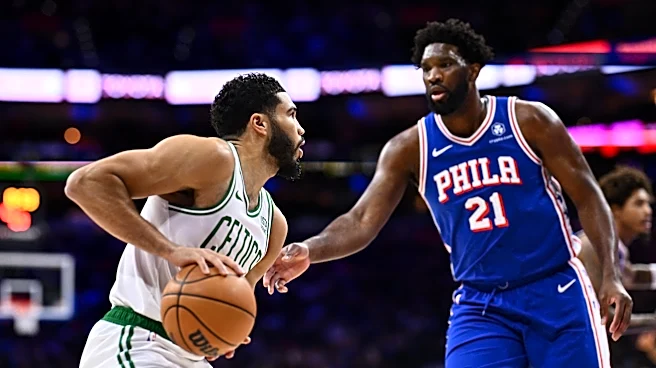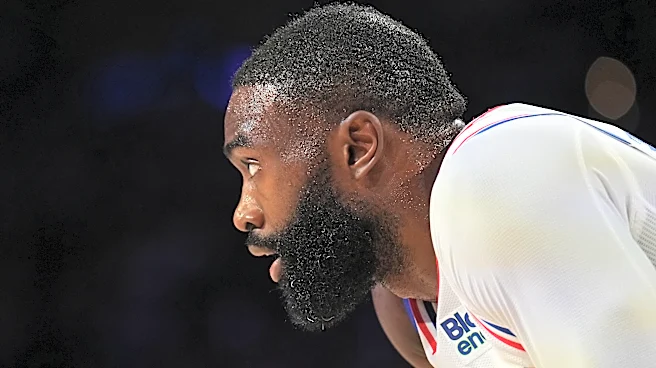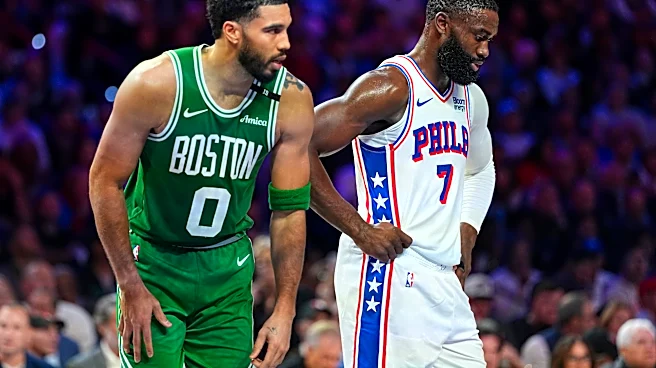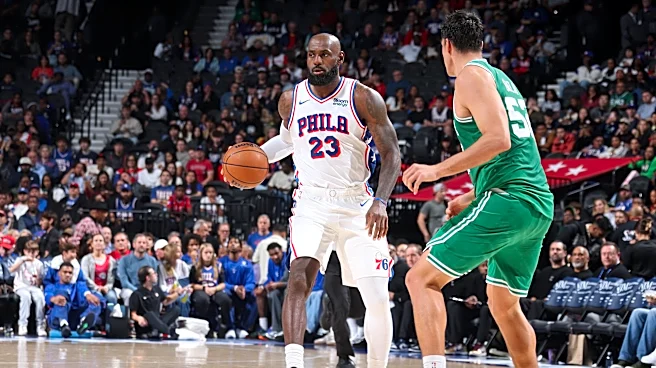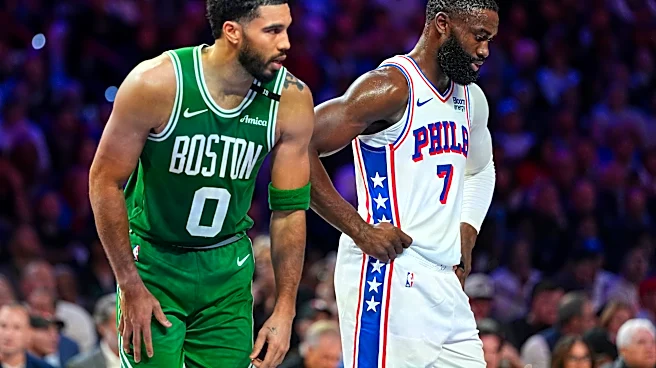

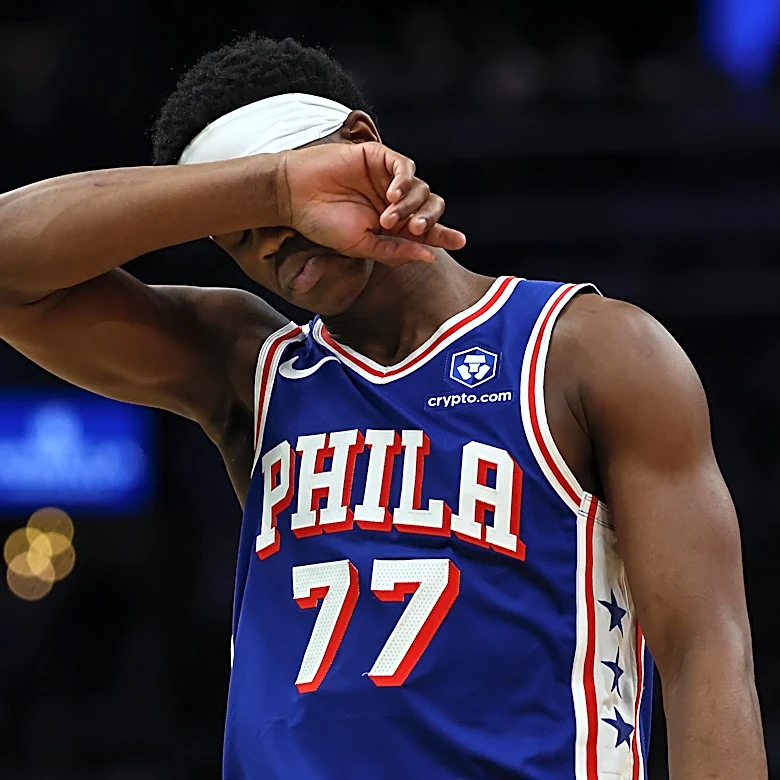

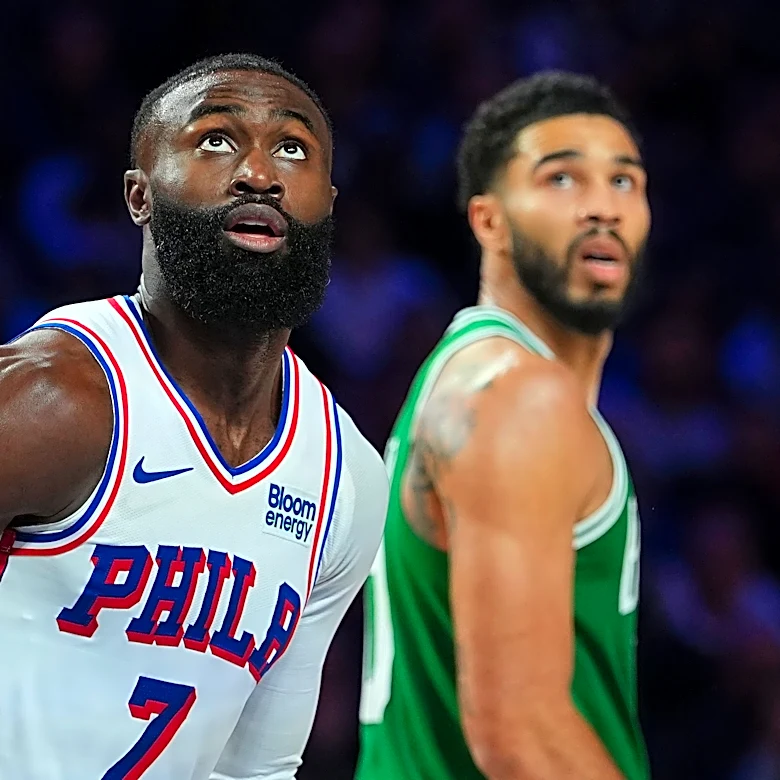

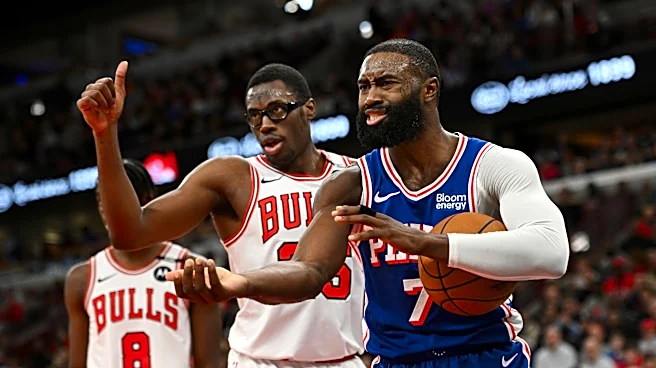
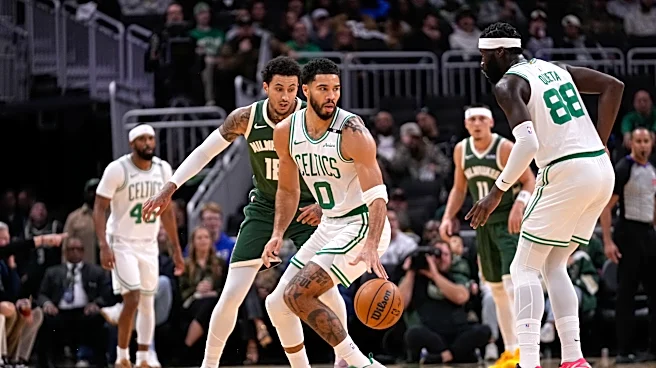
PHILADELPHIA – The last time Jayson Tatum and Jaylen Brown shared the floor was in late April, in Game 6 of the first round of the NBA playoffs.
Neither knew it then, but that lackluster game, a Philadelphia 76ers blowout, became their last as teammates. Tatum missed the subsequent Game 7 with a leg injury, and Brown was stunningly traded just a few months later to the very Northeast rival that ended their nine-year run as teammates.
Four months later, Brown turned a cold shoulder to Tatum moments
before tip-off of Tuesday’s highly-anticipated game between the 76ers and the Celtics.
With cameras and reporters flooding Xfinity Mobile Arena, the two stars never spoke or embraced, at least not publicly. Tatum punted Brown-related questions postgame, and Brown denied any ill intent behind the viral pregame exchange.
“To be honest, I wasn’t paying attention,” Brown said.
“No headlines about anything like that,” Tatum said when pressed on the interaction. “I was just getting ready for the game, ready for the jump ball, go out there and compete, have some fun, and try to get a win.”
Still, despite Tatum’s best efforts to downplay the storyline, the coverage leading up to Tuesday’s game between the 76ers and the Celtics centered on a now-fractured, highly publicized relationship between two superstars, one that has been analyzed and debated for nearly a decade. So many media members attended the game that Tatum said it felt like an NBA Finals game — and joked he didn’t expect to see most of us in Toronto the next day.
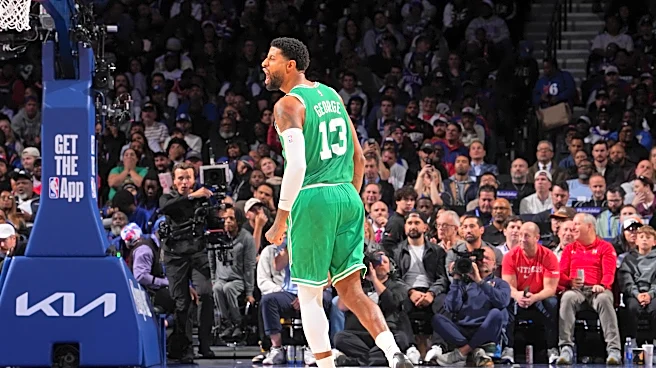
As someone who has covered dozens of Celtics playoff games, I can say the atmosphere felt heightened. The Celtics bench rose to its feet after nearly every play. Payton Pritchard and Paul George let out screams after back-to-back 3-pointers. Tatum jumped up emphatically and clenched his fist when Neemias Queta secured a putback over Joel Embiid.
The game pitted the East’s top two teams against each other, but more than anything, it was billed as a showdown between two former teammates turned foes. Brown struggled: he finished with a game-worst -27, four turnovers, four fouls, and a season-low 13 points. Tatum had the much better night, with 21 points, six rebounds, four assists, and two blocks, including a throwdown dunk on LeBron James that sent Hugo Gonzalez and the Celtics bench into a frenzy.
But ultimately, despite all the hype, neither player fittingly ended the night as the top performer on their team.
That morning, at Celtics shootaround, “Why Can’t We Be Friends?” blasted as players warmed up. Perhaps it was a coincidence, but the song was a fitting backdrop for the night and commotion ahead.
Why couldn’t they be friends?
Much of the reason the Tatum-Brown storyline has captivated the basketball world is that fans are so eager for players on their team to be friends.
Were they ever actually friends? Does it even matter?
A decade in the spotlight
For much of the past decade, the questions followed Tatum and Brown everywhere they went:
Do they actually like each other? Do they hang out? Do they secretly want the other one gone?
Every pregame dap-up and high-five seemed to prove they got along. Their (relatively) limited on-court synergy suggested otherwise. Every postgame answer about the other, and there were many, was scrutinized. Some left more room for interpretation than others, but hardly any felt completely satisfactory, at least not to the heaviest Brown-Tatum skeptics.
In 2024, when Brown won Eastern Conference Finals MVP and Finals MVP, all eyes were on Tatum’s reaction.
Was Tatum happy for Brown? Was he envious?
In the 2023 offseason, the duo made headlines with a joint, on-camera workout in Los Angeles, a rarity in their tenure. For those in the ‘Brown and Tatum are friends’ contingent, the moment felt like a victory lap. That contingent reached the mountaintop when the Celtics won the 2024 championship, and Brown earnestly credited Tatum in his Finals MVP speech.
“I share this with my brothers and my partner in crime, Jayson Tatum,” Brown said as confetti fell. “He was with me the whole way. So, we share this shit together.”
But even at that peak, Brown and Tatum were not particularly close friends, according to multiple sources. They were certainly in a better place than they were on Tuesday night; there’s no question about that.
But the notion that the two All-Stars were great friends was misguided.
So, for those who viewed the ice-cold exchange before tip-off felt like the punctuation mark on a public breakup, as the final act for body-language doctors and psychoanalysts to dissect — the reality is more complicated, more nuanced, and far less exciting, at least in my view.
NBA friendships differ sharply from the teammate friendships most of us know from middle and high school sports and other non-professional settings. NBA players have egos, money, and fame that are hard for the average person to relate to. They are surrounded by their own ‘camps’ – the people in their inner circle who look out for them and their careers, whether that’s family members, friends, personal trainers, podcast co-hosts, photographers, agents, or publicists.
Those are the people players, especially the highest-profile ones, often get closest to: people whose job, by definition, is to look out for their best interests. On Tuesday night, key members of both players’ camps were in Philadelphia, watching the two face off from the sidelines.
The incessant media coverage and fanfare are rooted in an assumption rarely challenged in sports coverage and discourse: that the guys on your team should be friends, that the best players should be particularly close, and that a championship comes as the end result when a group of talented people who love each other plays basketball together.
But the people who actually manage NBA locker rooms will tell you that’s not how it works, at least not the vast majority of the time.
“I’ll tell you right now, all 30 teams, it’s not Boy Scouts. We’re not all just sitting there getting along, and everyone’s happy-go-lucky,” Joe Mazzulla said before tip-off. “I mean, that’s just not how the world works… We’re going after something that’s highly competitive and stressful, and there’s things at stake, and with that comes conflict. Doesn’t mean it’s a bad thing; you work through things together.”
Mazzulla noted how much differing lifestyles play a role, too.
“You got people that are single, there are married, divorced, kids, no kids,” he said. “People have been traded four times; people haven’t been traded at all. You just have a plethora of experiences from on and off the court that you have to mix together into a group of guys, and you have to leave space for that.”
So, it’s important to note that Mazzulla and other NBA coaches are not striving to build a team of best friends, though those friendships do naturally blossom on occasion. Instead, he’s aiming to build a team that understands each other well enough to chase the same thing and set its issues aside for a common goal, a locker room filled with guys who respect one another, even if they don’t always see eye to eye.
“I think the one thing I’d like people to understand is this isn’t supposed to be summer camp where we all just get along all the time,” Mazzulla said. “There’s plenty of times within a great culture, good culture, where you have disagreements… That’s just a part of the competitive journey and going after greatness together.”
“How can we get to the point where we just go after greatness together, but at the same time appreciate each other’s life?”
76ers coach Nick Nurse put it more bluntly.
“The players usually understand, first and foremost, it’s a business, right?” Nurse said. “And almost no matter where they’re at in these relationships, these things can happen where they get separated because of the business aspect of it.”
Nurse suggested the friendships that fans picture belong to an earlier stage of sport.
“Obviously, you kind of hope sports bring a lifelong friendship in those kind of situations,” Nurse said. “I’m not sure that’s the case in professional nearly as much.”
NBA players describe the same gap from the inside; different family structures and lifestyles make genuine, long-term friendships rare.
“I think it’s just the stages of life,” former Celtics-turned-76ers center Tacko Fall told CelticsBlog. “When you are in high school, for example, you’re young, right? You don’t have a family to go back to and everything like that. As you get older, you become a professional. You have guys that have wives. You have guys that have kids.”
Payton Pritchard, who was teammates with Tatum and Brown for six seasons, added that managing egos plays a role, too.
“There’s a lot of egos in it, and people need an ego to get to the NBA. And so it’s definitely a balancing act,” Pritchard said. “Not to say that we’re not all buddies, but everybody’s got families. They’re trying to make it. They got things to prove, so it’s different.”
None of this means NBA friendships don’t exist – they certainly do.
Brown and Fall, now teammates in Philadelphia, have been very close since their days together in Boston, for example. Brown is the godfather of Fall’s youngest daughter, and the two often travel together in the offseason.
“Jaylen’s basically become family,” Fall said. “We started hanging out so much, and we’re just very similar in the way we are as people, in the way we think as well. And then, obviously, the more you hang out with someone, you kind of build those connections. Then our families kind of start to know each other even more, and that relationship just gets better and better.”
In Boston, it’s well-documented that Hugo Gonzalez and Baylor Scheierman have become fast friends.
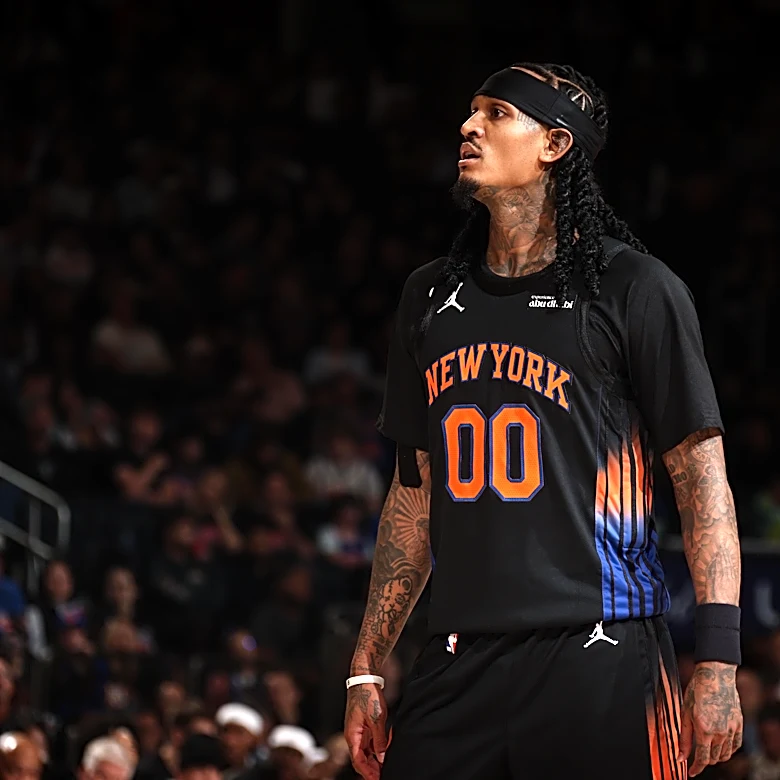
In New York, it’s well-known that Jalen Brunson, Josh Hart, and Mikal Bridges are close friends, though that friendship originated when they were teammates in college.
But those genuinely close off-court bonds are more of the exception than the norm. In my experience covering the team, players don’t hang out off the court nearly as much as fans think. The goal isn’t friendship; it’s professionalism, respect, and a willingness to set differences aside to win. It’s role acceptance. It’s discipline.
For the majority of their tenure, Tatum and Brown did that as well as any duo in this league.
“It’s working relationships,” Pritchard said. “Some people are closer than others, but find a way to win and keep going.”
Still, though real friendships aren’t all that common, camaraderie is crucial
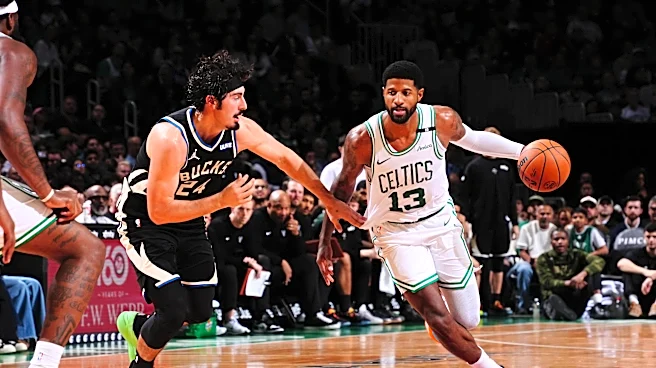
Paul George, fresh off a 36-point outing on Tuesday, said the most fun part of the Celtics season so far wasn’t going off against the team that traded him — it’s been the team bonding off the court.
“Sorry to give you the most cliché answer ever,” he said, “but the most fun is just the camaraderie, being around these guys, the locker room, the flights. That’s the most fun that I’ve had in a while. It’s just, again, a good group of guys out there competing together, and then it transfers on the court. You see how much fun we have off the court by how we play on the court.”
Pritchard echoed that sentiment, and credited Celtics president of basketball operations Brad Stevens for building a roster of guys who are easy to get along with.
“I just think it starts from the top, and got to give credit to Brad,” he said. “He picks really good people to be a part of it, and it’s not just about basketball. It’s the type of person they are. They’re hardworking. They’re good locker room guys and stuff like that. So we have a great group, and everybody enjoys being around each other. So that makes a difference. You want to see the next man win. We want to see PG kill. We want to see JT go off. It really matters. So everybody’s gonna have their nights, and we love to see it.”
And, Tatum’s enjoying the good vibes, too.
“We’ve really kind of bonded really, really well off the court, and I think it’s translated on the court,” he said. “We got a great group of guys, a bunch of funny individuals. It’s been cool.”
Maybe one day, Tatum and Brown will sit side-by-side on a podcast, years removed from their playing days, and talk about what went awry in their final act. Maybe one day, they’ll return to TD Garden for a marquee game as fans, just as members of the 2008 Celtics team have so many times.
Though their tenure as teammates has ended at long last, it feels inevitable that all eyes will be on their relationship moving forward, regardless.
Will they sit together?
Will they hug next time?
The scrutiny and questions will likely follow them forever.
But for now, it should be understood that what Brown and Tatum did for 9 seasons was co-work as well as almost any duo in modern basketball.
They played in a whopping 107 playoff games as teammates. They reached five Eastern Conference Finals and two NBA Finals.
Most importantly, they won it all, bringing the Larry O’Brien back to Boston for the first time in 16 years.
By the time Tuesday’s game ended, Tatum had already shifted his focus to Wednesday’s game against the Toronto Raptors.
“They all count as one,” Tatum said, as he has so many times in his years.
That was Tatum’s message to his team, too.
“Tonight in the locker room, he said it means nothing if we don’t play the way we need to play tomorrow,” Mazzulla said. “That’s just the nature of the business.”
And Jayson Tatum — and Jaylen Brown, for that matter — have both been very good at that business.