


Introduction
There are some real issues that arise when talking about relief pitching prospects, and I think it’s important we discuss them before actually highlighting the best 2026 seasons by relievers in the Diamondbacks farm system. If you’ve been around this game long enough, you’ll eventually hear a casual fan suggest a team fix their bullpen through the draft, or that they should use their first pick in a draft on some dominant college reliever.
Even in the weakest, shallowest of drafts, this is viewed
as a bad idea because you’re almost always going to be leaving better players on the board. The last time the Dbacks drafted a reliever with their first round pick was when they selected reliever Dan Schlereth with the 26th overall pick in the 2008 draft, while much more notable pitchers like Gerrit Cole, Jake Odorizzi, and Craig Kimbrel, and hitters like Dee Strange-Gordon and Charlie Blackmon were still on the board.
The list of successful early draft picks spent on amateur relief pitchers that then went on to become successful relievers in the Major Leagues is an incredibly short one, headlined by such notable names as Gregg Olson and Paul Shuey. This adds to the rarity of seeing a pitcher who is explicitly a reliever at the top of top prospect list unless they have overwhelming velocity. All of the dominant relievers you can think of are almost certainly a former starting pitcher who at some point in his professional career was converted to relief.
Aside from that, we have the real issue of how are we defining what does and does not count as a reliever?” If we exclude any pitchers who started a game, that leaves out pitchers who operated as openers but were no different in usage than any other relief pitcher. For the purposes of this article, I’m defining a reliever as a pitcher who did not start a game outside of being an opener, which would be a start with less than two innings pitched. If we just used examples of guys who are likely to be converted to relief or whom I think should be converted to relief we will be hear all day, so instead, we are going for the much more narrower definition. We are also going to exclude pitchers who have made their Major League debut, which would exclude Brandyn Garcia, who had a season just as worthy of being talked about, but this same rule applied for all the other All Star Prospects, so it still applies here.
With all that said, my 2026 D-backs Minor League Reliever of the year is…
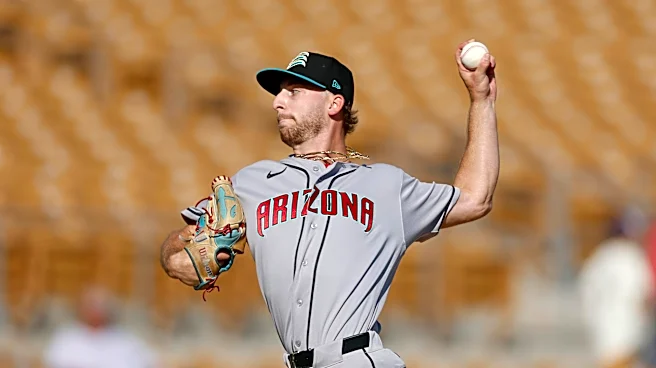
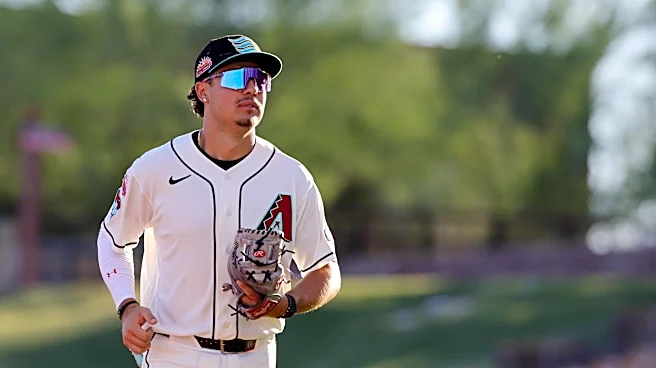
Joe Ariola, LHP
This might be a weird choice for the Dbacks Minor League reliever of the year. Joe Ariola didn’t pitch a ton of innings, just 34.2 innings total, and had just three innings in AA Amarillo before his regular season ended. With such a small sample size, I could understand why someone would feel that there are more deserving candidates.
Ariola has a quite a few reasons as to why I feel his accomplishments in 2026 are worth highlighting. For one, out of all pitchers with at least 30 IP, no pitcher across all the minor leagues struck out batters at a higher rate than Ariola’s 45.75% strikeout percentage, and only three pitchers had a higher strikeouts per nine innings (k/9) than Ariola’s 16.62 K/9. Amongst Dbacks pitchers with at least 30IP, his 2.34 FIP and 2.40 xFIP are the lowest amongst all pitchers, while his 1.54 ERA is the second lowest.
The real issue is the low inning total, which I think we can address by just going into the details of Ariola’s season. Ariola started his season by tossing two scoreless innings for Low A Visalia on April 5th. It was a very solid outing, he gave up just a hit and a walk while striking out three batters. Unfortunately, Ariola would hit the injured list the next day and he wouldn’t pitch again until July 4th, when he was activated for a three game rehab stint in the Arizona Complex League. Ariola was impressive in the first two games back, putting up two scoreless innings, while striking out a pair of batters in each, but walking a batter in the second game back. The third game Ariola struck out the side, but would give up a run on a pair of hits, which both came around to score after he had been taken out of the game with just an out. In his time in the complex Ariola struck out 53% of batters he faced while walking just 7.7% of batters he faced. He’d leave the complex with a 2.70 ERA, and the 1.60 FIP and a 2.05 xFIP show how he easily could have had even better numbers.
Ariola would be activated for Visalia and wouldn’t allow another run until the middle of August, after he’d been promoted and was already in his fourth outing with High A Hillsboro. Which gets us to his numbers in Low A Visalia, which are absurd. Six games, twelve scoreless innings, an ERA of zero, and a still very impressive 2.08 ERA and a 2.90 xFIP. He also struck 50% of batters he faced there, though his walk percentage ticked up a bit to 13%.
As far as his numbers in High-A Hillsboro, they weren’t quite as absurd, but they were still a very good. Across ten games, he’d pitch 16.1 innings pitched with a 2.76 ERA, a 2.93 FIP, and a 2.25 xFIP. Those numbers were impressive enough that it earned him a promotion to Double A Amarillo, for the last two games of the regular season. In the penultimate game of the season Ariola pitched two perfect innings, and would strike out three batters while working around a pair of hits in the season finale. Overall across all levels Ariola put up a 1.56 ERA and a 2.34 FIP and a 2.40 xFIP, though as a I said earlier, it is a small sample size of 34.2 innings.
That WASN’T the end of his season though. Ariola played a key role in Amarillo’s bullpen after that during their postseason run, tossing six scoreless innings across three games, allowing just a hit and three walks while striking out nine batters. Ariola currently has a zero ERA in AA regardless of including their postseason.
He was then sent to the Arizona Fall League, and in six games so far playing for the Salt River Rafters in the Arizona Fall League, Ariola has given up a just a pair of runs on six hits, while walking none and striking out eight. Despite the lack of walks his control wasn’t exactly perfect as he did hit a batter and uncorked a pair of wild pitches. Since he’s a reliever, the fact that he’s earned at least a hold in each one of his appearances makes the pair of runs completely forgivable, especially pitching this late in the year.(Don’t mind the fact that these are the first runs he’s allowed to score in a month.) If we’re including the extra 12 innings from Amarillo’s postseason and the Arizona Fall League, his stats just get better, and that puts him at a more reasonable innings total for a relief prospect. No I will not be calculating FIP and xFIP
Over on Fangraphs.com, Eric Longenhagen recently had this to sayabout Ariola:
Ariola looks like a standard middle reliever who could be ready fast.. has a riding 93-94 mph fastball and hammer curveball, pretty standard lefty fare in the Caleb Thielbar mold.
Not the most thrilling of endorsements, but considering the complete lack of a solid LHP relievers in the Dbacks bullpen in recent years, I’ll take it.
Honorable Mentions
I actually have two pitchers that I think are worth mentioning, as they also were well above average throughout their seasons and dominated multiple levels of the minor leagues.
Sandro Santana would be a very strong contender for reliever of the year, but unfortunately he was traded at the deadline in the Nootbaar trade. In 64 innings split between the Dbacks and Cardinals organization between High A and AAA, he put up a 1.97 ERA with a 2.68 FIP and 2.90 xFIP.
For a player actually still in the organization, I think the next best candidate is Luke Dotson. Dotson pitched 45 innings split between Low A Visalia (12.2 IP) and High-A Hillsboro, putting up a 3.00 ERA with a 3.01 FIP and 3.52 xFIP.
Conclusion
I think between Ariola’s rapid ascent and domination of multiple levels of the minor leagues from Low A to AA Amarillo, while also having to overcome the adversity of a three month IL stint, and then continued performance after the regular season ended makes him the obvious pick for reliever of the year. Do you agree or disagree? Is there some other reliever you think should be the Diamondbacks Minor League Reliever of the year? Who else stood out to you in the D-backs farm system this season? Let me know in the comments!