
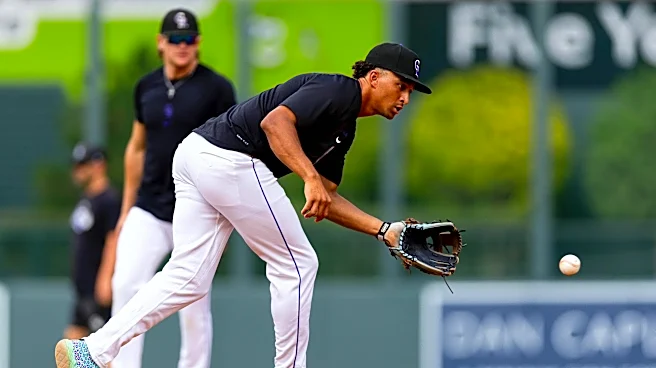

Fifteen months ago, with the 2025 Orioles in the midst of a lost season, Mike Elias put a metaphorical Clearance Sale sign on the O’s roster. Everything that wasn’t nailed down was up for grabs, and in the span of a week, Elias made seven trades that jettisoned eight players from the major league squad, including Cedric Mullins, Ryan O’Hearn, and nearly half the bullpen. In return, 14 newcomers joined the Orioles’ organization.
One notable fact about those 14: not a single one of them was a major
league player. Even with the trades creating a litany of holes in the Orioles’ active roster, the O’s didn’t acquire anyone who would immediately fill those slots. For Birds fans anxious to get their first look at the return haul from the fire sale, they’d have to wait a while longer.
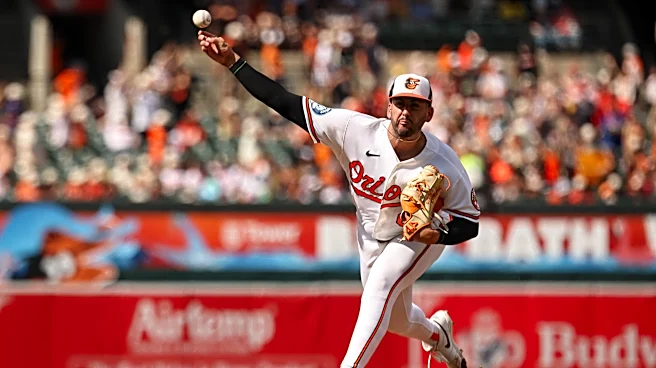
Enter Anthony Nunez. The rookie right-hander, acquired from the Mets in the Mullins deal, was the first of that 2025 prospect bonanza to arrive in the bigs after earning a surprise inclusion on this year’s Opening Day roster. And by the time the season ended, he’d become one of the Orioles’ most-used arms out of the bullpen, with his 52 appearances ranking fifth on the team.
Nunez’s path to the majors was circuitous, to say the least. A standout shortstop at Miami Springs HS, Nunez was drafted by the Padres in the 29th round in 2019, but was released two years later after topping out in Low-A. He took advantage of an NCAA rule that allowed former high school signees to return to college as long as it wasn’t with a Division I school, joining Division II University of Tampa in 2022.
With the Spartans, Nunez became a two-way player, taking the mound for the first time in 2024 and striking out 20 batters in 11.2 innings. With his arm clearly much more intriguing than his bat, Nunez landed a minor league deal with the Mets as a full-time pitcher, where he flew through the minors and reached Double-A Binghamton in 2025.
At the time the O’s acquired him for Mullins — along with fellow righties Raimon Gomez and Chandler Marsh — Nunez was laying waste to minor league hitters. He had a 0.80 WHIP, a 40% strikeout rate, and batters were hitting just .119 against him. The O’s immediately promoted him to Triple-A Norfolk, where Nunez had a bit of a ruder greeting, posting a 4.85 ERA and allowing 18 baserunners in 13 innings. He still racked up 21 strikeouts.
FanGraphs in particular loved Nunez, ranking him as the Orioles’ sixth-best prospect in May, ahead of Ike Irish, Nate George, and Joseph Dzierwa, among others. Eric Longenhagen and Brendan Gawlowski pegged him as “a premium reliever with three plus or better pitches and uncommon strike-throwing consistency,” and also suggested that he could eventually be stretched out as a starter. They praised Nunez’s fastball, changeup, and a slider that they called “an elite swing-and-miss pitch.”
It seemed certain that Nunez would make his MLB debut this season, but it happened sooner than most expected. His impressive spring training — five scoreless innings, with no walks and six strikeouts — earned him an Opening Day roster spot, even though he’d been optioned to minor league camp weeks earlier.
Nunez dazzled in his major league debut March 28, throwing two perfect innings in mop-up work against the Twins, and soon he worked his way into high-leverage roles, earning holds in three consecutive appearances in early April. After his first dozen games, Nunez was rocking a 1.35 ERA and 16 strikeouts, looking like a great find for the Birds’ bullpen.
But baseball is a game of adjustments, and hitters adjusted to Nunez. Just one month later, at the end of May, Nunez’s ERA had ballooned to 5.67. He suffered six outings in which he allowed multiple runs, including a four-run blowup in Tampa Bay on May 20 when he turned a 3-1 Orioles eighth-inning lead into a discouraging 5-3 loss.
In June, when closer Ryan Helsley returned from the injured list, Nunez lost his roster spot. The O’s optioned him to the minors, and he spent most of the rest of the year riding the shuttle between Norfolk and Baltimore. He spent the majority of September in the Orioles’ bullpen, and ultimately finished the season with a 4.07 ERA (and an exactly league-average 100 ERA+) in 52 games. He struck out 10 batters per nine innings, and he did a good job of keeping the ball in the park, with a 0.8 HR/9 rate. His walk rate was a bit high (3.9 BB/9) but not disastrously so.
The results may not have been overly impressive, but there was a lot to like about Nunez’s repertoire. His offspeed arsenal was especially sharp. The slider that the FanGraphs duo crowed about (which is classified in Baseball Savant as a sweeper) was Nunez’s most-used pitch. He generated a 45.8 whiff percentage with it, holding batters to a paltry .147 average and .200 SLG. His changeup was also elite (.102 AVG, .163 SLG), as was a cutter that he threw only 6% of the time (.125 AVG, .313 SLG).
Where Nunez struggled was with his fastball, which averaged a strong 96.1 mph but didn’t have enough movement to keep hitters off balance. Batters pounded his four-seamer for a .316 average and .561 slugging, and his sinker was simply non-competitive, surrendering a .458 AVG and .667 SLG. He’ll need to do some work on his heater this offseason so that opponents can’t just start sitting on his offspeed stuff.
Nunez’s 2026 performance had its ups and downs, but he showed promise as a 25-year-old getting his first introduction to the majors. It’s not out of the question that the Orioles could try to convert him into a starter, though as yet they haven’t announced any such plans. Even if not, Nunez should have a leg up for a spot in next year’s bullpen.
Not too shabby for a guy who was an infielder two years ago.