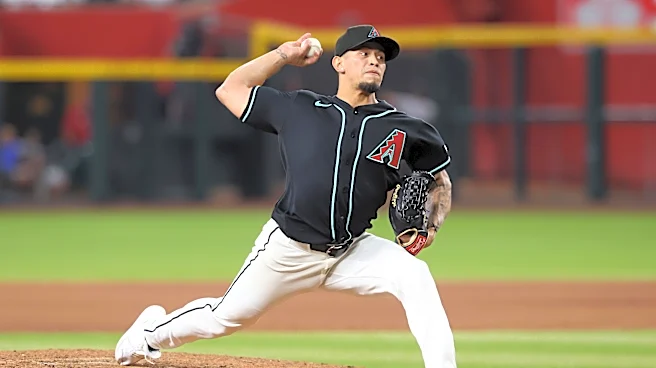


In his final game of 2026, Ketel Marte passed Luis Gonzalez as the all-time Diamondbacks leader for games played, appearing in his 1,195th regular season contest for Arizona. He is now ranked top three in most offensive counting stats, alongside Gonzalez and Paul Goldschmidt. There are still four seasons left on the contract extension which Marte signed in April 2025. But there is a very real possibility that Ketel has played his final game for the D-backs. Indications are that the team is now looking
to trade him, the second baseman having apparently worn out his welcome in Arizona, barely eighteen months after signing that six-year extension.
We recently discussed the rumors about a potential Marte trade. At the time of writing, the Baltimore Orioles and the Toronto Blue Jays are the teams who have been most frequently mentioned as a landing spot in any trade. Though with his long-term status on the Diamondbacks, Ketel now has the full ability to decline any move, a situation which complicates the process considerably. But will the team pull the trigger? And should they, especially if the return is not one they consider appropriate for a player of Marte’s undeniable talents. We are, after all, barely a year removed from Ketel winning the Silver Slugger and being mentioned on MVP ballots.
However, Mrs. SnakePit would likely point to Marte’s performance since the contract extension as further evidence for her theory that giving large, long-term contact extensions to players is frequently a mistake. [She still hasn’t forgiven Eric Byrnes, and considers fellow Cuban Yasmany Tomas a disgrace to the entire nation] When he signed the deal, Marte was coming off a year where he finished third in the NL MVP voting, and deservedly so, since he put up 6.8 bWAR. But that is basically his total production over the two seasons since then, with a pair of sharp drops, first to 4.4 bWAR and then all the way down to 2.5 bWAR.
That’s a troubling trend. One year might be a blip, but consecutive declines of around two wins is a concern. It’s also worth noting, Marte recently turned 33. At this point, we should be expecting a decline of about half a win per season, due to the aging curve. If you’re starting in the 6-7 win range, as Marte was when the six-year extension was signed, that’s bearable. He’d still be worth 3-4 WAR by the end of the contract. But the plummet of the past two years changes the maths entirely. If we use 2.5 WAR as the baseline, by the time he’s a free-agent, he’ll barely be better than replacement level, while earning $22 million or more (depending on incentives) in 2030.
It isn’t the kind of deal which any team is going to want. But there is evidence to suggest there were reasons for the slump in production – and not ones related to Ketel sitting in a Boston hotel-room. Steamer currently has Marte projected to bounce back and be worth 3.8 fWAR. It’s mostly because his Baseball Savant page is still heavily red-tinged. Metrics like average exit velocity and launch angle were not enormously changed from his fairly successful 2025 campaign. This leads to an expected batting average of .280 (actual value = .249) and slugging percentage of .461 (actual value = .432). So both numbers were about thirty points below what you’d expect, based on his peripheral numbers.
There is therefore a case to be made that trading Marte now would very much be selling at the lowest point possible, with everything working against a good return. While Ketel may be able to veto any potential trade, it’s also the case that the D-backs don’t have to trade him. I can imagine a scenario where Mike Hazen sits down with Marte and says, “Look, you don’t want to be here. But play well in 2027, keep your nose clean, and the range of possible destinations next winter will become much better.” As well as, from Hazen’s perspective, the returns could improve too – albeit considering there will be one less year of control – and a relatively cheap one, at that.
Another complicating factor is the looming lockout due to the expiration of the current CBA between the players and owners. We’re now less than two weeks out from that, and I have not seen much evidence of the expected rush of free-agent signings, before the expiration brings all such contract decisions to a grinding halt. I think teams might be viewing Marte as a fall-back option, if their pursuit of the top free agents is unsuccessful. There are names like Brandon Lowe, Luis Arraez and Jazz Chishom still available, all in the top twenty of MLB Trade Rumor’s Free Agent Rankings. The team might have to wait for some all of them to come off the market.
That’s a problem for the Diamondbacks, because they would really like to use the money saved in a Marte trade, towards their own free-agent needs, including starting pitching and right-handed power. Again, it’s a balance between how eager the D-backs’ front office are to trade Marte, and what they want to get in exchange. A rushed sale, before the lockout kicks in, is inevitably going to reduce the return, because there will likely be potentially interested teams with other irons in the fire. And we don’t know how much Marte wants to move. As noted, if he doesn’t want to move, he will be playing with Arizona through 2030, no matter what Reddit and Twitter think.
That’s a sobering remind that, as is always the case, there is a great deal we on the outside simply don’t know. Oh, we all have thoughts and opinions, such as in regard to Marte’s value to the club, or to other teams. But intellectual humility – or Socratic ignorance, if you prefer – needs very much to be the name of the game, when it comes to analyzing the situation and making pronouncements on what the team “should” do. In the absence of so much information, I tend to defer to those who are better-informed, and trust in their judgment. At least, until proven otherwise.