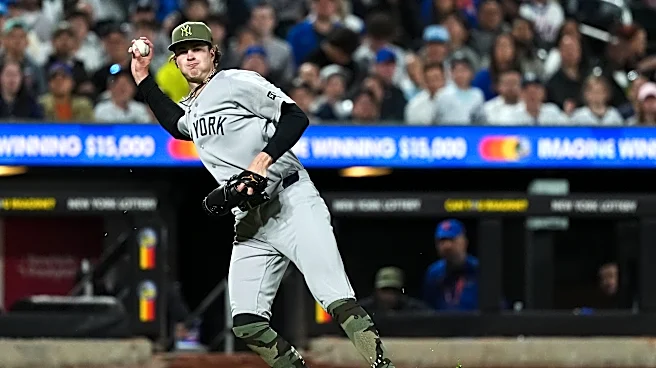





Ryan McMahon’s stat line still does not look impressive. Entering June, the Yankees infielder is still hitting just .207 on the season. However, if you dive a little deeper, McMahon appears to be adjusting his approach and has found more, albeit still limited, success doing so.
The most obvious evidence of improvement shows up in the most traditional statistic, batting average. After hitting a lowly .167 in March and April, McMahon raised that mark to .244 in May. Additionally, during this stretch
he also saw his OPS, a stat the Yankees often emphasize, increase by 130 points to .711 for the month.
In March and April, McMahon looked like a hitter trying to do too much. Nearly half of the balls he put in play were worm burners pulled to the right side of the infield or shot up the middle to a fielder standing behind second base. Hitting the ball hard is not the issue. McMahon ranks in the 86th percentile in hard-hit rate and around the 65th percentile in both average exit velocity and barrel rate. Even if you hit the ball hard, the easiest way to tank your offensive numbers is to strike out and hit ground balls into the shift. McMahon was doing both in spades.
However, May looked different. McMahon’s groundball rate dropped from 50 percent to 35.8 percent while his fly-ball rate rose 15 percentage points. Just as important, he began using the entire field. McMahon’s opposite-field rate more than doubled, climbing from 17.8 percent to 38.9 percent, a figure much more in line with his career norms.
The change becomes even more interesting when looking at the quality of contact. During March and April, 31.1 percent of McMahon’s balls in play were classified as hard hit. In May, that figure climbed to 37 percent. The most important number, though, is the strikeout rate, which he managed to cut down by roughly two percentage points.
These changes might not feel significant, but baseball is a game of inches. Within those margins, it is also worth noting that McMahon’s soft-contact rate increased from 2.2 percent to 25.9 percent. At first glance that might seem like a negative, but it might reflect a hitter becoming less concerned with squaring up or pulling everything and more focused on simply putting the ball in play. As countless coaches have preached over the years, you do not always have to hit the ball hard if you hit it where the defense is not.
These changes in contact resulted in a .244/.263/.449 slash line for the month. That’s not a typo — McMahon only walked twice the entire month but was still able to get his stat line from deplorable to decent. The irony is that the numbers turnaround happened during a month that included one of the worst stretches of McMahon’s career. At one point in May, McMahon went hitless in 24 consecutive at-bats.
Despite this stretch, McMahon’s production for May placed him right at league average at the plate with four home runs to his name. In addition, McMahon has been solid in important spots. With runners in scoring position, McMahon owns a .270 batting average, .774 OPS, and 120 wRC+. He has also produced in high leverage situations, slashing .250/.357/.500.
Looking at his career monthly splits, McMahon has often performed better once the calendar turns to May. Across his career, he owns a .231 batting average in March and April before improving to .257 in May, .242 in June, and .261 in July. Let’s be clear: I am not calling this a breakout performance. What I am saying is that if history is any guide, May was a return to form for McMahon.
The second half of the season has often been a different story. McMahon’s career batting average falls to .227 after the All-Star break and drops further to .212 during September and October. Whether that trend is physical, mental, or simply the result of a long season is difficult to know. It is also fair to wonder whether spending his career on Rockies teams that were often out of contention by the time summer arrived may have played some role.
During last year’s playoffs the Yankees saw a glimpse of the player they hoped they were acquiring. Across six playoff games, McMahon hit .286 with a home run, continued to provide strong defense, and while not fast, was a strong baserunner. While that is a small sample size, it reinforced the idea that he can be a useful contributor especially when it matters most.
Before the season, Aaron Boone said it was the coaching staff’s responsibility to help unlock McMahon’s offensive potential. Boone maintained that belief through a brutal start and that painful 0-for-24 skid in May. In mid-April, the manager suggested some of the changes the Yankees had been working on were beginning to take hold. Looking at McMahon’s batted-ball profile now, it is becoming easier to see what Boone and the coaching staff believed they were building toward.
Call me an optimist, but I believe there is a reason eight of his 10 extra-base hits have been oppo-tacos and the strikeout rate decreased. I believe that reason is the adjustment the staff is making to McMahon’s approach. For a player whose primary value is defense, hitting at a league-average level with a 20-home run pace is a solid contribution.
McMahon is not a great hitter, but he is an average one and a good baseball player. The cold streaks are almost unbelievably bad, which is why they tend to dominate the conversation. However, according to the law of averages, most nights McMahon does enough to help you win and, just as importantly, does enough to avoid costing you a game.
Like an old vehicle, McMahon’s offensive engine appears to cough, sputter, and require constant tinkering to run smoothly. The challenge for Yankees fans is remembering that the highs and lows are part of the same player. McMahon will never be the lineup’s biggest engine, but he remains a useful contributor when the bats around him help provide a spark and get him in a position to keep the lineup rolling.