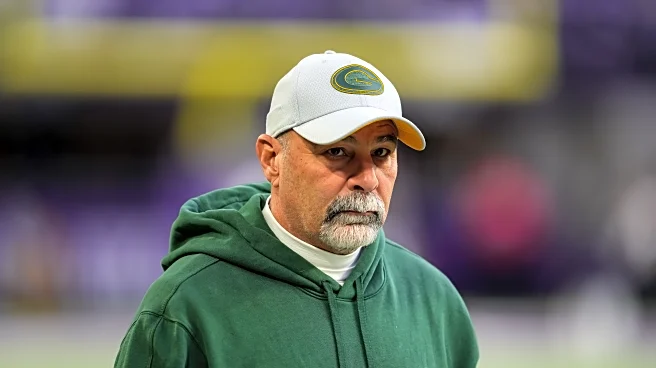



Since we’re all waiting on the news about Green Bay Packers head coach Matt LaFleur and whether he and the team can find a number that makes sense on an extension, I thought I’d make myself useful, take a break from the scrolling and talk about another member of the coaching staff. No, this time it’s not about the inexperienced true assistant pool. In this piece, I want to focus on veteran special teams coordinator Rich Bisaccia, who has 20 years of non-Packers on-field NFL experience, compared to just
27 years for the rest of the coordinators/assistants on the team combined.
Here, I want to talk about what Bisaccia is or isn’t, to better explain his role on the team. Things get funky when you group up special teams as one collective unit instead of six different phases (kickoff, kickoff return, punt, punt return, field goal and field goal rush), which really tells the story of why the Packers (and members of other organizations around the league) think he’s doing well in Green Bay.
If you don’t believe me, former Packers player John Kuhn, who still lives in the area and works in media covering the team, spoke on how “everyone in that building believes in Rich Bisaccia” this week. Former Raiders general manager Mike Mayock, in an ESPN article covering the pitfalls of Pete Carroll’s one season with Las Vegas, said the following: “Had the Raiders kept Bisaccia after the 2021 season, they would be competing for divisional titles, not for the 1st pick in the draft.”
I know you’re bombarded with DVOA numbers about how the team ranked 21st in the NFL on special teams this year, but the real devil is in the details here. When you examine the splits by their six phases and the type of support the team provides to these phases through roster spots, the picture becomes clearer about what Bisaccia is or isn’t, as well as what the Packers expect or don’t expect out of special teams.
The return game
Let’s start off with the bad. The Packers do not care about the return game, and I don’t think they will as long as they’re a draft and develop program (and there’s not an appetite to change that in the building based on what I’ve been told). In kick returns, they finished 17th in DVOA in 2025, while being just 28th in punt returns.
Why do I say that they do not care to be good here? Because they do not invest here. While they weren’t bad with Savion Williams at kick returner this season, they certainly put no effort forward toward finding a punt returner (and haven’t in years). Having a punt return body on the roster is going to be difficult in the Matt LaFleur era, where his average receiver is around 208 pounds, and the NFL average punt returner is 5’9”, 183 pounds. I wrote about this back in August.
There are a couple of things to unpack here. First of all, why is that on LaFleur? There are some aspects of the front office (we’ll get into them) that absolutely limit the upside of the special teams unit (in exchange for other benefits), but as I’ve written about before, I’ve been told by a former Packers coach (who worked under both LaFleur and general manager Brian Gutekunst) that Gutekunst very much takes into consideration the feedback that the coaching staff gives him during the evaluation process.
There’s certainly a limit to this. Gutekunst isn’t just going to let the coaches pick the groceries, but he’s also not going to bring home chicken if the coaches are planning on making a steak dinner, either. That’s why it’s my belief that the growing size of the offense (seen at receiver, the offensive line and even running back) is a preference for the coaching staff (the size on the offense changed when LaFleur got here, specifically, not when Gutekunst got the GM job).
To LaFleur, a receiver the size of the average NFL punt returner is basically a slot-only type of player in his offense. We know this because it’s the role Jayden Reed has been limited to during his entire NFL career. Again, we’ve been writing about this for years.
It’s not like Matthew Golden is a particularly large receiver, either, at 5’11” and 191 pounds, so for Green Bay to have a return specialist receiver (they’re almost always receivers) come in and help on punts, the team would allocate a third spot on the 53-man roster (and 48-man gameday roster) to a receiver that LaFleur probably doesn’t want to play outside receiver. (This is probably why Golden got a chance, and failed, as a punt returner this regular season, despite never having done it before in preseason action or at the college level.)
This is a non-starter, before you even include the fact that the team likes to use bottom-end roster spots for their draft and developmental program. It’s not uncommon for Green Bay to draft a year or two ahead of time, at a rate that is rare at the NFL level. Over the last 20-plus years, their first-round picks have only averaged six starts per season.
So if they aren’t gonna use the roster spot on a punt returner, especially when it doesn’t fit with what LaFleur wants to do on offense, don’t even start asking questions about the 10 players who are supposed to be blocking for that returner.
But the team sees this as a market inefficiency. That lack of caring for the return game, from a roster spots perspective, is also one reason why they can look forward from a roster construction standpoint and do things like not worry about receiver Romeo Doubs or left tackle Rasheed Walker leaving in free agency this year, because they drafted Golden and Jordan Morgan years prior. And they’ll be getting compensatory picks for Doubs and Walker hitting the market and signing with other teams, too. Fewer special teams spots (returner or not) means more spots for draft and development players, who they hope become 17-game starters on offense or defense down the line.
If you want another example of “the team doesn’t care about the return game, at least in the regular season,” look at who they had returning kicks in the playoffs. It was Keisean Nixon, a two-time All-Pro at the position, and Josh Jacobs, their starting running back (if you want to think about the average NFL returner, punts are for smaller receivers and kicks are for running back types, if that makes sense.) They had zero combined kick returns in the regular season.
Nixon and Jacobs have been practicing with the kick return unit since training camp. They were out there with the returners in the summer, in front of the fans who were in attendance. Several times throughout the year, Bisaccia and LaFleur mentioned that Nixon had been working with the kick return unit every week of the regular season…but we never saw it on gameday…until the playoffs.
Against the Bears, the combo of Nixon and Jacobs took returns out to the 26, 28, 31, 37 and 46 (average of 33.6, which would have been the best average starting field position in the NFL this season). They sacrifice their best options to give players a breather (at least in the regular season) in the two return phases. They snapped into caring for the postseason and postseason only at kick returns, because they at least had internal bodies to play the position, but they don’t have that internal option on punts.
Here was a LaFleur quote this week about Jacobs returning kicks:
Again, trying to put your best players in a position to go out there and impact the game. He came up to me, I want to say it was on Thursday, he’s like, “You’re not going to let me return?” Because when Rich brought that to me, I was like, “I don’t feel good about that.” But when he said that to me, I’m like, “Do you really want to return?” He’s like, “Heck yeah, I do,” so it was one of those deals that we were going to save until later in the game, crunch time when we needed it.
Believe them when they tell you their priorities.
Punt and kickoff coverage
This is where Green Bay actually cares about special teams, and it might be what Packers fans care about least on special teams. The team’s punt DVOA was seventh this year and their kickoff DVOA was ninth this year. Per DVOA, the only team better in both coverage units than the Packers in 2025 was the Washington Commanders. Collectively, according to DVOA, their coverage units were worth about 10.7 points over the regular season, which ranked eighth overall in the NFL and was within two points of every team but the Commanders, Seattle Seahawks and New York Jets.
They try here and are good here.
They actually allocate a roster spot to the position, often using their fifth linebacker job on a special-teams-only player. This year, that job went to Nick Niemann and Kristian Welch (when Niemann was injured). Nieman and Welch played 2 snaps of defense in the regular season and 201 snaps of special teams. Niemann’s first snap of defense all year came on a two-point play out of goal-line defense, with four linebackers on the field, and it took an Edgerrin Cooper injury for him to see action out there.
That fifth linebacker spot is the only special-team-only roster spot consistently taken up on the 53-man roster. There are times when other special-teams-only players are up (like safety Dallin Leavitt in the past or currently defensive end Arron Mosby), but it’s usually not a 17-week thing. For example, Mosby wasn’t brought up to the 53-man roster until Week 10. (People are going to scream about Bo Melton and Zayne Anderson here, but the team also likes them on offensive or defensive positions, which means that carrying them on the 48-man gameday roster actually costs the Packers nothing, unlike a Niemann, Welch, Leavitt or Mosby. Remember, Anderson is ahead of Kitan Oladapo on the safety depth chart. Leavitt and Anderson are different types of players.)
In the playoffs, the Packers’ kickoff unit, which has played well all year, did well. Running back Chris Brooks, a core special teamer and blocking back on offense, even sniffed out the opening kickoff, which was a fake end-around. They looked prepared all season.
The same could be said about the Packers’ punt unit…until the Bears game. With Melton and Anderson going on the injured reserve just before the playoffs, Green Bay was down to their backup gunners on the punt unit. There were several mistakes made by the backup gunners, which led to Chicago popping two not-long-but-not-insignificant returns in the punt game.
Terrible timing in a big spot for a unit that played well through the season. If I didn’t have the numbers to back it, it’d be hard to convince Packers fans that they were actually solid in these two phases this year. In press conferences this year, LaFleur admitted that the team mostly cares about the punt unit in the week of preparation for games.
Believe them when they tell you their priorities.
Field goal
This is the third phase of the six special teams phases that the team cares about. This year was chaos, and it’s really hard to evaluate because of the quad injury of kicker Brandon McManus. Basically, when McManus has been healthy the past two seasons, and didn’t have a kick blocked, he has been 41 of 43 in the regular season.
Now, that’s a pretty big asterisk, because there was a terrible stretch in the middle of the year, where it looked like McManus was actively playing through an injury, and he was still missing practices throughout the week. I don’t think the injury should let everyone off the hook. Personally, I think you can lay the blame on almost anyone for that stretch where McManus played injured:
- HC Matt LaFleur and SPT Rich Bisaccia: Why did you let your kicker play when you know he was banged up?
- K Brandon McManus: You just signed a three-year deal and didn’t have a job security issue. Why did you push to play less than 100 percent after your injury replacement hit a record-breaking kick? (This is your reminder that Lucas Havrisik missed two PATs in his next showing, which really calmed down the outside noise about replacing McManus for Havrisik).
- GM Brian Gutekunst: If the staff wasn’t convinced in Havrisik when McManus was hurt, the only justification that might have a leg for the coaching staff, then why wasn’t there more of an effort made to find a different kicker?
This, to me, was the biggest special teams mistake of the season, not McManus missing kicks in Chicago or the backup gunners playing poorly against the Bears. McManus playing through the quad injury seems like a complete system failure from the front office to the coaching staff to the player level.
The Packers also had two blocked kicks at the beginning of the season, which were under very different circumstances. The first one was a clean block against the Cleveland Browns in Week 3. The blocked field goal gave Cleveland a short field to try to avoid overtime, gained the necessary 16 yards and hit a game-winning field goal as time expired. Not. Good.
The second one needs some nuance. First of all, Green Bay went into the Week 4 game against the Dallas Cowboys down THREE of their offensive linemen (Zach Tom, Aaron Banks and Anthony Belton — with Travis Glover, who probably would have made this year’s 53-man roster, on the injured reserve), the players who make up most of their field goal protection unit. Because the team wanted to give a breather to center Elgton Jenkins (likely a Lafleur, not Bisaccia decision), the Packers trotted out Brant Banks, either the team’s 12th or 13th offensive lineman in the pecking order, for field goal protection while Jenkins and THREE injured Packers offensive linemen watched from the sideline.
The kick was blocked. Green Bay played Jenkins on protection, instead of the guy who was a practice-squad call-up that week, for the rest of the game. The team played every single starting offensive lineman available in games on field goal protection — even in their Week 18 game against the Minnesota Vikings, when the starters sat — for the remainder of the 2025 season. Yes, on that last-second field goal (following a timeout), their only kick attempt in the game against Minnesota, is where players like Rasheed Walker, Aaron Banks and Sean Rhyan made their first appearances of the game.
Their care level to use starting bodies on the field goal protection unit went from a 0 to a 10 after that blocked kick in Dallas.
Field goal rush
This is the final of the six units of special teams, and another “The team does not care” unit. For the most part, the Packers’ defense plays a version of defense stay (basically just normal defensive personnel) and field goal safe (preparing for a fake instead of sending an all-out rush). They’re not really trying to get after it.
Usually, the field goal block specialists at this level are defensive linemen. You want someone to block kicks? Find yourself a 6’8” Calais Campbell (10 career blocks). There’s one available in the next draft in Mississippi’s Zxavian Harris, who tied the SEC record with six career blocked kicks in 2025. The Packers have never really shown interest in these extremely long types of linemen.
If it’s not an extremely long defensive lineman blocking kicks, it’s usually a freak pass-rusher who ends up getting home. For example, Julius Peppers had 13 blocked kicks and extra points in his NFL career. Even when the Packers do keep their base defense on the grass for field goal rush, they specifically take off Micah Parsons (0 special teams snaps in 2025) and Rashan Gary (8).
This is a breather opportunity for the majority of the defense. The rushers on the line are backups who are non-block specialists. The non-rushers are, for the most part, just covering for a fake.
So what is Bisaccia?
To the Packers, Bisaccia is probably an experiment to limit test their roster structure. Over more than two decades, they’ve been dead last in special teams, which was the perceived price of doing business for leaning so hard into the draft and develop philosophy.
Because they hadn’t invested roster spots for their non-kicking battery special teams units, they sort of shrugged their shoulders and said, “Why pay for a veteran special teams coordinator, either?” for the better part of 2005 and on. That’s why they low-balled Darren Rizzi when trying to make Matt LaFleur’s first staff and hired a cheaper Sean Mennenga, whose only prior special teams coordinator experience before joining the Packers was one year with a losing Vanderbilt Commodores team that played under very different special teams rules at the college football level. When Mennenga was fired, the team internally promoted Maurice Drayton, a Mennenga assistant, to the main job.
When that also failed, the Packers changed their approach. They didn’t start investing in special teams players, for the most part, but they were willing to get someone who knew what he was doing to lead the special teams unit, so that they at least got a feel for what could improve within the roster limitations that came with the draft and develop structure. Bisaccia is here to teach them what they knew they didn’t know.
Since then, a couple of lessons were learned:
- The team has to play its linebackers and safeties on the kickoff unit, even if they have to put Xavier McKinney on the field, to be good there.
- Using the fifth linebacker spot for a true difference-making special-teams-only player (the only one who isn’t a member of the kicking battery who is consistently on the 53-man roster) went a long way toward helping virtually all non-field goal units on special teams.
- They have to use the starting linemen on the field goal unit, especially if the line depth gets so bad that special teams-types are backfilling those seventh and eighth offensive line spots on gamedays.
If you do that, the team can be pretty good on punt, kickoff and field goal units (barring kicker chaos) with little to no actual roster investment. That has been true throughout Bisaccia’s time in Green Bay, and the track record proves that. The team is still tapped out on kickoff return, punt return and field goal rush, as they clearly don’t feel the need to invest in players for those roles.
That, in a nutshell, is why there’s still a lot of respect for what Bisaccia has done in Green Bay (both in the building and with other organizations). The three units that the Packers have supported have been successful (again, outside of moments of chaos on the field goal team) while the three that the team doesn’t really try to be good at (in any way that would cost a true roster spot, anyway) are still poor.
Be it Bisaccia or someone else coaching the special teams in 2026, this is probably what Green Bay’s kicking game units will look like moving forward. If the Packers need a sacrificial lamb, Bisaccia is certainly one who will make Green Bay fans happy. His replacement would probably be cheaper (over time), even if the team has to pay Bisaccia out the remainder of his contract (sans a forced retirement situation).
What I wouldn’t expect, though, is for the Packers to all of a sudden start caring about the return game or field goal rush out of bleu after decades of preserving roster spots for the development of potential future starters that the roster currently doesn’t demand (like Golden at receiver this year or Morgan at tackle the last two years). They’ve learned that they can be good at kickoff, punt and field goal, even if they have to play some starters, without sacrificing more than one roster spot on a special-team-only player consistently. They seem pretty happy with that. Investments into those three other units are probably where conflict between the front office and their roster plans would start to actually become an issue, and I don’t see that changing in the near future.
(I’m still pissed about McManus playing through injury, and if you want to blame any one of LaFleur, Gutekunst, Bisaccia or McManus for it, by all means be my guest.)