

What I’m about to tell you might blow your mind. Hell, it might’ve blown my mind if I told myself this yesterday.
The Knicks are currently facing a roster dilemma. They have 13 players on standard contracts, two below the maximum and one below the minimum.
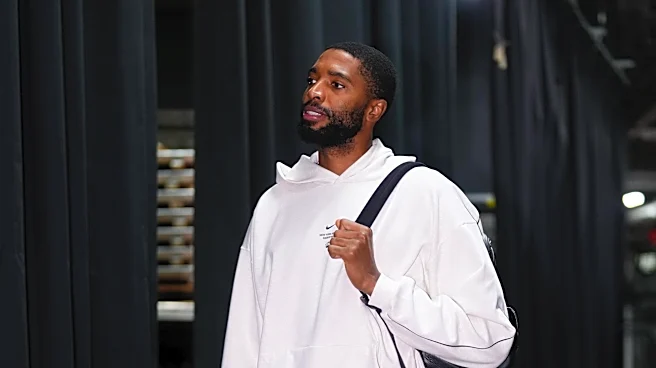
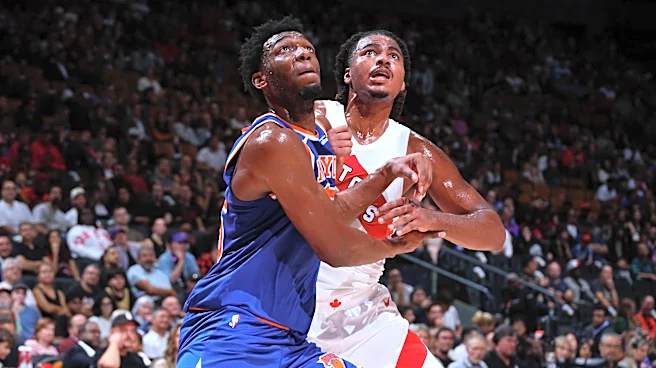
They have two veterans on Exhibit 10 contracts that they want to roster, Bruce Brown and James Wiseman, but they can only roster one and stay beneath the second apron, something that James Dolan has made clear is a hard cap for the team.
Brown and
Wiseman are different players and represent different things. They rose from a ragtag group of veterans fighting for that 14th roster spot, so much so that the Knicks are doing everything they can to keep both. It’s a dilemma we saw last year with Malcolm Brogdon and Landry Shamet before the former retired to make the decision easy.
Wiseman is considered the heavy favorite, to the point where Ian Begley called him a lock. At that point, it would be about trying to find a spot for Brown in a tough environment.
To keep both and stay within Dolan’s mandate, they will need to trade someone. The prevailing candidate has been third-year player Pacôme Dadiet, who is buried on the depth chart and running out of time to prove himself as a player. He’s likely on an expiring contract due to his team option almost certainly being declined by the end of October, but his value is still low enough that he’s a negative asset.
That has caused the team to shop the more productive reserve point guard Tyler Kolek, but such a move would leave the Knicks much more vulnerable in case of an injury to a lead ballhandler. It’s a tricky dilemma.
There are multiple ways that Leon Rose and company can try to sort this out, but there’s one that I recently discovered that would require some extreme savviness and careful day-to-day management.
The Knicks can retain both Wiseman and Brown into Opening Night without a trade. It’s risky, but could be worth it.
Here’s how:
The Knicks have two open roster spots, so just from simple roster management, they are allowed to sign both. Further, they are not hard-capped at the second apron, which allows them to exceed it.
The problem, as we all know, is that signing both would push the team over the second apron. While a change of heart is always possible, it would be idiotic and a very bad look if they exceeded it for Brown and not homegrown fan favorite Mitchell Robinson.
But what if I told you that the Knicks can temporarily exceed the second apron with extremely little penalty?
The punishments that come with the second apron are two-sided. They not only impact your trade flexibility but also harm your future. As a first-apron team, the Knicks are already restricted from doing certain things, but here are the things they cannot do as a second-apron team that they can currently do:
- Using any portion of the taxpayer mid-level exception
- Aggregating two or more player salaries in a trade.
- Sending out cash as part of a trade.
- Acquiring a player as part of a sign-and-trade (think why Denver got nobody back for Peyton Watson)
- Acquiring a player via trade using a traded player exception if that TPE was generated by sending out a player via sign-and-trade.
- A first-round pick seven years in advance is “frozen” and cannot be used in a transaction. This cannot be undone unless three of the following four seasons are spent beneath the second apron.
Looking at these restrictions, most of them apply to the offseason. The only ones that impact the Knicks in-season are aggregating salary in a trade, sending out cash as part of a trade, and, most crucially, the freezing of their 2033 first-round pick.
To me, the implications on future draft picks are the biggest reason you don’t want to be in the second apron. If the Knicks exceed it, they won’t be able to use the 2033 pick in a trade for at least four years, something that hurts flexibility as you manage salaries and egos. Not to mention that said pick gets thrown back to No. 30 if you’re in the second apron three times in five years.
Where am I going with this? Well, if you read the fine print of the league’s apron policy, you notice one thing in particular.
The first-round pick restriction is only if the team finishes a season in the second apron.
So, as an example, if a team were to exceed the second apron going into the 2026-27 season, but ducked it via trades at the deadline, they would be exempt from that policy.
So for a team that’s perilously close to said apron facing a dilemma… is that worth pursuing?
Let’s do the math.
If the Knicks were not to make a single roster move between now and Opening Night, they would go into the 2026-27 season as a second apron team, exactly $1.625 million over the barrier. That would mean they cannot do any of the trade-related stuff up there, but that’s about it.
It’s from here that Leon has to work his magic.
The simplest way to do this is to bet that you will eventually find a taker for Dadiet or reasonable value for Kolek, allowing you to trade them and shed their salaries off the books. If this happens in one week, two weeks, or three weeks, everything is all good.
NBA rules about salary retention state that, no matter when a player is dealt midseason, their full salary is wiped off the books. That means it can happen as late as the trade deadline, and it would be as if they had never played for the Knicks.
The problem you run into is that the Knicks lose leverage as time goes on. They don’t have much leverage already, with the league knowing their financials, but imagine a situation in February where they’re trying to find someone to take them out of desperation.
To go down this route, the Knicks would have to have confidence that a player could build up midseason trade value, an injury causes a need to open up elsewhere, or current negotiations evolve over weeks and months to make the transaction.
The other route would be to keep Brown and Wiseman on non-guaranteed contracts and watch the clock.
The two currently each have a cap hit of about $2.45 million, which combined is $4.9 million. That means that the Knicks, with no trade made, would need them to make $3.275 million or less combined to stay below the apron. The exact number that each player is able to make this season on the roster concurrently is $1,636,884.
As an example, let’s say Wiseman stays all year. That means he makes $2,449,421, which means that for the Knicks to stay under the second apron (assuming no trades), the max that Brown can make is $812,537. Via the NBA’s prorated salary system, he passes that mark on Black Friday (November 27), so he would need to be cut prior to Thanksgiving to get through waivers.
By doing this, the Knicks would use every last penny they have available to them to maximize their roster and give themselves an extra month to figure out what’s going on. The downside here is that you might get stuck in the same spot of figuring out who to keep, plus you would not be able to sign a 15th player in February, which they can do if they cut Wiseman or Brown this week.
If all of this cap jargon confused you, here’s a TLDR of the two ways the Knicks can go into the season with Wiseman and Brown and no trades:
- If the Knicks find a taker for Kolek or Dadiet or any way to cut $1.6 million off their books by the trade deadline, they will finish the season beneath the second apron
- If the Knicks release either Brown or Wiseman by November 27 (more like November 25 due to waiver rules), they will save enough money from the non-guaranteed deals to stay just beneath the second apron
I find these unlikely, just because it’s a very MyGM way of operating and not one you’d see in a league where you need to balance personal relationships with roster building.
But it’s theoretically possible!