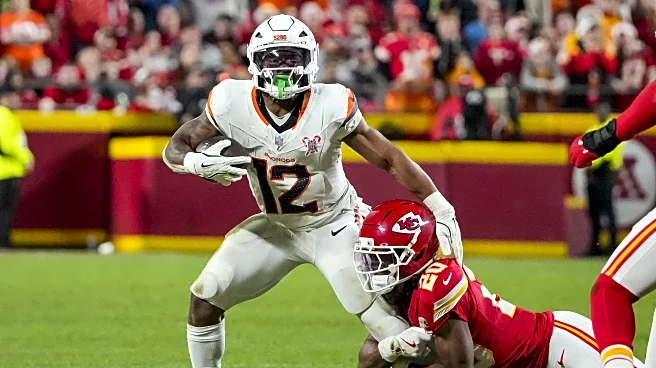

Now that the Kansas City Chiefs are no longer playing for the postseason — and dealing with a long list of injured veterans — the focus has shifted to gathering data on young players who may have key roles
in 2026.
No player has benefited more from those opportunities than rookie cornerback Nohl Williams. He had already been part of the rotation for much of the season — but with starting corners Jaylen Watson and Trent McDuffie sidelined, Williams has played nearly every snap over the past two weeks.
How has he performed? Is he someone the Chiefs can count on in 2026?
A closer look at the film from Thursday’s 20-13 loss to the Denver Broncos offers some encouraging answers.
Limiting explosive plays
Over the past two seasons, the Chiefs have transitioned toward more shell-based zone coverages. Now without cornerback L’Jarius Sneed, they haven’t been as effective in man coverage as they had been during previous years. On early downs, Kansas City prefers to play top-down and limit explosive plays, then get more creative on third down — a structure that fits Williams’ skill set.
This play provides a clear example. The Chiefs are playing a combination coverage, deploying four defenders to the three-receiver side in a box structure. Williams is responsible for the bottom-right quadrant, playing top-down on anything released into the flat.
Linebacker Drue Tranquill handles the bottom-left quadrant. When the running back releases vertically, Tranquill must turn to carry him before passing him off to the deep defender. Williams recognizes the conflict created by the flat route and triggers downhill, finishing the play with a secure tackle.
Tackling in space
Since Steve Spagnuolo became Kansas City’s defensive coordinator, his best cornerbacks have consistently shared two traits: the ability to fight off blocks and to tackle in space. Since the Chiefs blitz so often, those skills are critical against blitz countermeasures — especially screens.
This snap is a textbook example. The Broncos run a bubble-screen RPO. Linebacker Nick Bolton hesitates inside, giving the offense a numbers advantage on the perimeter. In theory, it should become a one-on-one between a receiver and a safety. But Williams immediately diagnoses the play — arriving before the receiver can even secure the catch — and blows it up.
Playing RPOs from even-numbers structures allows the defense to stay sound against the run while forcing throws like this. When those plays get shut down, it creates longer down-and-distance situations — and gives Spagnuolo more freedom to dial up pressure.
Tackling also matters against the run — and Williams shows value there as well.
Here we see the Broncos run a read-option concept with the tight end acting as a lead blocker. Williams sees it immediately, defeats the block, sets the edge and prevents quarterback Bo Nix from turning the corner.
Vertical speed
The biggest remaining question with Williams is his vertical speed. He wasn’t overly fast or twitchy in college, and opposing offenses will continue testing him downfield.
While the Broncos lack elite vertical threats, this rep was still encouraging. Williams aligns in soft press with outside leverage, stays underneath the receiver’s outside shoulder and funnels the route toward safety help. He remains in phase downfield and limits the throwing window.
Processing speed
As he showed in college, Williams is a smart player. But he could improve his processing speed in downfield zone coverage. The Broncos attacked him a few times by forcing high-low reads that put him into conflict.
Here, Denver runs a post-wheel concept against Cover 3. Williams opens to the post — but with a safety already sitting in the middle of the field, he needs to pass the route off more quickly so he can attach to the wheel. The delay leaves the window open long enough for a completion.
This isn’t a long-term concern — but as Williams’ role grows, improving route recognition will become more important.
The bottom line
There’s a real chance that in 2026, the Chiefs will look much different at cornerback. Watson is set to become a free agent and could command a significant contract. There’s also a plausible scenario in which Kansas City brings Watson back and explores trading McDuffie to add draft capital. Either way, the team is likely to need Williams to step into a full-time starting role.
There’s reason for cautious optimism. Williams still has limitations in pure man coverage against top-tier vertical threats, but he’s smart, tough, competitive at the catch point and effective in space. With more experience processing route concepts in zone, he profiles as a capable starting corner — and that’s excellent news for a roster with significant needs and limited resources.