


So you have decided to heed the call to adventure. Good for you.
If you need to recall what the Guide is or who I am, please refer to the included links.
The House that Apathy Built
The Guide has the following to say about going to a game at Rate Field:
Did you lose a bet? Were you too cheap to go to Wrigley Field? In either case, do I have a ballpark for you! An avatar to giving less than your all, a totem to mediocrity, a marker for failure in novel ways one would expect in fiction rather than in reality. If there is a corner
to be cut, Rate Field found a way. Prepare for the unreality, if you dare to tread here.
Rate Field stinks.
For the lazy or disinterested, you can stop right here. If you were somehow wondering whether Wrigley or Rate Field was the superior Chicago stadium, it’s Wrigley, which isn’t perfect by any means. Imagine your reaction if someone claimed that Angel Stadium was superior to Dodger Stadium, and the point is made.
Some stadiums in this Guide are not worth your time and money for various reasons. Some are the victims of terrible design decisions (Daikin Park, loanDepot Park). Some are victims of possessing a poor baseball culture (Angel Stadium, Truist Park, loanDepot Park). Some are venues that really should be put out to pasture (Angel Stadium, Chase Field, Tropicana Field). One is the Oakland Coliseum — it is this author’s opinion that anyone who likes a dive bar over the age of 25 needs to grow up. Rate Field does not even have “it’s just an average minor ballpark playing as a placeholder to everyone’s detriment” status working against it.
Rate Field somehow manages to combine all of the above demerits and adds a certain je n’sais quoi of soul-crushing apathy. At least it did, until one man sauntered in from Japan, someone whom I have been hyping for 18 months: Munetaka Murakami. Murakami-san has injected life—and he’s now hurt. Of course he is. Never mind; the rhetorical beating shall continue until morale improves.

The only positive of Rate Field is the home fans, those motley, brave souls who remain. I will not criticize them, because I can think of home fans that are instantly far more annoying in their home venues (Rogers Centre, Petco Park, Oracle Park, Busch Stadium 3, Angel Stadium, loanDepot Park) than fans of the White Sox.
There was always going to be one stadium that arrived too soon for the retroclassic ballpark boom started by Oriole Park at Camden Yards, and that was this ballpark. New Comiskey Park, as it was first known, was the house that cheapness and apathy built. But while missing the retroclassic boom may have capped this venue’s potential, it just means mediocrity on paper.
There was no reason that this stadium to be this bad. Rate Field has had multiple names over its 35-year history:
- “New” Comiskey Park: 1991-2002
- U.S. Cellular Field: 2003–2016
- Guaranteed Rate Field: 2016–2024
- Rate Field: 2025–Present
At the risk of bastardizing the Bard, a corpse flower by any other name would still smell just as bad in bloom.
We often learn more from failure than success, so it’s time to rip the figurative bandage off and see what went wrong. The following is all you will need to know if you made the mistake of going to Chicago for the purpose of seeing a Dodgers/White Sox game.
The Five Questions of the Guide
1. Is it worth going to?
No — unless you are trying to visit all 30 current MLB ballparks.

Establishing that Rate Field is a subpar venue is easy.
Narrowing down the why and how requires some rhetorical work. The most obvious flaw is the sheer, almost overwhelming sense of apathy that permeates the ballpark. If there was a corner to be cut to save a buck, this ballpark found a way. I visited in 2024 on a lark, which was the infamous year of failure for the organization.
This elephant in the room cannot be ignored while making or understanding this review, as the massive stench of the wafting failure was a long time coming. A fan had an infamously viral call to ESPN Chicago 1000 AM in 2023 that presaged the madness that unfolded in 2024.
Once the failure arrived, it was all-encompassing, all-consuming, a self-sustaining gravity well of terrible decisions that reinforced the failure.
But the White Sox being bad is actually good for a visiting team. Who doesn’t want to see the Dodgers win in person? When the proceedings are as drab as Rate Field, even ironic enjoyment is hard to come by because the visiting team better win. Imagine if the Harlem Globetrotters lost to the Washington Generals; that’s the level of ineptitude that was on display in 2024.
Poor performance on the field is one thing, but poor customer service in the stadium is another: disinterested, apathetic staff unable to answer basic questions. Lack of decent amenities is another, even in supposedly upscale portions of the park. The adjective “shabby” came to mind in multiple places and on multiple occasions.
Having cafeteria-level food is another. Imagine paying extra for an add-on with unlimited barbecue and drinks to hang out before the game, and then you get … cold this …


Having broken seats or other areas in need of obvious repair is another. I would call this ballpark a factory of sadness, but unfortunately, that name is already taken in Cleveland — in another sport! Rate Field is greater than the sum of its parts of collective failure in this regard.
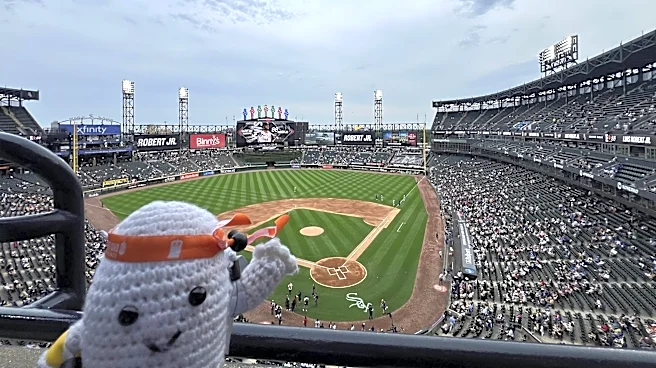
While the White Sox are playing better in a vastly diminished American League in 2026, the memories of the poor experience from my initial review in 2024 linger. “Imagine being in a dentist’s office where a baseball game broke out or a divorced dad’s apartment, who has given up” is the primary note I left for myself. The stadium is drab, with nothing interesting to see in the distance while looking out at the field.
It’s not as if Chicago is an ugly city, far from it. If you walk around Rate Field, you can see the gorgeous Chicago skyline, which begs the question: Why is the stadium pointing away from anything interesting? PNC Park in Pittsburgh and Busch Stadium 3 in St. Louis have iconic backdrops. Imagine the view below overlooking the outfield.

Rate Field was built across the street from Comiskey Park, which was at least pointing towards something.
As will be a recurring theme in this essay, the answer was ownership’s greed and skinflintry. There was a proposal to make the successor to Comiskey Park more like Wrigley Field and to integrate it into the surrounding community. Per the website This Great Game, owner Jerry Reinsdorf essentially said to hell with that idea:
Jerry Reinsdorf and the White Sox would have none of Bess’ retro idealism. Armour Field was to have a gorgeous view of downtown Chicago, but with New Comiskey the Sox strangely decided to look the other way, towards the southeast—where the distant landscape was dotted with hi-rise projects. Apparently, the team was more concerned with cheap home runs and decided to orient the ballpark so that typical winds from the southwest wouldn’t push fly balls over the outfield fence and toward Sears Tower. And rather than surround the ballpark with a neighborhood, they destroyed it—getting the backing of the city to tear down nearly 100 residences in a poor, black section that sat in the way of New Comiskey. For being in the wrong place at the wrong time, evicted homeowners were each given $25,000 to set up camp elsewhere….
…Some of Old Comiskey’s architectural touches would be retained in New Comiskey. Principal among these would be the arched openings spaced around the ballpark bowl—but unlike the old ballpark, the openings were covered with highly reflective glass which, along with beige-painted precast concrete etched with mild, abstract patterns, gave the overall structure the look of a sporty office complex. Worse, the structure—lacking embellishment at the top due to budget restraints—was largely hidden behind a series of switchback pedestrian ramps that interfered with what grace it had.
Inside, intimacy was hard to find. So were the players on the field for those sitting towards the top of the upper deck, an arduous ascent to a height so far up, you would have thought the White Sox would advertise for sherpas over ushers to assist fans to their seats. Someone did the math and discovered that the closest seat in New Comiskey’s upper deck was farther away from the field than the last row of upper deck at Old Comiskey. And it was much, much higher. The steepness of the upper deck, combined with Chicago’s famously strong winds, at times forced the White Sox to actually close portions of the level as a safety precaution. But fans did remark how cool it was to look down on a towering pop-up….
…At some point, around 2000, Reinsdorf and the White Sox finally experienced their come-to-Jesus moment and admitted that the ballpark could use some work. They hired a different architect (Dallas-based HKS, designers of the ornate Ballpark at Arlington), spent almost as much money ($118 million) as it took to build the entire venue and took seven years on a renovation that was undertaken bit by bit to keep distraction to the fans and players at a minimum. It may not have transformed the joint into Wrigley, but it was an improvement—a sorely needed one at that.
(Emphasis added.)
But one would be remiss in omitting the potential divine providence that was not present during my initial review. The arguably most famous White Sox fan no longer resides in the Oval Office, but in the Vatican with the new Pontiff.
In 2005, then-Priest Robert Provost was literally sighted on the telecast of World Series Game 1, a sweep which was the Southsider’s last championship. The White Sox put up a mural in Section 140 after his election as pope.
While kitschy elements and touches were added around the ballpark, one would have to be blind to ignore half-measures of them. Do you like cafeteria-grade food vendors scattered throughout the ballpark with bland empty hallways between them? Rate Field has that in spades. Do you want to pay for an add-on that gets you access to what would barely pass for cafeteria food 90 minutes before a game? Rate Field has you covered.
The standout item from Rate Field was the Campfire Milkshake, a chocolate milkshake. The White Sox brought it back in 2026; they just made it bigger and doubled the price, which is laziness personified.

Unsurprisingly, the White Sox do not offer tours of Rate Field, but they do offer virtual tours of premium areas to rent. As for First Game Certificates, the following is just the embodiment of the Rate Field experience. You go to Customer Service to get one printed out on cardstock, so far, so good. You are then asked to write your name in block letters so the customer service representative can enter it and the date, and complete your certificate, which is placed inside a folder. All excellent so far.
I did not bother to check the certificate until I got back to California, because I was carrying food at the time and saw that it was the correct cardstock. After all, I wrote my information in large, friendly block letters. You can see for yourself where things went awry.

Words can barely express my horror when I finally opened the folder to frame the certificate. The incompetence just grabs your attention and refuses to let go. If the above is not emblematic of Rate Field, I don’t know what is.
2. How should I get there?

Getting to Chicago is easy, all things considered. As we covered in “The House an Earworm Built,” getting to Chicago is pretty straightforward, as most major airlines have connections to Chicago, mostly likely Chicago O’Hare International Airport. One could make a road trip of it, driving across country, or even take major Amtrak routes from the coast. I would not recommend this last option, as American rail is infinitely inferior to Japanese rail in scope, speed, and quality.
Once in Chicago, unless there is a specific errand that requires a car, you can take the Chicago Transit Authority to just about anywhere. Taking the Blue Line train from O’Hare into Chicago is likely the easiest way to get into the city. For our purposes, the Red Line of Chicago’s Metro is life; it will take you just outside of Wrigley, and there is a dedicated stop for Rate Field.
A CTA Ventra 3-day pass allows unlimited use on the system after scanning your phone or card for 3 days, and is more than enough unless one is staying in Chicago for longer.
Weatherwise, it’s Chicago. It can be rainy, humid, or nice; just look at the weather report and plan accordingly. Chicago is not like San Francisco, where the temperature can vary wildly throughout the day or by neighborhood on a normal basis. Chicago can be sunny and humid, nice, rainy, or windy, or any combination thereof.
While there is parking at Rate Field, unless one is driving in from southern Illinois or Milwaukee, public transit is the best option to get to and from the ballpark, easily besting car or rideshare options. While one ultimately will walk a few hundred feet to get to the ballpark from the train station, there’s enough police presence and foot traffic for all but the most crowdphobic of fans to feel comfortable in making the transit.
3. Where should I stay?
The short answer is that any half-decent hotel near the Red Line will suit your purposes. One of the issues with Rate Field’s location is that the ballpark is near two highway interchanges, making it more car-friendly than people-friendly. As discussed above, it is not as if there is a thriving neighborhood nearby, ala Wrigleyville. Accordingly, hotel options near the Rate Field are somewhat limited.

While one might be initially tempted by these choices, note that you will be walking a considerable distance and multiple city blocks. For instance, The Polo Inn Bed and Breakfast is a mile walk from Rate Field.
One can bypass this conundrum by staying at a hotel in The Loop off the Red Line. The downside to this approach is that hotels in this part of Chicago tend to be more expensive. Also, Chicago’s Metro is not the friendliest when it comes to accessibility issues, i.e., if you have trouble with stairs, you might have issues reaching your train.

Another option to try is staying in Chinatown, which is just to the north of Rate Field. The Jaslin Hotel is a viable option because it is close to the train station without the arduous walk required by other hotels.
4. Where should I sit?

Rate Field does charge more for Dodgers games compared to standard fare, but not so much that it’s notable, or that you feel gouged. However, for field-level seats behind home plate, expect to pay north of three figures, which is bog standard for any MLB ballpark.
A seat behind home plate that would normally cost four to five digits at Dodger Stadium can be had for a few hundred dollars here. However, the positive remarks about the seating options end there.

If one attends a day game, one will be in direct sunlight unless one is either on the upper deck or sitting in the back of the sections in the stadium’s inner bowl. Outfield seating is exposed to the elements. While there are social areas in the outfield, if a traveling fan made the journey to Chicago, they can just socialize at their chosen venue or bar in downtown Chicago after the game. The White Sox do have a sports bar/restaurant adjacent to the ballpark, which is just about the only amenity outside it.
The stadium has a unique rule where if one is sitting in the upper deck (the 500s seating), they are not allowed to visit other parts of the stadium once up there. The broken seating I encountered was in this section, where not only was my assigned seat broken, but two other seats were either about to break and broke when I sat on them or already broken.
Thankfully, the upper deck was essentially empty for this game, so I eventually did find a seat comparable to the one that I paid for. Seat roulette should not be a thing and is a glaring red flag for skimping on maintenance. Yes, the seat was about $25 in 2024, but that price was dwarfed by both the almost comical lack of food options on that level and the social embarrassment of subpar seating.

While one can get closer to the visiting bullpen by sitting in the front of sections 104 and 105, it is done at the literal expense of watching the game without magnification. That said, when I visited the bullpen, they mostly spent their time underneath the awning to avoid the sun.

Seating in the 300s that allows access to the then-Huntington Stadium Club, where the original Campfire Milkshake was served. The private dining area I had access to before the game gave solid views of the Dodgers bullpen, less so of the game itself. Ultimately, during the game I sat in this section, there was a rain delay, which caused a good portion of the crowd to leave, but I switched my seat from the one above to the one at the very start of the Guide entry.
Anecdotally, while the staff at Rate Field was generally apathetic to customer questions and feedback, the one aspect in which they showed an unexpectedly high level of diligence was enforcing that people sat in their assigned seats. Granted, one would expect most ushers at most stadiums to do this act, but during inclement weather, one would expect a certain relaxation, considering that the original patrons likely left. Potential hermit crab fans would likely need to be mindful and avoid drawing attention to themselves.
5. After your trip, is it worth going back?

In the disclaimer to the Guide, I described the informal range of subjective outcomes that can occur after visiting a location. So far, I have attended three games at Rate Field in 2024, all of which the Dodgers won. After this visit, my rating of going to Rate Field is:
- Hey, that was somehow NOT fun. Why did I put myself through all of this work?
The Dodgers won three largely stress-free games (when Bobby Miller wasn’t pitching) on an outing that cost very little out-of-pocket costs in weather that was largely pleasant in a venue that was easy to get to and from. In theory, considering all the positive factors that should be in play at this ballpark, I should be raving. Yet two years later, I am still spectacularly annoyed by the experience of going to a series at Rate Field.
Going to baseball games should be a fun experience. When a venue makes decisions that make it harder to have fun, considering that one of the main purposes of a ballpark is to enable fun (while getting your money in trade), one cannot help but speak out. White Sox fans deserve better, both in venue and in ownership. It’s like watching a toxic relationship from afar; you cannot intervene (and odds are, your intervention would be unwelcome), but you know that they deserve better.
Therefore, based on the above information, I can not recommend attending a Dodgers game at Rate Field. If the above 3,450 words are not enough to sway all but the most hearty Dodger chasers from going to this ballpark, then please enjoy and be well. While new ownership is eventually coming to the Southside, the cavalry has ties to private equity, which is problematic in a familiar way.
While friendship is the gravity that might cause me to return, and while I remain hopeful for the future, my mind keeps returning to the song lyrics “Meet the new Boss / same as the old Boss … ”