




Last year we wrote about some Kyle Dubas tendencies in the NHL draft. Let’s see how that went in 2025 with an eye for what that could mean for 2026 when the draft goes from June 26-27.
Heavy on forwards early in the draft, two out of three first round picks have been forwards. Out of 10 first/second round picks, seven have been forwards. Often wingers.
The Penguins entered the 2025 draft with two first round draft picks. They wheeled around in trades and eventually ended up picking three forwards at
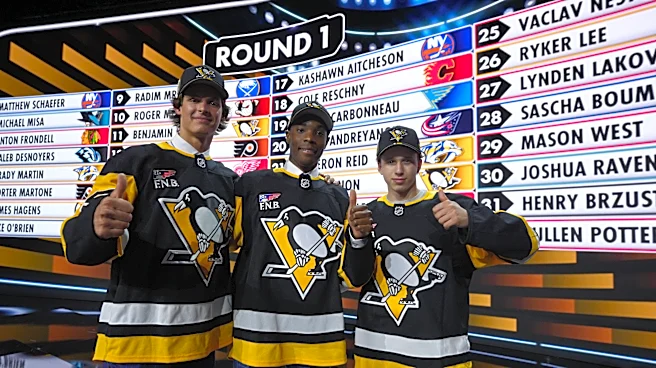
11th (Ben Kindel), 22nd (Bill Zonnon) and 24th (Will Horcoff). Positional flexibility has been a point with all three that are center capable, though Horcoff mostly has shifted to being a winger. Zonnon currently projects to be a pro center and Kindel already played center as an 18-year old in the NHL.
Overall last year was right in the Dubas wheelhouse to prioritize forwards with the highest picks that get made.
But just where did these picks come from this past year in comparison to past Dubas drafts?
Four out of six total top-50 picks have been out of the WHL. The others have been one a piece from Russia and the OHL. Has used zero top-50 picks from the QMJHL, US Colleges/USHL, Finland, Sweden, Czechia, Slovakia.
The Pens had four top-50 picks last year, and surprise surprise – two of them were from the WHL (Kindel and second rounder Peyton Kettles). Dubas opened his horizons by selecting Zonnon (QMJHL) and Horcoff (U. of Michigan) as first time going to those areas high in the draft. Given the bigger shift from top talent going from Canadian Juniors and now headed the NCAA route, this is likely a trend that will be continuing in the future – but it will be interesting to see how long Dubas keeps going back to Western Canada with his early picks.
Hasn’t really messed with QMJHL or Swedish based players at all at any point in draft — only two out of 43 skaters drafted were from the Quebec league (one of them even being a Russian import player and not a native Quebecois). Similarly, has only one player drafted out of a Swedish league (which doesn’t count Swedish native Rasmus Sandin due to playing his draft year in the OHL).
The Quebecer Zonnon, as noted, was an atypical selection from Dubas’s draft history. That in itself is all well and good – there’s no rule that says he has to pick players in the same fashion every time. It’s a positive to see him not beholden to absolute rules for where players are coming from, as obviously the main emphasis is about on how their traits could one day develop beyond which part of the world they hail from.
The Pens also selected goalie Gabriel D’Aigle in the third round out of the Q. Other than that, there were no Swedish players – or Europeans at all for that matter in the Pens’ 2025 large draft haul of 13 total picks in an interesting twist.
Late in drafts we see a heavy emphasis on US born or at least US trained players from the NCAA/USHL ranks from rounds 4-7. Out of the 27 skaters Dubas has drafted during Rounds 4-7 over the years, 10 have been from NCAA/USHL, compared to four each from OHL, Russia and Finland, two a piece from the WHL and QMJHL and one from Sweden.
Out of the six late-round picks last year, only one (sixth rounder Carter Sanderson) exactly fit to the qualification of Dubas’s prior tendencies. However, that comes with somewhat of an asterisk since a lot of the picks were from the OHL or WHL, many of those players are taking advantage of the recent shift in rules and going the NCAA route. It’s already been announced Ryan Miller is headed to Denver, Quinn Beauchesne to BC, Jordan Charron to UMass, Kale Dach to Penn State, which means they all to fit the profile in a roundabout way of getting future NCAA players later in the draft. As noted above, this trend likely won’t be unique to Dubas as the flow of talent shifts more towards the NCAA at large.
Has never drafted a goalie in Rounds 1-3, has not drafted a goalie in his stint as Pittsburgh GM. In the seven drafts, Dubas has only drafted four goalies total.
D’Aigle as a third round choice became the first goalie drafted so high by Dubas, although it could and should be noted that came with the sixth selection the Pens made in the draft (84th overall). Overall, Dubas hasn’t been a volume drafter of goalies in his managerial career and D’Aigle was the only goalie the Pens selected with the 13 picks.
Lots of right handed defensemen, 11 of his 47 total draft picks (23%) have been RHD.
That trend continued in 2025, Kettles (39th), Charlie Tretheway (73rd) and Beauchesne (148) were all right shot defenders drafted by the Pens. They only took one LHD (Brady Peddle at 91). Often times teams are looking strictly for best player available but it’s likely no coincidence that being a right-shot defender boosts the stock of prospects in the eyes of those making the picks for the Pens these days.
More of a European haul (especially in Russia) than most other NHL teams in the modern era. 14/43 skaters drafted played in Europe, which is not inclusive of several others like Sandin, Filip Kral and Joona Vaisanen that were European natives playing junior/college hockey in North America.
As mentioned above, an interesting developing note is that the Pens have not gone into Europe at all lately. You have to go back to 2023 to find Pittsburgh taking a European trained player (Emil Pieniniemi, who was coming to the OHL anyways, plus Emil Jarventie, Kalle Kangas from Finland, and also Mikhail Ilyin from Russia). That draft was prepped with Dubas only on the job for weeks, since he’s been entrenched the Pens have only ended up drafting North American trained players recently.
That could be a matter of circumstance or coincidence more than a concerted effort but it’s been the case nonetheless that the Pens have mainly been drafting out of the Canadian juniors lately (13 of their 19 picks in 2024+2025 have been CHL players either the season before or after being drafted).
Trading down to accumulate more picks has been common for Dubas with examples in 2022 (moving back in the first round to ditch Petr Mrazek’s bad contract and again dealing back in the third round), and again 2020 (when he traded back in the second round), 2018 (in the first round) and as an interim GM in 2015 Dubas traded down twice in the first round. Save for dealing a 2023-fourth rounder to get back into the fourth round in 2022, trading up hasn’t been a strategy often used, but he also has rarely been in position to have excess picks.
Dubas made three draft trades that involved only picks in 2025, twice moving down and once moving back up. Through a combination of two trades he essentially got picks 22+24 out of having 12+59. That could have been dependent on preferring getting two players at the back-half of last year’s first round over just one at 12 and unique to that draft class. There were reports and some comments from Dubas himself that he was looking to move 11+12 to get a premier top-5/10 level pick but found no willing trading partners. He might not always want to move down, but that’s the action taken more often than not.
In fact, over his history, Dubas’s tendencies to move down in the first round quite a bit – doing so in 2018, 2020, 2022 and last year in 2025. That tendency is amplified further considering Toronto didn’t make a first round pick in 2019 or 2021 – showing that only in 2020 (and the 11th overall pick in 2025) were rare examples of Dubas not ending up trading down to stock up on more picks from his first round slot.
That could come in play at this year’s draft where the Pens only have one pick in Rounds 4-7 (a sixth via Nashville). Last year Dubas traded a third rounder to move down for another later third and picked up an extra fifth round pick. It wouldn’t be surprising if a similar move to that was made this year.
These are all little tidbits to keep in mind, the past doesn’t always paint the picture of the future but it gives a pretty good indication of how Dubas has tended to operate historically. If all of this holds to create a broad expectation then expect him to move back via trade a time or two, take lots of Canadian junior players (particularly from the WHL early on), a bunch of right shot defensemen and likely not use the highest of picks to draft a goalie.