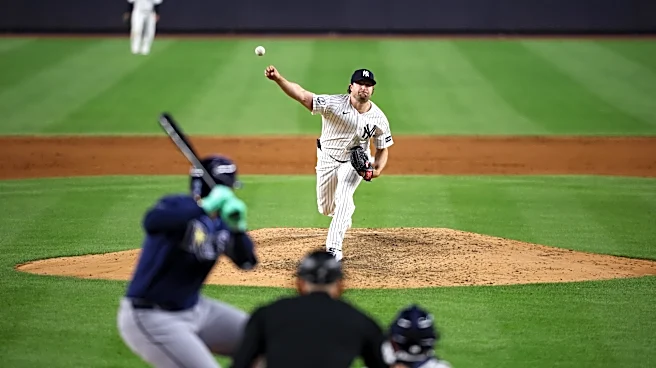






Choo-choo, the Cole train has been back on the rails now for five big league starts. It might be a small sample size, but let’s take a journey down the tracks and look at how the ace compares to the last time we saw him on the mound back in 2024.
Many have already written about Gerrit Cole’s new windup style and dad bod so we’ll be skipping over those two factors, but before we get into the analytics, let’s recap those five starts. In his season debut Cole was efficient and though not dominant, blanked
the Rays over six innings. Then Cole steamrolled the Royals striking out 10 in 6.2 innings.
Cole then made back-to-back starts against the Guardians. The first time around, the longball bit him as he surrendered three home runs in 5.1 innings in the Bronx. The second time, he battled through four innings in Cleveland. Finally, this week Cole tossed six innings of two run ball against the surprisingly good White Sox, striking out six.
Thus far on the season, Cole’s record sits at 2-1 with a 2.57 ERA with a 3.0 K/BB rate in 28 innings. The only real area of concern from a statistical standpoint is the lack of strikeouts. If you set aside the 10 punchouts against the Royals as a one-off, Cole would only have 14 punchouts on the season. Though this might concern some fans, the data so far suggests it may be partially due to adjustments made to his approach and pitching arsenal during his comeback.
The first place to look to see these adjustments is Cole’s arm slot. In 2024, Cole worked from an average arm angle of 43 degrees. Through his first five starts of 2026 that number has dropped to 37 degrees. The change becomes even more noticeable when looking at individual pitches. Cole’s four-seam fastball has gone from a 43-degree release angle to 38 degrees, while his changeup has dropped from 44 degrees all the way down to 35 degrees. A lower arm slot does not automatically make a pitcher better, but it can dramatically alter how pitches move and interact with one another.
The lower release point has reshaped much of Cole’s arsenal. His four-seam fastball is averaging 96.7 mph, nearly a full tick harder than in 2024, while also generating more arm-side movement. The biggest transformation, however, appears to be the changeup. Once a rarely-used offering that accounted for only four percent of his pitches, the changeup now makes up nearly 15 percent of his arsenal.
At the same time, Cole’s changeup is arriving more than two miles per hour (MPH) slower than it did in 2024, at 85.9 MPH, while generating significantly more horizontal movement. Cole is spinning this pitch with 100 percent active spin, which is up from 98 percent in 2024.
It is also worth noting that Cole is generating more efficient spin on his four-seamer as well. His four-seamer is now operating at 97 percent active spin compared to 91 percent in 2024. While those changes may seem small, the resulting movement is not. The fastball is carrying more effectively through the zone while the changeup is generating substantially more arm-side movement. Together, those changes have increased the separation between the two pitches while allowing them to tunnel from nearly identical release points.
This is called the Magnus effect and basically means Cole has become better at creating natural deception between his primary pitch in his four-seamer and its best natural dance partner in the changeup. The result is a very different looking version of Cole than the one Yankees fans have grown accustomed to watching. Rather than relying primarily on a high-powered fastball and big breaking curveball combination, Cole appears to be leaning into a more modern approach centered on pitch tunneling and movement. His fastball, sinker, and changeup all feature increased horizontal action due to the change in arm angle. This allows multiple pitches to travel on similar planes before breaking in different directions and speeds when they reach the plate.
Interestingly, the slider may be the biggest beneficiary of these changes despite only modest changes to its movement profile. While its movement profile has changed only slightly, the pitch is generating a significantly higher whiff rate than it did in 2024, up eight percent. While the fastball, changeup, and slider appear to have benefited from Cole’s new release point, the knuckle curve may be the one pitch still searching for its old identity. The pitch now sweeps more and drops slightly less than it did in 2024, resulting in a dramatic decline in whiffs and run value.
Rather than forcing the issue, Cole appears to have adjusted by leaning more heavily on his changeup and slider, creating a new pitch mix built around horizontal movement and weak contact rather than pure vertical deception. In 2024 Cole threw his curve and cutter 18.7 percent and 15.8 percent respectively. The curve is now down to 13.2 percent of the time, and the cutter has been scrapped completely. With the changeup essentially replacing the cutter, instead of using a hard glove-side pitch to disrupt timing, he’s using a slower arm-side pitch that creates more velocity separation and more movement.
The sinker is also being used more in 2026. Cole’s sinker comes in at about the same velocity as his four-seamer, but has a similar run pattern as his changeup. This allows Cole to present multiple pitches that initially look alike before revealing themselves too late for comfortable swings. What makes all of this particularly fascinating is that while the strikeouts have declined, the quality of contact has improved dramatically in Cole’s favor. Opponents are producing less hard contact, down over 8.5 percentage points, barreling fewer pitches, and seeing lower expected batting average and slugging percentages than they did against Cole in 2024.
In other words, hitters are making more contact, but they are doing far less damage. Cole’s expected batting average has dropped from .223 to .199 and his expected slugging percentage has fallen from .385 to .305, suggesting the weaker contact is not simply a product of small-sample luck. For a pitcher returning from major surgery at age 35, evolution makes perfect sense. The version of Cole that won the Cy Young Award did so by challenging each hitter and overwhelming them with velocity and toughness. The 2026 version appears more interested in preventing damage than piling up punchouts.
Through five starts, the strikeout totals are down, but so are the barrels, hard-hit balls, and expected results. The early results suggest the Yankees’ ace may have found another way to dominate. Rather than overpowering opponents, Cole is beginning to look more like a craftsman, using movement, tunneling, and sequencing to create outs. He’s making pitching art and as long as he keeps it up we all can be happy little fans!