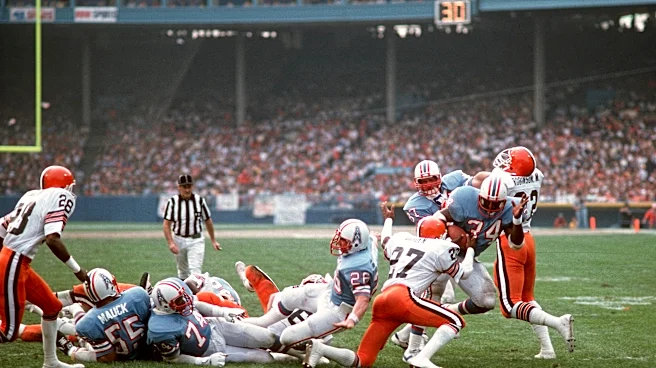


The Cleveland Browns are one of those teams that have had their fair share of really good defensive units. Folks kinda expect that from this franchise – even today. And the list of great Cleveland defenders is pretty lengthy. Somewhere, safety Thom Darden fits nicely on that list as a member of the defensive backfield.
Darden is an Ohio guy. He grew up in Sandusky and attended Sandusky High School. In 1965, they were Ohio State champions in football. The school is known for its football tradition
and is the fifth winningest program in the state.
RELATED: DT JERRY SHERK INTERVIEW
But Darden’s interest in football was situated in third place early on. His love was basketball, but his athletic greatness was on the diamond playing baseball. He was even scouted by the hometown Cleveland Indians.
Coming out of high school playing safety, cornerback, and middle linebacker, Darden was recruited by many Big 10 colleges, with Ohio State and Michigan leading the list. He gave Ohio State the first shot at recruiting him to play football, but ultimately signed with Michigan, where he was part of head coach Bo Schembechler’s first recruiting class.
Darden would go on to become a First Team All-American (UPI), Second Team All-American (AP), First Team All-Big 10 as a junior, and First Team All-Big 10 in his senior season. He played in 33 college games with 218 tackles, 11 tackles for loss, 11 interceptions, three touchdowns, and 13 pass defenses. He also ran back 42 punts. In his final two seasons at Michigan, Darden’s teams only lost three games, including a Rose Bowl defeat when the 8-3-0 Stanford Indians upset Michigan 13-12. Darden was also part of two Big 10 conference titles.
After his Michigan career, he played in the 1971 Coaches All-America Game in Lubbock, Texas, an All-Star contest. He was voted the game’s MVP.
In April, he was drafted by the Browns in the first round with the 18th overall selection. Darden grew up a Browns fan. Before reporting to training camp, Darden participated in the Chicago Charities College All-Star Game on July 28, 1972, against the Super Bowl champs, the Dallas Cowboys.
In his first NFL training camp, Darden was with a defensive backfield that the year before had started Clarence Scott and Ben Davis at cornerbacks, and Walt Sumner and Mike Howell at the safety positions. Darden had a great rookie training camp and was an immediate starter for the Browns at strong safety when they switched Sumner to free safety. Darden started all 14 regular season games in 1972. He received votes for the “NFL Defensive Rookie of the Year.” In the 1975 preseason, he suffered a knee injury and missed the entire season.
In all, Darden played 10 years, all with Cleveland. He was voted to the Pro Bowl in 1978 and was named Second Team All-Pro in 1976, 1978, and 1979. In his Pro Bowl year, he was the “NFL Interceptions Leader” with 10 for 200 yards. Both stats led the league.
Darden still has three Browns team records: Most career interceptions – 45, most interceptions in a single season – 10, and most interception return yards – 820. He last played with Cleveland in 1981. Since that time, hundreds of defensive backs have come and gone. That’s 45 years his team records have stood.
Today, Darden lives in Cedar Rapids, Iowa. He and his wife Melissa have raised six children.
Darden was inducted into the:
- Sandusky High School Athletic Hall of Fame (1991)
- Cleveland Browns Legends Program (2016)
- Northwest Ohio Sports Weekly Top-10 Athletes in Erie County History
Dawgs By Nature staff writer Barry Shuck was able to interview Darden and find out what his trick is with getting so many interceptions, if he grew up a Browns fan, and why the heck did he choose Michigan over Ohio State?!?
Shuck: You were a standout basketball and baseball player at Sandusky High School. Why did you pursue football at the college level instead of these other sports?
Darden: My first love was basketball. I loved it and started playing in the 10th grade. I played baseball since I was seven until I was 18 years of age. My high school was considered one of the better programs in the State of Ohio. With football, in my sophomore year, we were Number 1 in the state, and Number 3 my junior year and Number 5 in my senior year. We had a good foundation. If you were any kind of athlete, your goal was to get a college scholarship. My father told me if I wanted to go to college, I better figure it out how to pay for it. So, I had to get a scholarship because I didn’t have any money. My best way of going to a prominent school was through football because our program was well liked across the State of Ohio. We had good coaches.

Shuck: What is the story about you almost signing with the Cleveland Indians?
Darden: You have done your research. I was a pretty good pitcher, a left-hander. And played first base. And left handers were rare back then. I played on our legion team which you had to be 16 or 17. My coach said that this guy was coming in from the Indians and wanted to see about two or three of us on the team. And when I got up to bat, the scout brought his own pitcher and told him to throw low and inside on me. I couldn’t hit the low and inside pitch. I think that’s what kept me from being signed by the Indians. So, the Indians never offered me a contract and I never heard another word from them. I was a senior in high school and decided to go to Michigan and play football instead of baseball.
Shuck: Did you grow up a Browns fan?
Darden: I definitely grew up a Browns fan. Loved Jim Brown. After Otto Graham, I remember when they got Milt Plum and then sent him to Detroit. Frank Ryan and Gary Collins. Paul Warfield. All great players. And all players that a young man would admire and want to root for. Plus, they won all the time. Warfield ended up being my roommate when he came back that second time to Cleveland.
Shuck: You had plenty of college offers coming out of high school. I am perplexed. You had the opportunity to go to Ohio State. Why choose Michigan?

Darden: You want the full version? Going into my senior year at high school, I played safety and also cornerback. But our middle linebacker broke his arm, and because I knew how to hit, they wanted me to move to his position. I was about 173 pounds in probably the second-best conference in the State of Ohio. So, when I got recruited the coaches had to tell these schools that I was really a defensive back. Woody Hayes of Ohio State told me they had this position that they wanted me to play – it’s a hybrid position. And it was a weakside linebacker/safety type position. It was still in the 4-3, but the outside linebacker played off the line. My father later became a minister, and Woody came by himself and started talking about football. He sat in our living room. And then he started talking about war. He would congregate war and football. When he would start doing that, he got excited. And then he started frothing at the mouth. And then he started cussing. When he left, my father, said, “You’re not going there.” So, with Michigan, Bo Schembechler didn’t come until January. A gentleman, soft spoken, and my mother fell in love with him. As parents, you want your son to be somewhere safe and can flourish and be taken care of. You’re sending your boy off and he’s not going to be down the road and you want him to be taken care of at just 17 years old. As a teenager, you don’t know what’s going on in life. And I signed with Michigan, but Ohio State went first.
Shuck: So, tell me about your house called the “Den of the Mellow Men.”
Editor’s note: Darden is #35, front row, third from left
Darden: When I went to Michigan, there was four black players on scholarship. In my freshman class, there were seven. In that class, there were four All-Americans and three first-rounders. It was a special class. Back then, whites and blacks did not room together. As freshmen, you had to be on campus, but could go off campus the following year. When we went to Bo, he let us rent a house that was still part of campus and down the block from University Hospital. It had six bedrooms, with two of us having to share a room which we pulled cards for. I had my own room for two years. I lucked out on that one because everybody has a roommate. I can’t remember to be honest with you of how our house got the name the “Den of Mellow Men.” But all us guys were calm and effective and had the same goals in mind: Be good representatives for the college, be good football players, and all liked the females. We used to have a party after every home game. If those walls could talk. A couple of the coaches would come, and our families would show up, cook, eat, and interact with the other guy’s families. Because it was a family. But after they left, that is when the party started.
Shuck: Your interception on the pass intended for Ohio State’s Dick Wakefield was ranked #58 as the greatest plays in the Michigan versus Ohio State rivalry. Tell me about that play, and what happened with Ohio State head coach Woody Hayes? Didn’t Coach Hayes tear apart the yard marker?
Darden: That was something. We had just scored. It was third down, and they were driving down, must be around midfield. Wakefield was running across the field on a crossing route. I saw that quarterback Don Lamka had him all the way. I had watched this same play on film not too long ago. He threw the ball lower than normal, as it was usually where the receiver had to reach up to catch it. We both jumped for the ball, and I jumped over Wakefield and reached out my hands. It happened so quickly. After we both fell down, when I rolled over, the ball was still in my hands. I lifted the ball up and then showed it to the official. Woody thought it was interference because I had jumped over the receiver. Because of the no-call, Woody went ballistic and came onto the field to the 50-yard line yelling and screaming. He tore the patch off of the official’s jersey, and then he grabbed the yard marker, tore it up, and then threw what was left onto the field. Then he tore up one of the distance markers. He put on a show. They got a 15-yard penalty because he came onto the field and Woody was ejected. There was no doubt in my mind he had white stuff at the corner of his mouth.
Shuck: Your final year at Michigan was gold. You were named an All-Americanand voted First Team All-Big 10 for the second straight year. How did you find out you were named All-American, and did you get to meet Bob Hope and be on TV?
Darden: I think the way they did it was they would always have someone from the athletic office call over to house where the player lived. It’s been a minute since that happened. Then, the players had to go to a banquet, and they had a plane ticket ready for me. So, they would call you to tell you, if I remember correctly. This banquet was in Chicago. Now, this list was the UPI, and I made Second Team All-American on the AP list. That is the one where Bob Hope brought out players on TV, so I missed out on meeting him.
Shuck: 1980 was the year the first televised NFL draft was on the air. Back then, you were in the 1972 draft class. How did you find out that the Browns had drafted you?
Darden: I can’t remember what his position was, but someone from the team called me from Cleveland and said that they had just picked me with the 18th pick in the draft. At our house, we actually skipped classes, stayed at the house, and sat around our phone waiting for the call. There weren’t cell phones back then, so it was just the one landline. And if the phone rang, we would all jump. I was just waiting for a call.
Shuck: The Browns head coach was Nick Skorich. What was he like?
Darden: Yeah, Nick Skorich was my first head coach. He was stoic. He was a former offensive lineman. He was kind of quiet and didn’t fool with the defense that much.

Shuck: What was your first training camp like?
Darden: I played in the (Chicago Charities) College All-Star game and should have beaten the Cowboys. I was in Chicago, and Cleveland’s general manager Harold Sauerbrei came and got me. We got on a plane together and flew back to Cleveland. Then they drove me immediately up to Hiram for training camp. The team had already been in camp like two weeks, which means as a rookie, I was that much time late. And now I am trying to catch up in practices and learn the playbook. I was drafted in the first round, but that didn’t guarantee me anything but a roster spot. I came into camp to replace somebody. And back then, it was two-a-days, and we had a six-week preseason. And it was hot.
Shuck: You were in the same draft class as QB Brian Sipe (Round 13). Do rookies’ bond with each other and follow each other’s careers?
Darden: Not really, unless they play the same position as you. I met a lot of rookies at the Coaches All-America Game and and the College All-Stars game and got friendly, but not close. I remained close to the guys who I shared a house with at Michigan because they played on different teams. As far as the Browns’ rookie class, I never really developed a lasting relationship with anybody except for my roommates.
Shuck: You started as a rookie. Who did you have to beat out?
Darden: I beat out Ernie Kellerman for the starting strong safety. He was such a good guy, and didn’t mind showing me things. It was in his character to help me even though I was drafted to replace him, and he was very much aware I was there to take his place. He was a last-day cut. And I made mistakes. Early on, I remember doing things differently after I got beat for a touchdown, and it never happened to me again. That play, the backs went one way, and I was locked onto the tight end. But he stayed in to block and didn’t even release. That was my man. So, here I am standing there looking at the other side of the field where the play should be going, and laser-focused on the ball. Well, the tight end eventually released and was wide open for the touchdown. I was so dumbfounded and also angry because I didn’t read my keys. That never happened to me again.

Shuck: Week 10 of your rookie season you played in your first Browns-Steelers contest. As a lifelong Browns fan, did you realize that this rivalry was on the same plane as Auburn-Alabama and Michigan-Ohio State?
Darden: That Ohio State-Michigan rivalry is compared to none. It is a game where you hate it when you lost, and hate it more because of who won the game. There were more fights in the stands than on the field. I’ve never witnessed anything like that. Unbelievable what that rivalry represented. But the Browns and Steelers are a really great rivalry as well. The fans really hate each other. And Cleveland dominated the Steelers until Chuck Noll was hired as the head coach. They were the team in the 70s. Then they got Bradshaw and Mean Joe and Franco Harris and started drafting the right players. We always played them to beat them in Cleveland. But I lost every time I played in Three Rivers Stadium. Never won a game against the Steelers on the road.
Shuck: In your rookie year, the Browns went 10-4-0, then played the unbeaten Miami Dolphins in the playoffs. At one time, Cleveland had a 14-13 lead in the fourth quarter. Do you realize how close you came to defeating the only untied/unbeaten team in NFL history? Did you think that the playoffs would be an annual event?

Darden: After that, I died and went to Heaven. I was a rookie, and looks like we had a chance to get to the Super Bowl. This is great, and should be an annual thing. Two things happened down in Miami: One, they called a pass interference call on (LB) Billy Andrews against Paul Warfield, and suddenly they were down inside the 20. Two plays later, Jim Kiick ran up the middle in a gaping hole, and I hit him pretty hard on the one-yard line. They scored because of the pass interference call on a third-and-long play. We had a 14-13 lead before that play. Two, we had quarterback issues. Mike Phipps was the quarterback. He was up and down. He was supposed to be the wonder boy. And part of that was all of the negativity that was thrown at him. That’s the thing about playing football in the National Football League. I don’t care how good you are, you are going to get negativity by the fans, by your family, and by the coaches. And you got to be able to withstand all the negative stuff that’s thrown at you and restart.
Shuck: In the 1975 preseason, you injured your knee. What happened, and did it require surgery?
Darden: I don’t like to talk about people who are no longer on this earth. I don’t know why, but the coach had me back returning punts. I liked returning punts, but not in preseason, with the other team having a bunch of guys running downfield who weren’t going to make their team and were trying to impress their own coaches. Plus, I had nothing but rookies around me. Against Philadelphia, my thing was, I never let the ball hit the ground because you never know how it’s going to bounce. So, I catch everything. I always just take a quick look while the ball is in the air and see who is going to be the first guy on me. I saw our gunner running right with the guy, so I decide I’m going to catch it and run with it. The ball goes down my stomach and hits the ground. My first reaction, of course, is to pick it up. I pick it up, and this guy who was coming from my left is coming down, and he hits me with his helmet right on my left knee. I heard the pop. They carried me off the field, and the doctor came and looked at it. It destroyed my MCL, but fortunately my ACL was not damaged. The ligament on the inside was ripped in two spots and shrunk the cartilage. They shaved the cartilage, saved some of it, and required surgery. They put me on IR, and back then that meant you were gone for the season. I had two different guys helping me with rehab. One was at the Browns training facility. And I had a private guy that pushed me like I don’t know what. Towards the end of my rehab, I was a consultant with Michigan. Back then, the double zone, and the double zone man were just coming out. So, I helped put it in and continued my rehab. I didn’t ask for any money.
Shuck: Where did you live in the Cleveland area, and what places did you like to go out to eat?
Darden: I always lived on the Eastside. Back then, race was always an issue. Most of the players lived on the West side. Little Italy was always a favorite. And I don’t remember the name of the place, but it was a place down in Chagrin Falls that was really the best place to get great steaks. This was a while back.

Shuck: In 1978, you led the league in interceptions with 10. Did you play off of pass catchers and bait quarterbacks, or were you simply very aggressive?
Darden: Both. I dropped four. I literally drop four interceptions. So, 14 would have been the most since Night Train Lane. Someone asked me what I wanted, and I didn’t want anything except for my name in the record books when I get out of here. That would have done it for me. I did it with the Browns, but that would have done it for me with the league. With quarterbacks, I learned their offensive formations, the plays they loved to run off of certain formations, and where they were on the field. If they were near midfield, or inside the 20, or if they were down on their side of the field, what plays do they like and their tendencies. That’s how I learned. I had my own cheat sheet. You have to study film. I took home film on everything.
Shuck: You were a huge hitter. Hanford Dixon said you were the greatest safety to ever play for the Browns. Sport magazine listed you at #4 in the NFL’s hardest hitters. Did you get pleasure from a vicious hit? And what about you laying out Pat McInally of the Bengals with that big hit in 1980?
Darden: I take that as a compliment coming from Dix. As far as hitting, most definitely I got pleasure. Most definitely. To me, that was the payback for the defensive backs. The offensive guys always got more money, headlines, and the girls. The offensive guys got everything. The thing that I always tried to instill into our secondary was we got to knock somebody out of the game. McInally was running an inside route, and his quarterback, Kenny Anderson, was trying to figure out how to time the throw to get just past the linebackers. I saw him cock his arm, and he threw the ball and I got there. I was hesitant of what I was going to do. If I went for the ball, I had to know for sure I was going to get it. So, I just improvised. McInally was going for the ball, and he ducked his head. Both of us were in the air jumping. When he ducked his head, my forearm was aiming right for his chest. I then hit him right below his facemask. I don’t think it was the hit that did the most damage, it was the ground when we landed. It scared me at first watching them take care of him on the ground. But it didn’t change my game.
Shuck: Did the defensive coaches allow you to freelance your coverages to wherever you saw the best chance to snare an errant pass?
Darden: We had a number of coverages where I didn’t have freedom. But the ones where I did have freedom in the middle of the field, I had to get to the ball whether it was the right sideline or the left sideline. I had to get to it.
Shuck: In 1981, that was your final year. What view did you have of Red Right 88? What was the temperature like?
Darden: I was on the bench. Once you get off the field, the best thing to do is sit down, get some rest, try to warm up because it was really cold, and drink some water. Obviously, I knew what happened, because now we had to go right back out. But when you are standing out in that kind of weather and get running, the cold doesn’t bother you as much. You still feel it on your face. You still sweat.

Shuck: Other than money, how has the NFL changed since you played?
Darden: I think they try to protect players more. But by doing this, they allowed this game to be watered down. Especially for defensive players. You can’t touch receivers, pass rushers have all of these extra rules about quarterbacks, and it has taken away from the defense in order to help the offense score more points. Well, as a defender, we don’t want the offense to get advantages to help them score points.
Shuck: Thom, you had 11 interceptions in college and 45 career NFL picks – 10 with the Browns in 1978 alone. What was your secret?
Darden: A lot of film study. You can see what a quarterback is looking for when you watch his film. You can tell who his favorite targets are, and when he wants to throw to him especially on certain down-and-distance situations. Quarterbacks are no different than any other player on the field – they have tendencies. And it helped me to figure out the quarterback if I watched him in game situations.
Shuck: What is your fondest moment of being a Cleveland Brown?
Darden: Wow. It was a big one, when we won the AFC Central Division title down in Cincinnati. And when we came back to Cleveland, the airport was packed with fans. It was nothing like I had ever seen before.