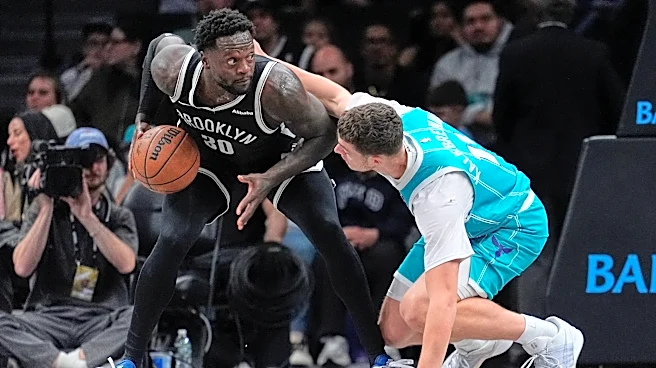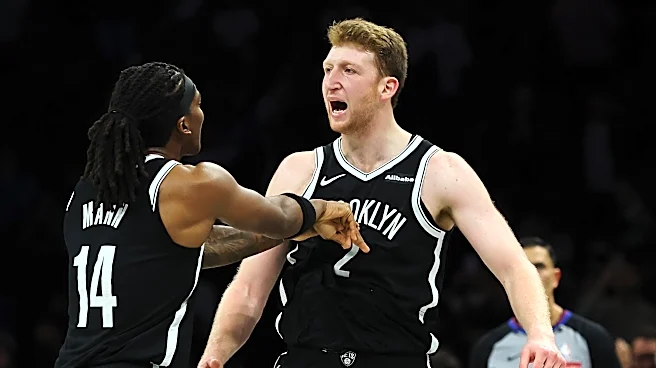

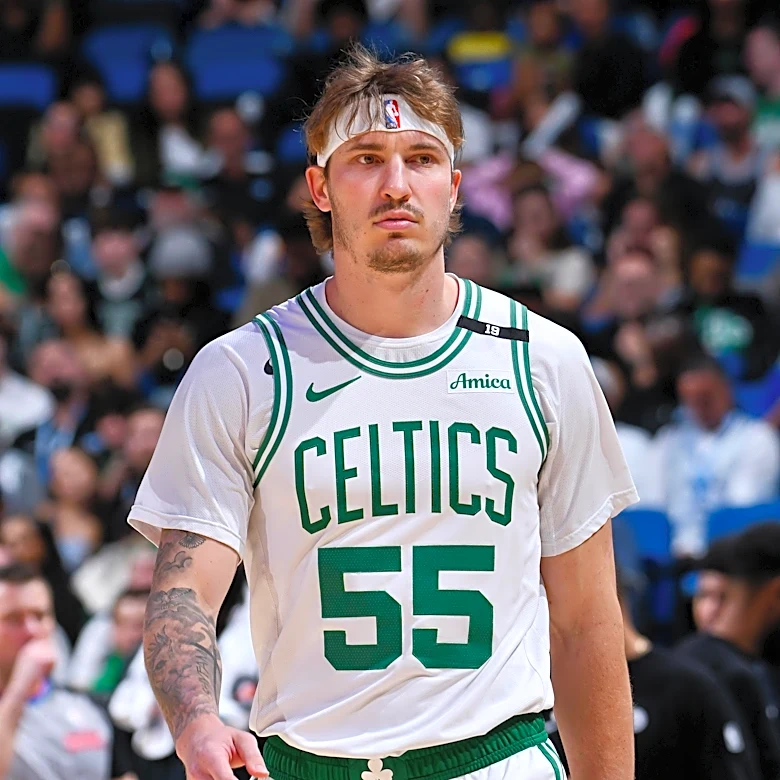


The Nets cried Wolf. This time, he was telling the truth.
Despite selecting a historic slew of first-round picks in 2025, the Nets had seen just two of those rookies, Egor Demin and Nolan Traore, crack Jordi Fernández’s rotation through the first seven games.
Injuries mounted alongside Brooklyn’s losses. Entering Wednesday night with a 1-6 record and coming off a deflating loss to the rival Knicks across the river, they were still winless on their home floor. Urgency kicked in.
Noah Clowney suffered
a knee injury in the first half and was ruled out for the remainder of the night, joining Demin, Joshua Jefferson, Ben Saraf, and Drake Powell on the inactive list — five rookie-contract players forced to watch from the sidelines (or Long Island).
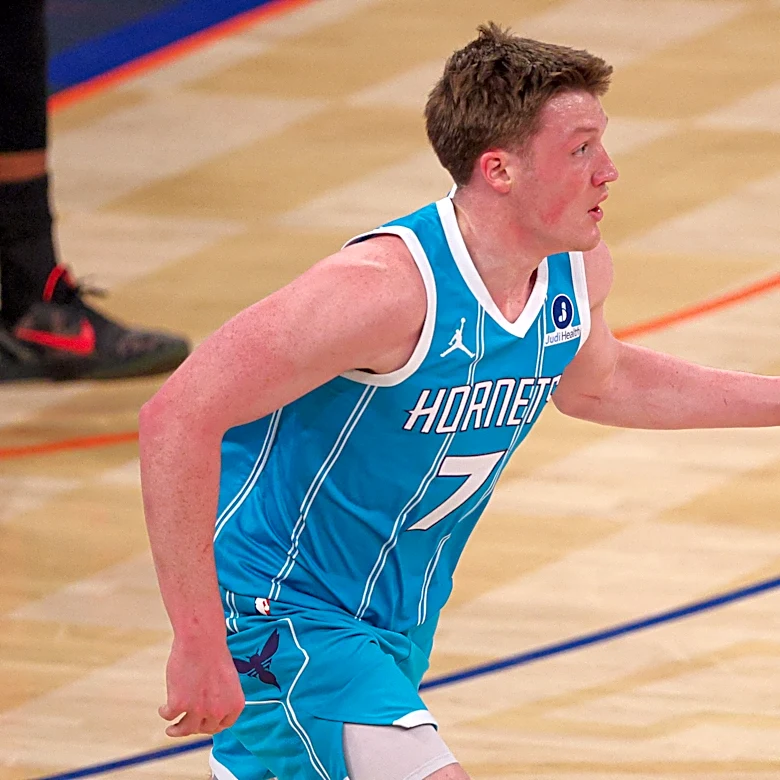
Enter Danny Wolf.
Before Wednesday, the former 27th pick had logged minutes in just two games. His 27 minutes on the court was less than two-way’s Grant Nelson’s 35.
But by the second half, he anchored a unit that turned a tight game into an uncontested 114–104 victory, finishing with 13 points, five rebounds, and three assists on 4-of-6 shooting — including two 3-pointers and a game-high +17 in just under 19 minutes.
“Obviously in the NBA, there’s going to be times especially early in your career that you might not be in the rotation, and that was the case for me starting the year,” Wolf admitted postgame. “Everyone emphasizes and preaches ‘you got to be ready’ and you hear it over and over… When coach called my name in the second half, I was ready.”
It’s a small sample size, but when Wolf knocks down shots and makes plays as a secondary facilitator, he gives Brooklyn a distinct way to generate offense in transition. That dynamic starts on the glass: the more defensive stops the Nets string together, the more opportunities Wolf has to snag a rebound and push the pace before opposing defenses can set up.
General manager Sean Marks has long shown an appreciation for frontcourt players who can rebound and push — from Trevor Booker to Ben Simmons to Julius Randle. Wolf fits that modern “grab-and-go” archetype, but adds a legit 3-point stroke to the equation.
“The biggest staple of our team, especially our offensive identity, is supposed to be playing fast,” Wolf explained postgame. “We use the terminology ‘pace and space’ and I feel like there’s times with my play style that I can really help us push the ball up the floor, make simple passes, start the break. Momentum is what helps win you a basketball game.”
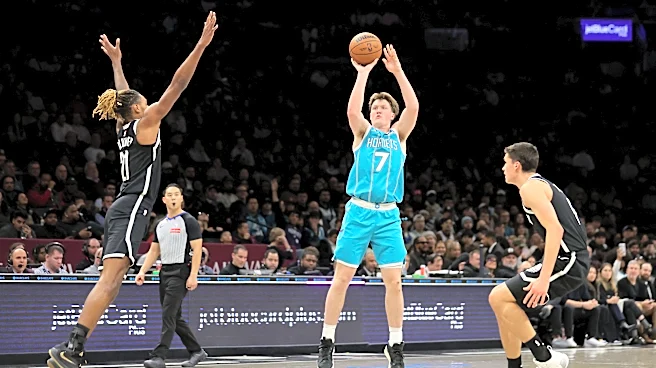
The sequence that swung Wednesday night’s game highlighted that approach. Moments after checking in during the third quarter, Wolf snagged a defensive rebound, pushed the pace, and initiated a transition drive that resulted in a Julius Randle AND-1 layup. On the next possession, he trailed the play, spotted up behind the arc, and hit a 24-foot triple to give Brooklyn its first lead of the second half at 61–59, forcing a Charlotte timeout.
To make it work, Fernández sat three-time All-Star Julius Randle down the stretch in favor of the rookie. Crucially, Fernández didn’t deploy Wolf as a standalone center.
Wolf played every single minute alongside a traditional interior anchor — logging 15 minutes and 37 seconds next to Day’Ron Sharpe and 2 minutes and 59 seconds alongside Moritz Wagner.
Protecting Wolf from heavy low-post drop coverage and rim-protection duties allowed him to roam freely and make decisions in the open floor. During Wolf’s 15:37 alongside Sharpe, the Nets outscored Charlotte 46-32 (+14), with Wolf racking up 10 of his 13 points, all five of his rebounds, and two of his three assists.
The framework for utilizing a player with Wolf’s skillset is familiar to Fernández from his time under Michael Malone in Denver.
“I think that you have to be creative with players that are uncommon,” Fernández said in Oct. 2025. “I was very fortunate to work with Nikola [Jokic], and we had to let him show us what he was able to do. Otherwise, if you see him as a traditional player, then you could fail… Nikola showed certain things that were so different for his position and a seven-footer, and that’s why he makes all these plays and plays in situations where no other big man plays.”
It isn’t about becoming the next Jokic, though. Wolf finding his footing in the NBA has required him adjusting from his heavy-usage roles at Yale and Michigan, where his playmaking came from high volume.
“I think that the coaches [at Michigan] didn’t even know what my role was going to be,” Wolf also said in Oct. 2025. “At Yale, I was more of a traditional 5, and then at Michigan, I don’t even know what you would call my position or how I played… In the NBA, it’s about continuing to get better within the confines of the roles your coach wants you to play.”
On Wednesday, that work in progress delivered real results.
Wolf opened the fourth quarter by hitting a 25-foot transition jumper off a pass from Terance Mann. Operating out of the high-post, he delivered a crisp pass to Traore for a driving floater before driving into the lane himself for an And-1 layup. When Charlotte made a late push, Wolf secured a key offensive rebound, drew the foul, and sank both free throws to seal the victory.
Michael Porter Jr. echoed that praise in the locker room.
“I ain’t gonna lie, the difference tonight was Terance Mann and Danny Wolf. They haven’t been in rotation much, they came in ready to play… Danny coming in and contributing right away like that, that takes a lot of readiness and a lot of discipline to not play for so many games, come in the second half, and contribute the way he did. I always thought Danny was a special player, and I’ve said that since he got here.”
During his first Summer League in August 2025, Wolf said he’s a “work in progress.” Now, some of the progress is tangible and helping lead to wins.