
Before I begin, I should let you know that this article is mostly just venting. Major League Baseball hasn’t listened to me when I’ve written on this topic before and I’m pretty sure they’re not going to listen now.
Nevertheless, I persist.
March 26 is too early to play baseball in northern cities. Period, full stop. I’m sure those of you who live in the Chicago area are familiar with this meme. This version was posted eight years ago, but is still absolutely relevant:
No question, we are somewhere between “spring of deception” and “third winter,” and after all the rain we’re about to get over the next few days, it will definitely be “mud season.” (The White Sox called off their scheduled home opener Thursday because of a forecast of heavy rain; they rescheduled for Friday.)
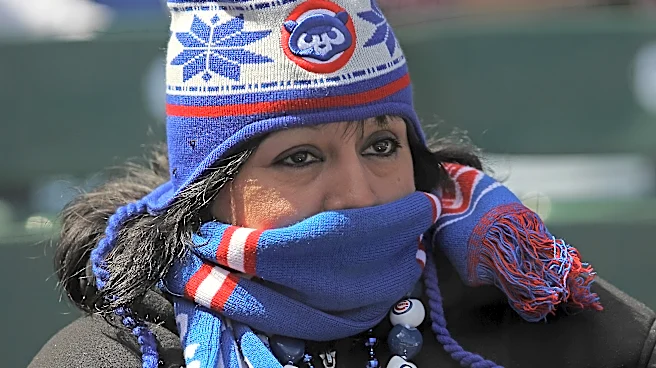
“Spring of deception” was in evidence Monday evening at Wrigley Field, when the game time temperature was 77 and more than 36,000 paid to see the Cubs defeat the Angels. I was told that there were thousands of walk-up tickets sold that night, and given that the paid crowd Tuesday was about 26,000, that tracks. Even with that 77-degree temperature, the average game-time temp for the six-game homestand just ended was 51.5 degrees. That’s barely tolerable for this time of year, and take that day out and the average for the other five games was 46.4. Yuck.
Further, Wednesday afternoon’s game was played in 39-degree weather with a reported sustained wind speed of 21 miles per hour, blowing in. That was just the 10th game in Wrigley Field history (where there’s officially recorded weather data) with both a temp that low and a wind speed that high:
| Rk | Team | Date | Temp | Wind Speed | Opp | |
|---|---|---|---|---|---|---|
| 1 | CHC | 2026-04-01 | 39 | 21 | LAA | |
| 2 | CHC | 2023-04-01 | 39 | 23 | MIL | |
| 3 | CHC | 2018-04-14 | 38 | 24 | ATL | |
| 4 | CHC | 2014-04-04 | 38 | 23 | PHI | |
| 5 | CHC | 2013-04-09 | 39 | 23 | MIL | |
| 6 | CHC | 2005-04-23 | 36 | 25 | PIT | |
| 7 | CHC | 1997-04-08 | 29 | 22 | FLA | |
| 8 | CHC | 1994-04-05 | 35 | 25 | NYM | |
| 9 | CHC | 1993-04-20 | 36 | 26 | HOU | |
| 10 | CHC | 1990-04-10 | 37 | 30 | PHI |
I remember that 1997 game well. It was Opening Day, and the 29-degree temperature remains the lowest ever recorded at a Cubs game at Wrigley Field. It was impossible to not be freezing that afternoon. The famous 14-10 comeback win over the Braves in 2018 was a game played in possibly the worst conditions ever at Wrigley, given that a light rain fell throughout the game and they never stopped play.
The Cubs have a three-game series against the Pirates next weekend at Wrigley after the current road trip, then hit the road again for a three-game set in Philadelphia before returning for a seven-game homestand against the Mets and Phillies beginning April 17. By then, maybe, we’ll begin to have decent weather in Chicago.
March 26 (actually, March 25 if you include the Giants/Yankees season opener in San Francisco) is far too early to start the MLB season. Why are we here? In part, because recent CBA’s between MLB owners and players have mandated a certain number of off days during the regular season. Now, I’m not opposed to that; rest days are a good idea for players. But adding those extra off days has also added several days to the regular season’s length, which this year spans 187 days from March 25 to Sept. 27. Ten years ago, the regular season length was 182 days, and if you remember shorter seasons that began in mid-April and ended before October, that was in the days of scheduled doubleheaders. For example, 60 years ago in 1966, the season was 171 days long (April 12 to Oct. 2), but the Cubs had 10 scheduled doubleheaders that year. That’s simply not possible in baseball in 2026.
The expanded postseason then lasts almost five weeks. MLB hasn’t set a postseason schedule for this year yet, but if it mirrors last year’s, Game 7 of the World Series would be played on Oct. 31.
If MLB wanted to have a schedule that made more sense by the calendar, they’d push it back about 10 days. Typically, the weather in northern cities is better in October than it is in April. The problem with that: TV networks don’t want the World Series pushing too far into November, because that is “ratings sweep month” and they want their entertainment shows there, not baseball.
Some will say that if the league insists on scheduling games in northern cities in March, they should at least be divisional games, where the team would come into town later in the year and you’d at least have a potential makeup date for a postponement. That would be slightly better than scheduling, for example, the Nationals and Angels… but it’s still dumb when there are alternative ideas.
So what are those alternative ideas?
The way I see it, there are two possible solutions.
The first is shortening the season, which I wrote about here a few weeks ago. This is undoubtedly going to happen once MLB expands to 32 teams, which will likely not happen until the Rays stadium situation is settled, so we could be five years or more away from that. Even so, when that happens and the regular season is shortened, we are likely going to have an expanded postseason, which would eat up some or all of the saved time from shortening the regular season. Thus that isn’t necessarily going to push the regular season start date back into April, where it belongs.
The second is something that’s been resisted by MLB and its teams for quite some time, but it’s also something I think has to happen if the league is going to insist on playing almost a week’s worth of games in March: Play all of them in warm weather cities or cities with stadiums with roofs. It was especially dumb, for example, to have the Angels playing in Chicago this week. Not only did that risk postponement, but with a team that has its home 2,000 miles from Chicago, that made potential makeup dates difficult because the Angels schedule is more West Coast-centric. The league was lucky that rain didn’t interrupt the last two games of the series given dire forecasts, but the Tuesday and Wednesday games were played in awful conditions that weren’t fair to fans, gameday staff or players.
Here are the MLB teams that I would consider to be either located in warm-weather cities or with indoor stadiums: Blue Jays, Rays, Astros, Rangers, Angels, Mariners, A’s, Marlins, Braves, Brewers, Dodgers, Diamondbacks, Giants and Padres. That’s 14 of the 30 teams. The following MLB cities are what I would consider “mid-latitude” locations, places where it can generally be warm enough in late March/early April to host games: Kansas City, St. Louis, Cincinnati, Baltimore and Washington. The league could rotate those five cities, one every five years, in joining the other 14 to host games over the first week.
Yes, I’ve heard the objections:
- Those cities don’t want all the early season games; kids are still in school, people aren’t on vacations, etc.
- Teams don’t necessarily want to start on the road every single year
To which I say, “Too bad.” It’s just too cold and potentially wet in most northern cities to play baseball there in March. Granted, this sort of bad weather can — and does! — happen in those cities well into April, but at least the chances of good weather are better in April than in March.
I think the teams/cities noted above need to suck it up and host the first week of games. Every single year. MLB is a $12 billion business, they could make it worth those cities’ while to be the hosts for a week at the beginning of the season, instead of (for example) seeing Wrigley Field with announced crowds of 25,000, maybe a third of whom are actually in the ballpark.
Beyond the fact that playing in cold conditions like this is inconsiderate to fans, gameday staff and players, it doesn’t make for good baseball. You saw quite a number of routine pop flies that should have been caught at Wrigley over the first homestand drop untouched. Cold weather makes it more difficult for players to get loose and risks injury.
All right, I’ve had my 1,400 words of venting. What do you think?