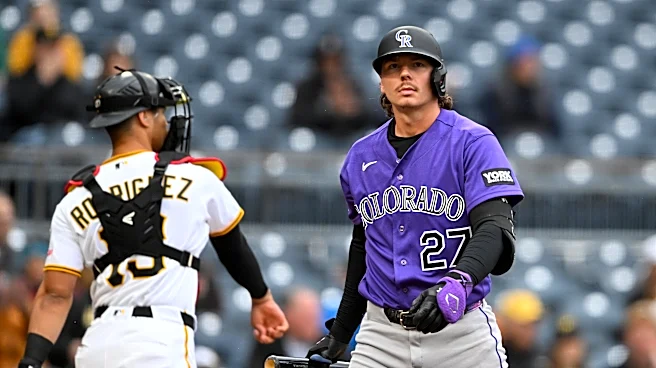



Welcome to the 2026 edition of Ranking the Rockies, where we take a look back at every player to log playing time for the Rockies in 2026. The purpose of this list is to provide a snapshot of the player in context. The “Ranking” is an organizing principle that’s drawn from Baseball Reference’s WAR (rWAR). It’s not something the staff debated. We’ll begin with the player with the lowest rWAR and end up with the player with the highest.
No. 50, Troy Johnston (-0.8 rWAR)
Troy Johnston wasn’t guaranteed anything when he arrived in Scottsdale
last spring.
The Rockies had claimed him off waiversfrom Miami in November, during that strange period between Bill Schmidt stepping down and Paul DePodesta taking over baseball operations. He joined a crowded collection of first basemen and corner outfielders, and even making the Opening Day roster was hardly assured.
He made it.
Then he never left.
For the first time in his career, Johnston spent an entire season in the major leagues. He appeared in 128 games, received 449 plate appearances and, for long stretches, became one of the more reliable bats in a Rockies lineup that badly needed them.
Johnston spent months hitting around .300, piled up 32 doubles and showed an ability to square up major-league pitching. He also hit just four home runs, struggled in the field and on the bases, and gradually moved from an everyday role into something much more selective.
By the end of the year, the Rockies had a much clearer idea of what Johnston could do. The harder question was how much value that package ultimately carried.
The numbers
Johnston finished with a 95 OPS+, putting his full-season production just below league average. That still does a poor job of describing how he actually got there.
There were extended periods when he was quite a bit better than that. He hit .313/.371/.448 in March and April, .307/.365/.398 in May and .319/.402/.464 in June. Then came a disastrous July, followed by a .319/.407/.511 August and another sharp downturn in September.
Johnston did not spend six months looking like a 95 OPS+ hitter. He spent parts of the season looking like a legitimately good one and other parts looking like a player whose grip on regular playing time was disappearing.
What actually happened
Johnston wasted very little time making himself difficult to remove from the lineup.
On April 6 against Houston, batting cleanup and starting in right field, he went 3-for-5 with a double, a home run and two RBI in a 9-7 Rockies win. Less than two weeks later, he put together what may have been his best all-around offensive game of the season.
On April 18 against the Dodgers, Johnston went 3-for-4 with two doubles and two RBI as Colorado won 4-3. It was exactly the kind of night that would become familiar during his first few months: plenty of contact, balls into the gaps and production without needing to hit the ball over the fence.
Johnston made most of his defensive time in the outfield, primarily in right field, while also seeing action at first base.
Johnston showed some value on the other side of the ball the next afternoon, making a diving catch in right field for the final out of a 9-6 win over the Dodgers.
The Rockies responded by treating him like a regular. Through the end of June, Johnston had started 68 of the 77 games in which he appeared. His place in the batting order reflected it, too. There were experiments near the top early in the season, but by May and June he was regularly hitting fifth, right in the middle of the lineup.
He kept giving the Rockies reasons to put him there.
On June 14 against the Athletics, Johnston doubled, homered and drove in four runs in a 23-9 win. It was his biggest RBI game of the year and one of those occasional reminders that, while power was never going to define his game, he could still do damage when he got the right pitch.
By the end of June, Johnston was hitting .312/.378/.435 through 284 plate appearances. A player who entered camp unsure of a roster spot had become a regular in the lineup.
Then July changed the conversation.
Johnston hit .148/.234/.185 in 64 plate appearances. He still started 16 games during the month, but his place in the lineup was changing. After spending much of May and June batting fifth, Johnston made most of his July starts in the sixth or seventh spots.
August complicated the picture again.
Johnston was no longer playing every day, but he started hitting again. He batted .319/.407/.511 with a .918 OPS in 54 plate appearances while making only 12 starts. Five of those starts came from the No. 8 spot, and another five of his appearances came off the bench.
On Aug. 22, Johnston had two hits and a double. The next day, he came off the bench and doubled again. On Aug. 26 in Washington, hitting eighth as the designated hitter, he went 2-for-5 and launched his fourth home run of the season, a two-run shot in a 13-1 win.
The regular middle-of-the-order role was gone, but Johnston showed he could still produce when the plate appearances became less predictable.
The next day in Washington offered a reminder of the other parts of his game. Johnston was on first with two outs in the seventh inning when catcher Keibert Ruiz caught him straying too far from the bag and picked him off to end the inning.
By September, the smaller role had largely stuck. Johnston appeared in 14 games and started 11, receiving 47 plate appearances. Seven of those starts came from the seventh spot in the lineup.
On Sept. 6 against St. Louis, the Rockies briefly moved him all the way up to second. He went 0-for-5 with four strikeouts.
Nine days later, Johnston provided one last reminder of why the bat had kept him around all season. Against San Diego on Sept. 15, he went 3-for-3 with two doubles and two RBI in a 9-3 win.
He followed that with a handful of scattered hits down the stretch but finished September at .186/.255/.279, another sharp downturn after the August rebound.
The contact was real, but so were the limitations
Johnston’s July collapse looked dramatic in the box score, but he had not suddenly stopped hitting the ball hard.
In fact, his hard-contact rate increased to 46.7% during the month. The problem was where those balls were going.
When we looked at Johnston near the end of July, the issue was less about finding additional raw power than getting back to the line drives and gap contact that had made him productive earlier in the season.
The line drives returned in August, and so did the results.
That fits the larger offensive profile. Johnston’s .276 expected batting average was among the best in baseball, while his 39.7% launch-angle sweet-spot rate and 86% zone-contact rate reflected how consistently he put the ball in play at useful angles.
But useful contact and damage are different things. Johnston’s barrel rate was just 2.2%, his expected slugging percentage was .375 and he chased more than 35% of pitches outside the zone.
He was good at making contact when he swung. He just did not create much margin for error around that skill.
The platoon split points toward a more selective role. Johnston hit .299/.380/.418 with a .798 OPS in 337 plate appearances against right-handed pitching, compared with .214/.252/.320 and a .573 OPS against lefties.
The rest of his game pulled the overall value in the other direction.
Johnston stole four bases and was caught five times, with Baseball-Reference grading him two runs below average on the bases. Defensively, Baseball-Reference credited him with -9 Defensive Runs Saved overall and -9 fielding runs, while Statcast also graded his range below average.
Baseball-Reference graded Johnston at just four runs below average with the bat. The larger losses came on the bases, in the field and through the positional adjustment, leaving him at -0.8 rWAR.
There was, however, one place Johnston did not allow a run all year: the pitcher’s mound.
He made two appearances, worked two scoreless innings and allowed one hit. Baseball-Reference even credited him with 0.1 pitching WAR.
Johnston also brought plenty of energy and personality to a team that spent most of the season losing. It won’t determine a roster decision, but if Baseball Savant ever creates a personality percentile, Johnston would have a pretty strong case for the red.
Where does Johnston stand heading into 2027?
Last spring, the question was whether Troy Johnston could make the Rockies.
A year later, he is in almost the same place.
Colorado now has a full season of evidence showing what Johnston can provide, particularly against right-handed pitching. It also has a much clearer view of the limits around that skill set.
That still leaves Johnston looking like a possible left-handed matchup bat in a flexible role. His remaining options help, but younger players will be competing for those opportunities.
He made the team last March without any guarantees.
Heading into 2027, there is no guarantee he even gets the chance to do it again.
Join the conversation!
Sign up for a user account and get:
- Fewer ads
- Create community posts
- Comment on articles, community posts
- Rec comments, community posts
- New, improved notifications system!
Download the SB Nation app on iOS or Android.
Please keep in mind ourPurple Row Community Guidelines when you’re commenting. Thanks!