
As Miami returns to the apex of college football for the first time in a quarter century, Florida State fans are forced to reckon with an uncomfortable question: how did the Seminoles end up in their current
situation?
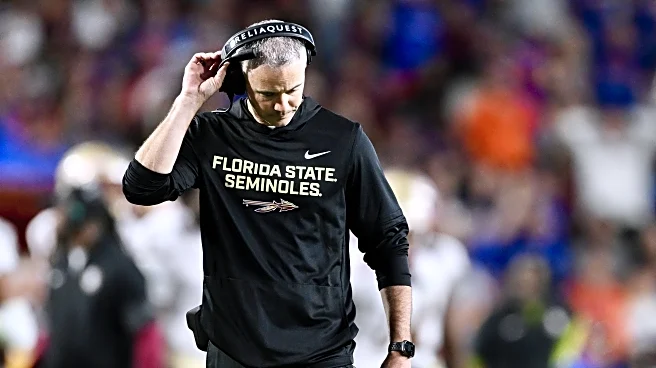
Mike Norvell’s return to Florida State in 2026 is not a vote of confidence. It is an admission that Florida State is effectively trapped in football purgatory until it can secure an exit from the ACC, whether to the Big Ten, the SEC, or whatever structure ultimately emerges from an inevitable college football breakaway.
The program’s current balance sheet explains why Norvell was allowed to return despite Florida State not winning a game away from Tallahassee and going 3–13 against the ACC since the 2023 playoff snub. It is not because the university believes he is the long-term answer, but because Florida State lacks the financial capacity to absorb his buyout while also hiring a top-tier replacement.
Athletic director Michael Alford bears some responsibility for this moment. He authorized Norvell’s massive contract extension and now manages its consequences. But focusing narrowly on Alford or Norvell misses the larger truth. Florida State’s predicament is not the result of one bad hire or one failed season. It is the product of two decades of institutional drift, misaligned incentives, and governance failures spanning multiple administrations.
To understand how Florida State arrived here, one must return to the foundational decision that continues to shape everything that followed: joining the ACC rather than the SEC in the early 1990s.
Rival fans and lazy sports commentary often reduce that choice to a single Bobby Bowden quote about the ACC offering the “best route to a national title.” That framing is both misleading and historically incomplete. Bowden was not the primary decision-maker, nor did easy football wins dominate the calculus.
At the time, the choice made rational sense. Under commissioner Gene Corrigan, the ACC was financially strong and culturally aligned with Florida State’s academic aspirations. A television environment that emphasized basketball allowed the ACC to secure the richest per-school media deal in college sports. The league’s 1992 agreement, buoyed by Florida State’s football brand and elite basketball programs, paid more per school than any other conference. For more than a decade, the ACC led college athletics in per-member distributions.
A fact often ignored by prognosticators and fans is that university presidents, not football coaches, vote on conference affiliation, and Florida State was no different. University leadership viewed ACC membership as a strategic tool to elevate Florida State’s academic profile and shed its reputation as a party school with a football team. Rubbing shoulders with presidents from institutions like Duke, Virginia, and North Carolina provided Florida State access to academic and institutional networks it previously lacked.
That financial reality matters because it reframes Florida State’s decision. This was not competitive cowardice. It was a business decision that delivered strong dividends for Florida State athletics and the university as a whole for more than a decade.
Yet even in those early years, there were warning signs that the partnership was built on unstable ground. Wake Forest and Duke opposed Florida State’s admission over concerns about diluting ACC Tournament ticket shares. On the day of the vote, Maryland unexpectedly flipped to “no,” nearly derailing expansion. When Corrigan called Maryland athletic director Andy Geiger to ask why, the answer was an additional $60,000 in annual travel costs to Tallahassee.
Corrigan’s incredulous response, “Andy, we’re talking about millions of dollars here”, captured the wildly divergent institutional priorities operating under the same revenue model, tensions that would simmer for decades.
Those differences were initially papered over by money. Florida State used ACC television revenue to make Bobby Bowden the first college football coach to earn more than $1 million in a season. The league’s basketball-centric schools largely ignored football while Florida State dominated it. Between 1992 and 2003, the Seminoles won more ACC games by 50-plus points than they lost in total. ACC schools routinely moved home games against Florida State to Jacksonville, Orlando, and Miami because the revenue upside outweighed the loss of home-field atmosphere.
This arrangement bred complacency on both sides. Florida State grew accustomed to competitive superiority without meaningful peer resistance. The rest of the league grew dependent on Florida State’s value while investing little in football infrastructure. As long as basketball generated comparable media revenue, the imbalance was tolerable.
That equilibrium collapsed in the mid-2000s, when football became the dominant driver of television value. The ACC attempted to respond through expansion, raiding the Big East for Miami, Virginia Tech, and Boston College. Miami and Virginia Tech had combined to appear in three national championship games and six BCS bowls in the five seasons prior to joining the ACC. The expansion was anchored on the assumption of recurring Florida State–Miami championship matchups. More than 20 years later, those two programs have never met in the ACC title game.
The results were worse than disappointing; they were structurally damaging. 2026 will be the first time Miami will have a Top 5 finish since joining the ACC. Virginia Tech has finished ranked just twice in the past 13 seasons and has not finished in the Top 10 since 2009. More importantly, the ACC badly misread the next phase of realignment: securing large, statewide fanbases capable of forcing conference networks onto basic cable tiers. That miscalculation would soon prove catastrophic.
When the Big Ten launched the Big Ten Network, it turned television inventory that had previously been financial dead weight into a gold mine by pooling third-tier rights and distributing them via cable. The SEC followed suit in 2014 with the SEC Network. Conference networks quickly became the clearest dividing line between leagues that understood the future and those reacting to the past.
The ACC reacted poorly. In 2010, it signed a deeply backward-looking television deal with ESPN that remains the root cause of its present dysfunction. While headline rights kept pace with peer conferences, the ACC surrendered all third-tier rights to ESPN for virtually nothing. ESPN then sublicensed those rights to Raycom Sports for roughly $50 million per year—revenue the conference never touched.
This decision was driven by commissioner John Swofford, who prioritized maintaining Raycom as a partner. Swofford cited Raycom’s long-standing relationship with the league, but the optics were impossible to ignore: his son was a Raycom executive, and retaining ACC rights was critical to Raycom’s survival after losing the SEC package. Whether viewed as nepotism or catastrophic miscalculation, the outcome was the same. The ACC forfeited the revenue stream that would soon define competitive viability.
Maryland later cited this television structure as the primary reason it left for the Big Ten, a warning Florida State ignored.
At the same time the college sports world was reinventing itself, Florida State was actively tearing itself down. Bobby Bowden’s decision to circumvent Florida public employee nepotism rules and install his son Jeff Bowden as offensive coordinator marked the beginning of the program’s internal decline. For six seasons, Bowden ignored mounting evidence that the arrangement was disastrous, until the program hit bottom with a 30–0 loss to Wake Forest in 2006.
Jeff Bowden resigned days later, cushioned by a $500,000 buyout assembled by the Seminole Boosters and athletic director Dave Hart. Removing Bowden’s son without his consent fractured internal trust and created political aftershocks that still reverberate. In 2007, Hart’s contract was not renewed amid the online music class scandal. Leadership believed the NCAA would issue minor penalties and provide convenient cover for a transition. Instead, the NCAA imposed multi-year sanctions and vacated wins across football and basketball. Those sanctions permanently stripped Florida State of recognized NCAA records, including Bowden’s career win total and the program’s bowl streak.
More damaging than the sanctions themselves was the timing. Florida State entered a period of seismic change in college athletics without stable, experienced leadership at the top of its athletic department.
As Florida State searched for stability, it faced an additional structural problem; the outsized influence of Andy Miller, longtime president of the Seminole Boosters. Because the Boosters operated as a legally separate entity, Miller functioned as the true power broker within FSU athletics. His philosophy, shaped during Bowden’s dominance, emphasized austerity and tradition over modernization. By the late 2010s, this approach had become a liability, most infamously illustrated by Miller’s suggestion of an “old-fashioned door-knocking campaign” to address growing budget shortfalls.
This governance structure,unique among major programs, discouraged qualified athletic director candidates and slowed Florida State’s response to an escalating facilities and spending arms race.
Randy Spetman, hired in 2008, proved ill-suited to navigate that environment. Despite prior experience at smaller programs, he struggled with the scale and complexity of a Power Five operation. Under his tenure, Florida State’s finances deteriorated, scheduling decisions drew widespread criticism, and institutional complacency toward conference alignment became public. Spetman’s assertion in 2011 that Florida State was “comfortable” in the ACC aged poorly. He was ultimately dismissed in 2013.
The most consequential decision of this era fell to then-president Eric Barron. Barron, an academic by disposition, showed little appetite for aggressive athletic positioning. Rather than explore alternatives, he dismissed SEC and Big 12 rumors and defended ACC membership at the height of realignment volatility. In an internal memo, Barron wrote, “It will cost between $20M and $25M to leave the ACC and we have no idea where that money would come from,” and “[FSU] can’t afford to have conference affiliation governed by emotion.”
He signed the Grant of Rights in 2013 and departed less than a year later for Penn State, leaving Florida State locked into a long-term commitment without having fully reckoned with its implications. It will ultimately cost
John Thrasher, Barron’s successor, brought personal investment and political capital but relied heavily on athletic leadership for strategic guidance. That guidance came from Stan Wilcox, hired from Duke. From the outset, observers questioned Wilcox’s grasp of evolving media economics. Those concerns proved prescient. Wilcox championed the ACC Network and projected annual revenues of $15 million for Florida State. Those projections that helped justify Thrasher extending the Grant of Rights through 2036 as a condition of ESPN’s launch.
Instead, the network struggled to gain carriage leverage with cable operators. Since Florida State joined, ACC expansion had added private schools (Miami, Boston College, Syracuse) or secondary public institutions (Virginia Tech, Pitt). The league lacked large, statewide fanbases capable of forcing conference networks onto basic cable tiers. This structural weakness capped the ACC Network’s upside from the start. It took more than three years for the ACC Network to achieve full major-carrier distribution, compared to just months for the SEC Network.
ESPN-mandated investments pushed Florida State athletics into annual deficits approaching $4 million before Wilcox left for the NCAA in 2018. While the ACC Network has generated revenue, its upfront costs, restrictive contract length, and exposure to accelerating cord-cutting trends have rendered its long-term value dubious. By 2036, conference network subscriber revenue may be entirely obsolete.
This is the context for Florida State’s current decision-making. The lawsuit against the ACC was coming regardless of the playoff snub, because Florida State failed to recognize and act on conference realignment warning signs. The renovation of Doak Campbell Stadium was necessary because Florida State needed to more aggressively monetize the venue, even as officials admit they badly mishandled the messaging surrounding the project.
Florida State’s problems are not cyclical. They are structural. The lawsuits, the deficits, the competitive decline, and the leadership churn are not isolated failures but symptoms of a long arc of institutional misalignment. Until Florida State confronts that reality honestly, no coach, returning or otherwise, will be able to fix what decades of decisions have broken.