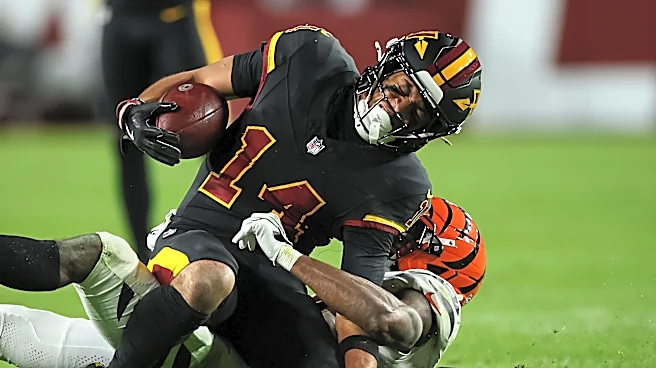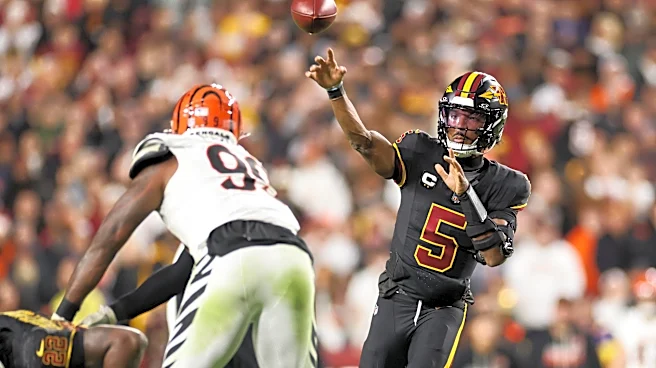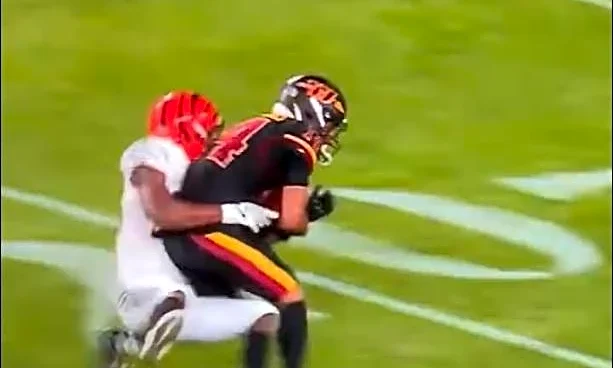

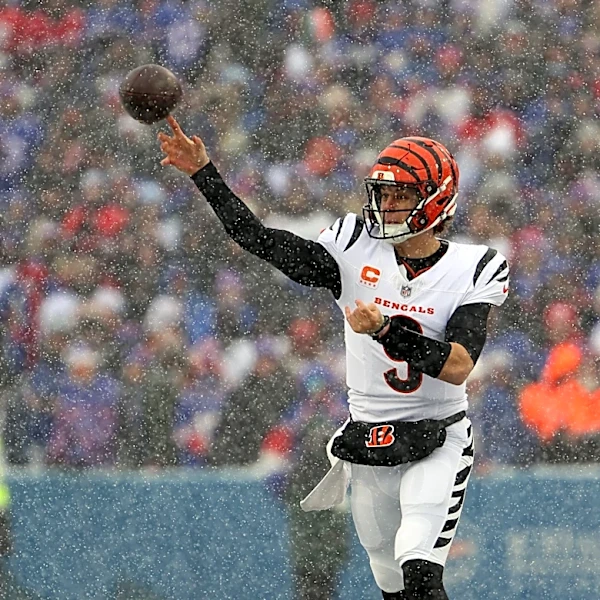

Last Sunday night, when Cincinnati Bengals cornerback Dax Hill dragged down Washington rookie wide receiver Antonio Williams in the fourth quarter of the Commanders’ 22–20 win, no flag hit the turf. Four days later, the NFL fined Hill $17,911 for a hip-drop tackle.
If you have followed the hip-drop tackle rule since the league banned it in March 2024, that sequence probably felt familiar.
Nearly three seasons into the ban, the rule remains one of the strangest enforcement experiments in football: a 15-yard
personal foul that officials almost never call during a game — one which is enforced almost exclusively through Tuesday and Wednesday fine letters. Yet for all the friction around how it is policed, the league’s latest adjustments—triggered in no small part by Washington linebacker Frankie Luvu’s 2025 saga—seem to be moving the needle.
Why the NFL banned the play
The push to eliminate the hip-drop tackle came down to injury math that the league’s health and safety staff, a few years back, felt it could no longer ignore. After studying film from the 2022 and 2023 seasons, NFL Executive Vice President Jeff Miller reported that defenders used the technique 230 times in 2023, resulting in 15 players missing time—an injury rate 20 to 25 times higher than a standard tackle.
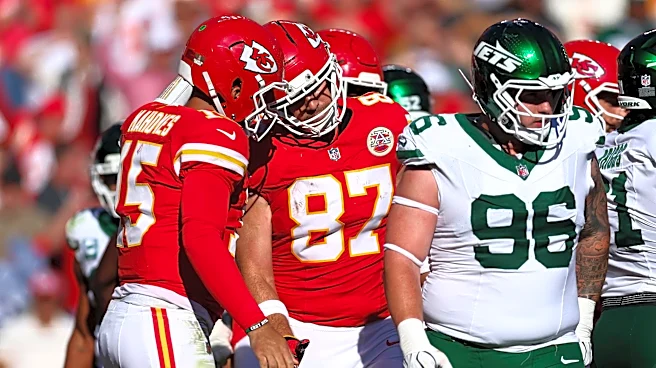
But it was some high-profile lower-leg injuries to Ravens tight end Mark Andrews, Cowboys running back Tony Pollard, Chiefs quarterback Patrick Mahomes, and Seahawks quarterback Geno Smith that really put the play under a microscope.
Essentially, it was found that when a defender wraps a runner, swivels his hips, unweights himself, and drops his full body weight across the back of the ball carrier’s trapped legs at or below the knee, ankles and fibulas simply have nowhere to go.
On March 25, 2024, NFL owners unanimously approved Rule 12, Section 2, Article 18, making the swivel hip-drop a 15-yard penalty and an automatic first down.
Pushback and real-time growing pains in 2024
Players and fans hated the idea from the start. The NFLPA opposed the ban publicly before owners even voted on it, arguing that defenders were being asked to make split-second geometric calculations while chasing elite athletes in open space. Buccaneers head coach Todd Bowles voiced what plenty of defensive coaches were thinking: “Don’t tackle high. Don’t tackle low. Don’t hip-drop. What are you going to tell a guy?”
To prevent flags from flying on every routine wrap-up tackle from behind, the league instructed officials that all three mechanical elements — that is (1) grabbing/wrapping, (2) swiveling and unweighting, and (3) landing on/trapping the lower leg — had to be “clear and obvious” in real time. The result in 2024 was an odd dichotomy:
- On the field: Officials threw just one hip-drop flag across 285 2024 regular-season and postseason games (against Carolina’s Jacoby Windmon in Week 16) — and the league office didn’t even fine Windmon afterward, effectively acknowledging the flag was wrong.
- In the league office: Postgame video reviewers handed out 27 fines over the course of the season.
In the 2025 offseason, the Competition Committee tightened the rulebook language slightly — clarifying that grabbing with “one or both hands” or “landing on and/or trapping” the legs met the threshold. Still, on-field officiating barely budged: referees threw only two flags in all of 2025 (one of which the league later rescinded), while postgame fines crept up to 30.
The Frankie Luvu turning point
If the first two years of the rule exposed the gap between Sunday officiating and weekday discipline, Frankie Luvu’s 2025 season exposed the flaws in the disciplinary ladder itself.
Luvu was fined for hip-drop tackles in Week 4 and Week 8. When he brought down Seahawks wide receiver Jaxon Smith-Njigba in Week 9, the league office flagged the play on Monday tape review as his third hip-drop offense of the season and handed him a one-game suspension without pay—a punishment that would have cost him a $508,333 game check on top of the fines he had already paid.
Luvu appealed, and hearing officer Derrick Brooks (jointly appointed by the NFL and NFLPA) overturned the suspension, reducing it to a $100,000 fine — significant, but far less so than the suspension would have been.
Watching the film, it was easy to see why the suspension didn’t hold up: while the third tackle looked awkward at full speed, momentum carried Luvu into the tackle rather than him intentionally swiveling and unweighting onto Smith-Njigba’s legs. Suspending a player without pay for a play that wasn’t egregious enough to draw a flag on Sunday — and that looked borderline even in slow motion — created an obvious due-process problem.
That standoff led directly to the joint NFL–NFLPA disciplinary overhaul announced on August 26, 2026.
Instead of ad-hoc suspensions, the league and union established a formal “three-strikes” system covering five specific player-safety fouls (hip-drop tackles, horse-collar tackles, launching, hits on defenseless players, and blindside blocks):
- Clear threshold: Any combination of three offenses across those five categories in a season triggers an automatic one-game suspension.
- One-off forgiveness: A player who finishes the season with only a single violation across the five categories receives a 50% refund of his fine at year’s end.
- Coaching accountability: Coaches must attend league review meetings alongside players approaching the three-strike threshold, and teams with excessive violations face club-level fines.
Where things stand in 2026
Through 11 weeks of the 2026 season, the revised framework appears to be working as intended.
After a sloppy Week 4 spike that saw six players fined — including 49ers linebacker Fred Warner and Jets safety Minkah Fitzpatrick — the weekly pace has cooled. Through Week 11, the league has issued 14 hip-drop fines (an average of 1.27 per week, down roughly 24% from 2025’s full-season pace of 1.67 per week). Just as notably, not a single player has been fined for more than one hip-drop tackle so far this season, meaning the 50% end-of-season rebate is giving first-time offenders a real financial incentive to adjust their technique.
The remaining tension is the one that has existed since Day 1: zero hip-drop penalties have been called on the field in 2026. In real time, referees still cannot reliably distinguish between a defender whose momentum pulls them down from behind and a defender who actively swivels and drops their weight onto a runner’s ankles.
For fans, that means a 15-yard foul that almost never affects a live drive on Sunday — even when a play like Dax Hill’s tackle in Week 11 is later deemed illegal by the league office. Until technology or replay assist enters the picture, the hip-drop ban will remain what it has quietly become: a rule enforced in slow motion on Tuesdays rather than in real time on Sundays.