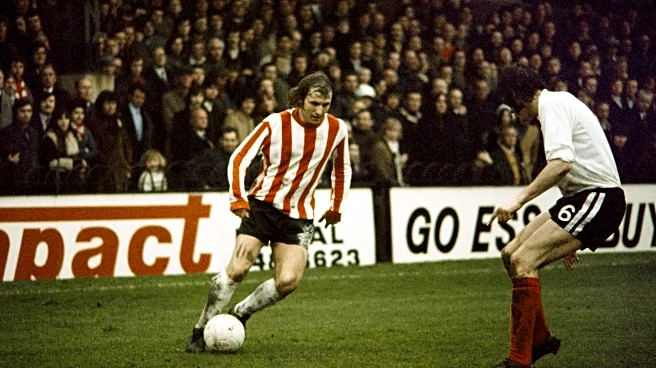


Born in Newcastle — in times when it wasn’t a big issue to Sunderland fans where he came from — Dennis Tueart came through the club’s youth system. Tueart actually started out as a striker which came to serve him well in his senior career as he himself described himself as a ‘right-footed left winger’ but would also play up front.
The predatory instincts in front of goal and positional awareness helped him towards his phenomenal career tally of 196 goals.
He was part of the highly productive Sunderland
youth team of the 1960s, and under manager Alan Brown and aged 19, he made his debut in 1968 in a 0-0 draw against Sheffield Wednesday. His first goal for Sunderland came a few months later in a home win over Stoke on 1 March 1969. Alan Brown was gradually phasing out many of the established players whom he himself had brought into the team in his first spell as Sunderland manager, and replacing them with players such as Dennis from the youth ranks.
It was a curious season on reflection, with Sunderland in mid-table around Christmas time but suffering some catastrophic defeats in their away trips, particularly to the capital, where more than just a couple of big-name strikers cashed in big time when we came to town. Geoff Hurst scored 6 goals in an 8-0 capitulation at West Ham, then a few weeks later on our next trip to London, Jimmy Greaves scored four in a 5-1 defeat. It wasn’t over there because Bobby Tambling scored four for Chelsea in another 5-1 drubbing in April. By the time the season was winding to an end, Sunderland were in another relegation battle and finished only four points above the drop zone.
The next season, Dennis established himself as a first-choice player, but it was not a good campaign on the pitch for Sunderland, as they rarely got out of the relegation places and dropped into the Second Division at the end of the season. The club hoped to bounce back with promotion the next season, but never got going, while Dennis himself fell out with Alan Brown. Still on relatively low wages after coming up from the ranks, he wanted a new contract, which Alan Brown refused to sanction, all the while refusing to pick the player for the first team and putting him in the reserves for three months.

1971-72 saw Dennis back in the starting eleven each week and he started to come on leaps and bounds at this point. He added goals to his game and in each of his next three seasons for Sunderland he reached double figures, and indeed for every season for whichever team he played for up until 1982 he got into double figures.
He was a fast darting winger who could roast full-backs for pace, while also having superb close control that could turn defenders inside out.
Although he thought himself as right-footed he could put in a good cross with his left which created many a goal for grateful centre-forwards.
Meanwhile, Alan Brown’s time as Sunderland manager was coming to an end with the team sinking towards the foot of the table in the winter of 1972-73 and when he departed, in came the man who would change the lives and public awareness of every player involved in our F.A. Cup of 1973 — Bob Stokoe.
While Alan Brown’s style of play had been very regimented in what the players were allowed to do, Stokoe let his team get on the front foot and express themselves. Players like Dennis and Billy Hughes were effectively let off the leash, and their game went to another level, as Sunderland recorded wins against some of the biggest teams in the country: Manchester City, Arsenal and then in the final, Leeds United.
Dennis himself scored three goals in our cup run, and when Jimmy Montgomery pulled off his famous double save at Wembley, he watched from the halfway line. Norman Hunter, who was standing beside him, turned and said, “It looks like it’s going to be your day, Dennis”.

After the cup win, Sunderland were expected to push for promotion in 1973-74, but it didn’t happen.
He was playing well, scoring goals, including one in the Cup-Winners Cup and was ambitious for more. When Manchester City came calling in March 1974, he knew he wanted to leave, and so the first of our Wembley heroes moved on.
He won the League Cup with Manchester City in 1976, scoring a spectacular goal against Newcastle in the process, and he became a firm favourite of the Maine Road crowd for many years.
He also won England caps in the Don Revie era, but the F.A. Cup win of 1973 with Sunderland remained the biggest prize that Dennis Tueart won in his career.
It’s fitting that on F.A. Cup weekend, Dennis Tueart is our featured Sunderland Great.