
Trouble has been brewing for quite some time with Main Street Sports Group (MSSG), the company behind FanDuel Sports Network (“FanDuel” — not to be confused with the other FanDuel, which is a gambling outfit), home of dozens of professional sports teams’ regional broadcasts, including the Atlanta Braves.
Late last year, MSSG failed to make a scheduled and required payment to the St. Louis Cardinals, according to multiple reports. Then, this past week, MSSG failed to make payments to multiple NBA teams.
There has been a lot of in-depth coverage on the topic from multiple sources, but Tom Friend and Mike Mazzeo at Sports Business Journal have been on the leading edge of reporting on the subject, and this updated report last Thursday is a good primer on the topic if you need more background on the topic and the issue.
The short version is this: MSSG has been trying to sell itself to DAZN, although reports indicate that deal may not happen and a second party may be involved. Multiple reports have suggested that if MSSG were to not sell to DAZN, they would end their broadcasting at the conclusion of the NBA and NHL season.
Last week, that timeline changed, as all nine MLB franchises whose games were slated to be broadcast by MSSG via FanDuel Sports Network opted out of their broadcast agreements, putting the future of their broadcasts in question.
When similar issues have arisen in recent years with other MLB teams, MLB stepped in and took over broadcasting for the clubs, including adding the ability to stream those team’s games in-market via MLB.tv.
What does this mean for the Atlanta Braves?
The Atlanta Braves will be fine. Full stop.
The ongoing joke of putting the Braves back on TBS, their long-time broadcasting home that hooked millions of fans across the country and beyond, probably isn’t going to happen in 2026 since TBS is a national broadcast partner of MLB. But because of that fan base, and the team’s consistent success over the past 35 years, the Braves would be one of the most appealing teams whose broadcasting rights are now available.
The path forward isn’t clear. But we’ve taken the liberty of prognosticating the relative likelihood options as they look right now:
- Re-negotiate with MSSG — low probability. The most recent status quo is always possible. MSSG could find a buyer-slash-savior, and whether they do or don’t, the Braves would could negotiate with them to get FanDuel, or whatever successor to FanDuel exists, to put them back on the air. Maybe this happens just for 2026, maybe it doesn’t happen at all. During the earlier, pre-MSSG, Diamond Sports Group bankruptcy, the Braves were initially the only team that maintained its contract terms with Diamond/FanDuel amid the bankruptcy, though the final reorganization plan revised those terms anyway, including offering a direct-to-consumer option. Why is this option low likelihood, despite being the most recent status quo? Because the Braves and the other eight teams terminated their contracts because they no longer wished to be enmeshed with MSSG/FanDuel, especially not with another bankruptcy proceeding looming. Given that step, diving right back in seems unlikely, given that no one forced the Braves to take the termination step at this time.
- Find another broadcast partner – low probability. On the one hand, the Braves are an attractive property to broadcast. On the other hand, there simply isn’t a lot of time. Spring Training starts in a few weeks, and even if you a figure a new partner won’t take over that, Opening Day is marching on. Maybe a lot of FanDuel infrastructure can be ported over. Maybe it can’t. But before that, the Braves and whoever this partner is would also need to negotiate on agreeable terms, which might take a while. With more time, the Braves might also have the luxury of playing offers against each other and maybe even coming out ahead, revenue-wise, from where they were with MSSG/FanDuel, but that seems unlikely now with the clock ticking.
- Join the MLB Media bandwagon – high probability. If no other action is taken, this is likely the interim default. MLB Media already took over broadcasts for other teams, and has the structure to expand that model wherever they need to. The downside is that this will almost certainly have meaningful, adverse revenue implications for the team — if it could maintain the status quo revenue-wise, the Braves would’ve bailed on the FanDuel mishegoss a while ago.
- Gray Media — medium probability, maybe? Gray Media broadcast 15 Braves games in 2025 via over-the-air stations in multiple Southeast markets. In Atlanta, Gray Media owns WANF (Channel 46), a CBS affiliate until midyear 2025, and also owns Peachtree TV. Gray Media has a fair bit of broadcasting infrastructure, as it handled some Gwinnett Stripers games last year, and other professional sports in the Atlanta area. Could there be free, over-the-air Braves games in Southeast viewers’ futures? Who knows, keep an eye on it.
- An integrated, Braves-owned broadcast experience – low probability (for now?) But for timing, this might be the way to go, in the footsteps of the Yankees and the YES Network. The Braves are already more than just a baseball club (wave to the Battery and the club’s real estate investments, everyone), and one way to reduce the broadcast headache for consumers is to make it the team’s direct headache instead. There are two things working against this: first, there simply may not be enough time for 2026, and with the lockout looming in 2027, it may not be very exciting to start building the groundwork for until after that’s resolved. Second, the winds emanating from Rob Manfred suggest substantial interest in packaging all MLB team local rights and selling them for a princely cash bounty to some big tech player. That makes a team investment in building up its own broadcast infrastructure iffy, unless the Braves get a sense of which way those winds are blowing. Braves honcho and control person Terry McGuirk, who represents the team in the colloquium of owners, cut his teeth working with TBS and is very plugged in to all matters media, so the Braves won’t be caught flatfooted here — chances are, if they proceed this way, it won’t backfire.
So, while we don’t know how things will shake out, the Braves definitely have a fallback option (MLB Media), and the question isn’t whether you’ll be able to watch the Braves — just how you’ll get the majority of the games, and what hoops you have to jump through to access the rest.
What about the broadcasters?
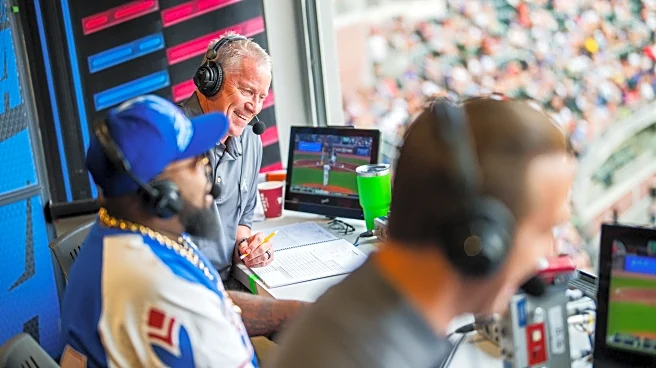
As for the team’s television broadcasters, barring something unforeseen, there will not be any changes to the broadcasting team regardless of who ends up with the 2026 in-market broadcasting rights. Most teams, including the Braves, have substantial, if not complete, influence on who represents the team live on air, and a disruption of what is generally considered to be a strong broadcasting team is not be expected.
Resolution for this issue may not happen in the next few weeks, but with Spring Training almost one month away and the regular season starting in the last week of March, expect a resolution — at least for 2026 — sooner than later. The Braves might not come out of this unscathed, but they’ll come out of it.