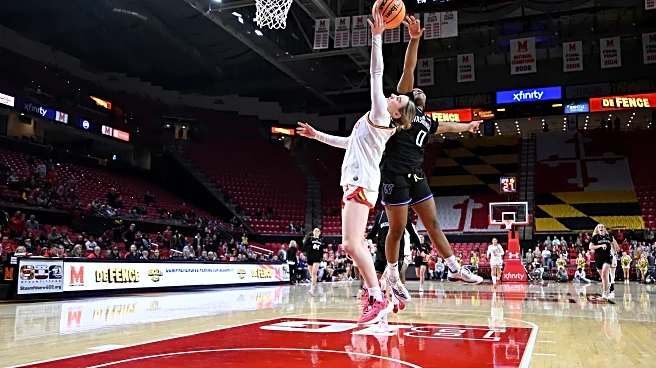


No. 16 Maryland women’s basketball fell to No. 25 Washington in a double overtime thriller. The Terps had multiple chances to win the game, but didn’t pull through.
Here are three takeaways from Maryland’s third consecutive loss.
Clutch free throw shooting
At the end of the first overtime, the Terps were given a lifeline.
Down by one, Saylor Poffenbarger was fouled before time expired. All Poffenbarger had to do was make both of her free throws to win the game.
She swished the first one, and the game came down to the second attempt.
It clanked off the rim.
With a chance to win the game, Poffenbarger went 1-of-2 from the free throw line — something she did on all four of her trips to the charity stripe.
“We had plenty of opportunities,” head coach Brenda Frese said. “We make some layups, we make some free throws, it’s a different outcome.”
Late in regulation, Poffenbarger had a chance to extend Maryland’s lead to four and give the Terps a two-possession lead. She missed the first and made the second. Then, Elle Ladine cashed a second-chance 3-pointer to send the game to overtime.
Again in double overtime, Poffenbarger had a chance to cut the deficit to one — she missed the first.
Kyndal Walker had a chance to tie the game and split her attempts from the line. In regulation, she made two clutch free throws to give the Terps the lead, but Poffenbarger’s later miss allowed the game to go to overtime.
The Terps had a relatively solid free throw shooting night; they shot 13-of-19. That said, they could not convert in high pressure situations that would’ve made the difference in the game.
“We stay positive and confident with them. You’ve got to put in the work, which this team does,” Frese said. “That was the disappointing thing, we’ve been shooting a lot of free throws. We’ve had a lot of time with no school and then through the winter break.”
In the second half and overtime, the Terps had eight trips to the charity stripe with two attempts. They cashed in on both three times and missed five free throws. Washington won the game by three points.
“At the end of the day, you’ve got to have a mentality when you go up that you want it,” Frese said. “Very similar to how [Sayvia] Sellers performed, she met the moment, she wanted the moment. Then, we’ll continue to grow in these moments.”
Failure to guard Sayvia Sellers
Sellers came into Wednesday’s game averaging 18.3 points, the seventh-most in the Big Ten.
In the first half, she scored four points. She finished with 38.
“Sellers was sensational, especially in the second half,” Frese said. “Showed she’s the All-Big Ten player that she is.”
The Terps, having contained her, had a sizable lead at halftime.
“We knew the first half we could have defended a lot better,” Sellers said. “We came out of halftime and really locked in on the defensive end, and then we were able to get in transition.”
Coming out of the half, Sellers broke away. She scored 45.8% of Washington’s points on the game, including 56.7% in the second half and overtime.
“She had her way with anyone put on her,” Frese said. “We tried a lot of different full screen defenses at her, and she just knew the right plays. If you tagged it, she was going to go kick to the corner.”
The Terps had Oluchi Okananwa, Kyndal Walker and Mir McLean try to guard Sellers. As Frese said, whoever was guarding her wasn’t able to contain her.
“She played a pretty flawless game,” Frese said.
Another tight loss
Wednesday marks Maryland’s third straight loss and second consecutive loss in overtime.
The Terps have spiraled, now having lost five games in January — falling to 5-5 in Big Ten play.
Maryland has won some tight games, but it has lost more. In the majority of those losses, the Terps had a chance to win but did not execute.
“We all wanted this competition when we came here to Maryland to compete in the Big Ten,” Yarden Garzon said. “Our coach is doing an amazing job, and our staff is doing an amazing job of helping us get ready for every game… We trust them to make us better.”
Most of these losses have been driven by the same reasons: injuries, foul trouble, a big performance by an opposing player and poor execution.
Injuries have been the primary reason all season, but were less relevant on Thursday. It was poor execution and Sellers’ domination — something that Maryland would have thought it could rely on its healthy players to stop.
The Terps had at least three prime chances to win the game and didn’t convert.
“We are trying to pull in each other these positive thoughts about next shots, next play. It doesn’t matter what happened before. We’re going forward,” Garzon said.
In its final eight regular season games, the Terps will need to prove that they can execute in late-game situations. Recent examples suggest that they will struggle to do so, though.