
With very limited exceptions I don’t think it’s ever a good idea to draft a tight end in the first round of the NFL draft. Even good ones often take some time to develop, and while elite, multi-faceted
tight ends are incredibly valuable, you can get “good enough” production from the middle rounds with regularity. I mean, Tucker Kraft was a third rounder.
I am also about to compare Bears’ tight end Colston Loveland to Colts’ tight end Ty Warren, and before I do so, I want to be clear that Ty Warren is awesome. Warren was taken with the 14th overall pick in the 2025 draft, four picks after Loveland, and he has been the rare first round tight end that has absolutely been worth the pick. Given how deep threat heavy the Colts were coming into the season with their skill position players, I think it’s fair to attribute much of Daniel Jones’ resurgent season specifically to Warren as a dynamic, reliable target and pass blocker.
Warren has been a huge part of the Colts’ offense, second on the team in targets, with 90 to Michael Pittman’s 99, and he averages almost a yard more per catch than Pittman. His pass blocking has been very good (per PFF) though his run-blocking is still allegedly a work in progress (though to my untrained eye, his run blocking looks quite good). What I’m trying to say is that nothing I’m about to write should be viewed as a knock on Warren. Warren appears to be great.
Many made fun of the Bears for drafting Loveland ahead of Warren, and for taking a tight end as highly as they did in the first place. For full disclosure, I was one of the few people who had a higher grade on Loveland than Warren and so I’m bringing some pre-draft bias into this, but even I thought that was a reach by the Bears. And Warren got off to such a hot start that it almost seemed a forgone conclusion that the Bears once again drafted the wrong guy. I’m no longer sure that’s the case. And again, Warren appears to be awesome.
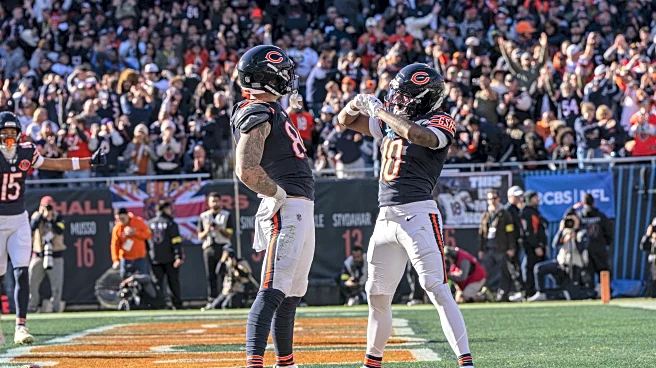
Loveland’s usage has ticked up steadily after a slow start to the season, and since November second, he averages over five targets per game, and he is now an integral part of the Bears offense. While he won’t catch Warren for volume before the season ends, Warren, who sits at 718 yards and four scores, is likely to slow down with Philip Rivers at quarterback, while Loveland continues to see more and more action. And volume is only a part of the story anyway.
Warren is currently catching 70% of his targets for 11.4 yards per reception, which is very good numbers by tight end standards, and especially for his volume, but Loveland has actually managed to drive his catch percentage past Warren’s, up to 72.2% while maintaining a more explosive profile, averaging 12.8 yards per reception. The only two tight ends with a better catch percentage and higher Y/C than Loveland are Dalton Kincaid (14.5) and Tucker Kraft (15.3, RIP). Oronde Gadsden of the Chargers averages 14 Y/C with a 71.7 catch percentage.
This is not an apples-to-apples comparison as efficiency almost always falls with volume and Warren is a much bigger part of the Indy offense to date. Loveland only has 498 yards and four touchdowns, and trails Warren by 220 yards on the season. But Loveland has also made up ground on Warren, and with the quarterback situation a big question mark in Indy, that may very well continue.
Of course, receiving is only a part of a tight end’s value, but even in the blocking game, it’s complicated. Warren is very obviously better as a pass protector, per PFF and everyone else, which is very important, but Loveland, who has admittedly struggled as a pass blocker, has a much higher run-blocking grade (69.5 to Warren’s 56.1), and in the context of both the Colts and Bears, run-blocking is almost as important as pass blocking.
If I was forced to choose between the two, I’m still picking Warren, but I think it’s important to remember that player evaluations are not binary. Just because a player may have been overdrafted due to positional value does not make that player worthless. Just because a slightly better player may have been drafted later doesn’t make that player worthless. And players can accumulate value in different ways. If you’re going to power run and throw deep, it’s hard to argue against Loveland as the more useful player. If you need a more solid high-volume target, and a good pass protector, and don’t mind sacrificing some downfield throws (which can just to go Alec Pierce anyway) Warren is probably your guy.
And while Warren has been very good, Loveland has as well. With Luther Burden and Rome Odunze both injured for today’s game, Loveland likely sees his target share increase. We’ll see if he can still produce when he’s a bigger share of the offense.