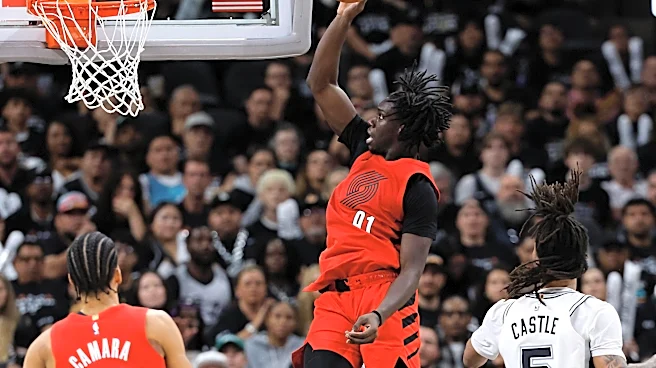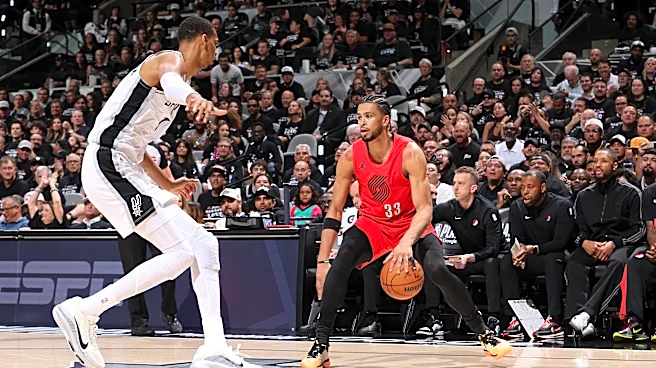





Portland Trail Blazers forward, Toumani Camara has been a revelation since he arrived 3 years ago. At the time he was acquired in the Damian Lillard/Jusuf Nurkic blockbuster trade, he was virtually unknown. Drafted late in second round (52nd overall) of the 2023 NBA draft, the senior forward out of Dayton would soon make his presence known. Shortly after the trade, it was reported that Camara was targeted by the Blazers front office, and insisted he be included in the trade that brought beleaguered
center Deandre Ayton to Portland.
It didn’t take Camara long to impress his coaches and teammates. By the ninth game of his rookie season he was inserted into the starting lineup, and hasn’t looked back since. When most older college players drafted in the second round struggle to ever make a NBA roster, Camara is about to embark on his 4th season, while starting the first of a four-year, $82 million contraction extension.
Now at age 26, Camara is entering his prime. His accolades during his first three seasons include:
- 2024-25 All-NBA Defensive Second Team
- Set the NBA season record for most offensive fouls drawn (105) in 2025-26
- One of 18 players to play in all 82 games last season, ranking 4th in total minutes played.
Most players’ skillsets peak in their prime. With Toumani Camara, once an “old” rookie and now a seasoned veteran, how much growth does he have left as a player? Let’s take a look through a few different lenses.
Culture Setting
Older college players are considered mostly developed when they’re drafted, otherwise their talent would have stood out at a younger age. It’s typically veteran teams in contention that draft them as higher floor options for the end of their bench. Most of the time those rookies only see garbage time minutes or become stop gap solutions for injured players. Portland was in a major transitional phase so the opportunity for Camara to shine with his work ethic, tireless effort, and defensive IQ was wide open and welcomed. He became undeniable.
Before Camara arrived, Portland had been one of the worst defensive teams in the league for several seasons. GM Joe Cronin made it a goal to turn that around, and Toumani lies at the heart of that change. Even if the results didn’t change immediately, the eye test showed that the team played harder, and gave more effort when Camara was on the floor. Over the past two seasons, with the helpful additions of Donovan Clingan, Jrue Holiday, and Deni Avdija, Camara remains the heart and soul of the Blazers’ defensive identity. The Blazers have seen their defensive rating rise over his three seasons from 27th to 14th.
The next phase for Camara is to develop his on court defensive leadership to gain buy in from his less defensively inclined teammates. A great example of this would be Camara learning how to push the right buttons with Damian Lillard and Ja Morant to get the most out of them on the defensive side. That might be asking for miracles, but growth as a culture setter comes when your impact is seen by outsiders in how the team reflects your values with its effort and performance. Draymond Green is a great example of this for Golden State’s modern dynasty. He could single-handedly change the momentum of games because he not only locked in defensively by himself, but his intensity and insistence for his teammates to meet him on that level, made them a better unit. That is the place Camara has room to grow. Become such a great connector, that when the team is down 15 points, he’s the voice and the spirit for locking in and guys fall in line.
Offense
For those who vividly remember the original Willy Wonka and the Chocolate Factory, remember the scene where Charlie and Grandpa Joe drink the experimental Fizzy Lifting Drink? After a couple of sips, they began to levitate towards to the top of the room where they are greeted by an enormous industrial vent fan that threatens to chop them to shreds. Before they learn that burping is the only way to go down, poor Charlie’s hand is on a metal beam just under the fast, spinning fan blade. Consider this an analogy to how close Toumani Camara is to his peak as an offensive player.
Camara lacks shot creation ability, and his ability to attack close outs and drive to the rim are pretty average. He uses a patented ball fake before he likes to put the ball on the floor, and its not really fooling anyone. He finds himself having to pass the ball rather quickly after he dribbles and is faced with a defender ready to cut him off. The Blazers were forced to lean on putting the ball in Camara’s hands more than what is ideal for him because the team has been short on playmakers during his time. That should change drastically now with Lillard and Morant onboard. Camara should naturally settle into the ideal offensive role for him as a three-point sniper. With Deni Avdija and the aforementioned guards able to draw defenses to them, Camara will be ready for a steady diet of open looks from downtown.
Last season, he took the 9th most three-point shots in the NBA, and converted on an above league average 37.5%. If there’s any growth from Camara here, it can come in the form of pushing his made percentage closer to 40% by improving his makes from the right side of the floor. A good sign he still has room to improve as a shooter, is his volume jumped between his second and third seasons. In Year 2, Camara converted 37% on 4.6 attempts per game. Last year his volume jumped to 7.2 attempts while raising his made percentage half a point. Shooting better on more attempts gives him the runway to become a better marksman.
His glaring weakness shooting the three, comes from the right wing and corner. Click hereto see his shot chart from last season, and you can see it’s a bit Jekyll & Hyde from the left and right sides of the court. At the top of the circle, he shot an incredible 48.3% on 58 attempts. On the left wing (his favorite spot), he shot 40.2% on 202 attempts, and in the left corner 36.4% on 99 attempts. Over on the right wing, he hit 33.8% on 148 attempts. The right corner is his kryptonite by hitting 28.2% on 85 attempts.
Two-thirds of his attempts are considered “wide open”, defined by no defender within 6 feet of him. On the same 7.2 attempts per game, if he can raise his 2.7 makes to 2.9, he’ll cross the 40% threshold. He generates two-thirds of his offense beyond the arc, so with incremental improvement on his open looks, it goes a long way in helping his rim attacking compatriots.
I don’t expect Camara to evolve much as a scorer, but it wouldn’t surprise me if he has an outlier season or two where he might average 17+ points for a season.
Defense
Once you make the league’s all-defensive second team, there’s only one way to keep going. By playing in Portland, his notoriety will always be dampened unless the Blazers are among the best teams. Does he have the defensive talent to make the first-team? Perhaps multiple? His reputation for being among the league’s peskiest defenders is growing. I mentioned above about developing into a defensive leader who positions his team among the league’s best in that department. Whether or not Camara can become a transcendent defensive catalyst remains to be seen.
Conclusion
Whether Toumani Camara has peaked or not, he has been an exceptional addition to the Blazers when they needed it most. He’s on an excellent, long-term contract for his skillset. Portland is pretty much playing with house money with Camara already overdelivering on expectations.
What do you think? Have we seen the best that Toumani Camara is capable of? What other areas can he realistically improve in? Could he be a late bloomer who still has another talent level to unlock?
Let us know below!