
Earlier this week MLB announced details of the ABS challenge system that will go into effect this season. If you missed it, here’s my article describing all those details.
There’s going to be another change you’ll notice on TV broadcasts of MLB games this year, and Jeff Agrest of the Sun-Times notes that change:
The strike-zone box, which has become as vital to baseball broadcasts as the first-down line is to football broadcasts, will remain on the screen but no longer will indicate whether a pitch
was a ball or a strike. (In addition to showing the pitch speed and type, the box previously marked a strike with a filled-in circle and a ball with a hollow circle. Home viewers might never have noticed.)
The change was made because that box now will be used for the ABS system, and MLB is doing everything it can to ensure no one can exploit it. In fact, the box will be shown in just one place in the ballpark: the broadcast booth.
You know… he’s right. I never noticed that. Did you?
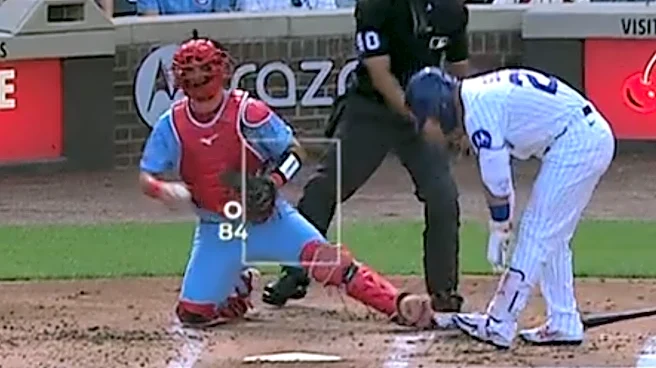
Here are two screenshots from games of the final weekend of the regular season at Wrigley Field, Cubs vs. Cardinals. Both are from Seiya Suzuki at-bats — I chose him because he might become one of the biggest beneficiaries of the ABS system.
Here’s a screenshot of a called third strike Suzuki took on the final day of the season, Sept. 28:

As you can see, that pitch was a strike. And the circle indicating the location and speed is filled in.
Now, here’s a pitch on which Suzuki walked on the previous day, Sept. 27:

Now, that pitch was exceptionally close. Some umpires might call that a strike, in which case it would probably be challenged with the ABS system. In this case it was ball four, and you can see that the circle indicating the pitch isn’t filled in.
With the ABS system, you’ll see the same indicator no matter whether the pitch is a ball or strike, along with the pitch speed. (Some TV channels also indicate what type of pitch it is. The White Sox channel CHSN does, as shown here (another Suzuki at-bat from the Crosstown Series):

Personally, I’d like to see Marquee Sports Network do that. Perhaps they will this year.
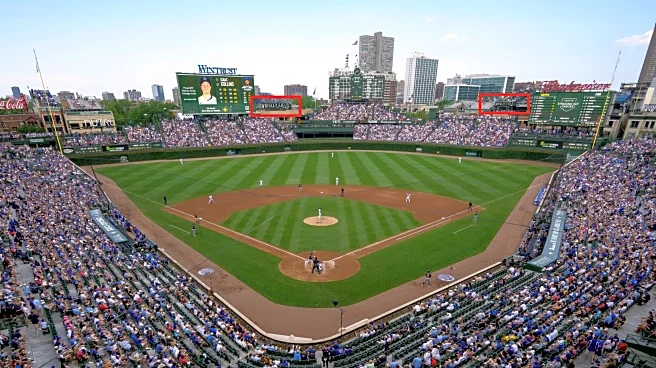
As noted by the Sun-Times article, you will still see the box if you are watching at home or on one of your devices. But at the ballpark, no one will see that box except in the broadcast booth:
That means players in the clubhouse and dugout and fans waiting in line for concessions won’t see the strike-zone box on nearby televisions. Technical teams from local and national outlets have spent a lot of time figuring out how to change the feeds they send through the park. It won’t affect home viewers.
Producers don’t expect ABS challenges to provide many dramatic moments to display, and they want to be careful not to overdo them. The challenge system might just blend into the game as quietly as the pitch clock has. But in big moments, those 14 seconds could provide some compelling sights.
As I mentioned in my article giving the details of the ABS system, MLB wants to get the box you see on MLB Gameday, the box you see on broadcasts and the actual box used for the ABS system to be the same. Presuming they do this, that will be a distinct improvement for what you’re watching at home, where the box on broadcasts will represent the actual ABS zone.
I’m a big fan of the ABS system and I believe that as players get used to it, there will be more challenges retained as teams and players pick the most important spots to challenge ball-and-strike calls. Hopefully, the feedback gained by this system will help umpires improve their calls, too.
As always, we await developments.