
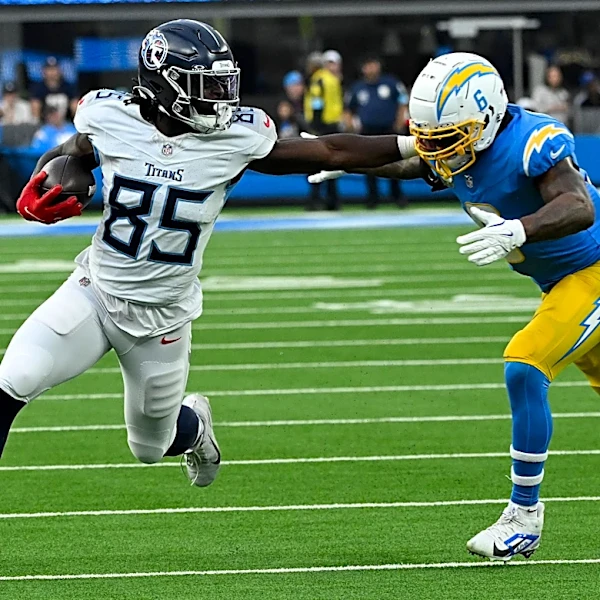
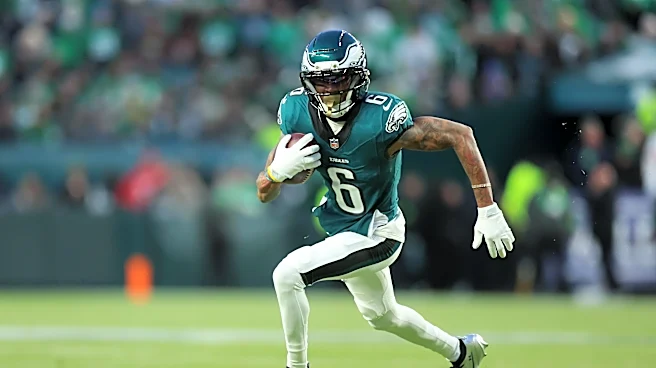

Taken by themselves, the Cowboys roster numbers currently don’t mean all that much. But once you place them next to the numbers of the other NFC East teams, you may be able to learn a lot: Which positions are overrepresented, which positions are underrepresented, and where teams could still be looking for upgrades.
To see if I could glean anything from the Cowboys’ 90-man roster and the rosters of the remaining NFC East teams, I tallied the division’s offseason rosters by position, using the official
team rosters and cross-referencing them with the ourlads.com rosters, as they are usually the most up-to-date rosters available. Here are the numbers:
body .sbnu-legacy-content-table td, body .sbnu-legacy-content-table th, body .sbnu-legacy-content-table { border: 1px solid #000 !important; border-collapse: collapse !important; }| Cowboys | Giants | Eagles | Commanders | |
| Quarterbacks | 3 | 3 | 4 | 4 |
| Running Backs | 7 | 7 | 6 | 6 |
| Wide Receivers | 13 | 14 | 12 | 11 |
| Tight Ends | 6 | 5 | 8 | 7 |
| Offensive Linemen | 15 | 16 | 16 | 15 |
| Defensive Linemen | 10 | 12 | 8 | 10 |
| Edge | 8 | 6 | 8 | 9 |
| Linebackers | 7 | 7 | 8 | 7 |
| Defensive backs | 18 | 17 | 18 | 18 |
| Special Teams | 3 | 3 | 3 | 3 |
| Total | 90 | 90 | 91 | 90 |
All teams are allowed to carry 90 players plus one International Pathway Player (IPP). All four teams carry one such IPP, which means the Eagles are maxed out at 91 players, while the other three NFC East teams all still have one open roster spot.
The first thing to keep in mind as you compare these numbers is that there is an interdependence between the numbers across positions on each team. If a team has an above average number at one position, the roster limit dictates that it must have a below average number at another spot. An argument can therefore be made that overinvesting in a position is a matter of choice, underinvesting at another may be more a matter of necessity.
The Cowboys, to my great surprise, are pretty much in line with the NFC East average at each position. The next table illustrates that point by showing how far above or below each team is relative to the NFC East average at the position. The positions at which a team is one player or more above the average are marked in red, the positions where a team is one player or more below the average are marked in green.
body .sbnu-legacy-content-table td, body .sbnu-legacy-content-table th, body .sbnu-legacy-content-table { border: 1px solid #000 !important; border-collapse: collapse !important; }| Cowboys | Giants | Eagles | Commanders | |
| Quarterbacks | -0.5 | -0.5 | 0.5 | 0.5 |
| Running Backs | 0.5 | 0.5 | -0.5 | -0.5 |
| Wide Receivers | 0.5 | 1.5 | -0.5 | -1.5 |
| Tight Ends | -0.5 | -1.5 | 1.5 | 0.5 |
| Offensive Linemen | -0.5 | 0.5 | 0.5 | -0.5 |
| Defensive Linemen | 0.0 | 2.0 | -2.0 | 0.0 |
| Edge | 0.3 | -1.8 | 0.3 | 1.3 |
| Linebackers | -0.3 | -0.3 | 0.8 | -0.3 |
| Defensive backs | 0.3 | -0.8 | 0.3 | 0.3 |
| Special Teams | 0.0 | 0.0 | 0.0 | 0.0 |
You could argue that the weak spots on each team are the positions where they are overinvesting relative to their division rivals, the strong spots are where they are underinvesting versus the NFC East average.
By this reckoning, the Cowboys don’t have obvious weak spots – but neither do they have any obvious strong spots, at least relative to the NFC East teams.
The Eagles for example are short on the defensive line, possibly a sign of their confidence in the strength of their position group, but appear to be less sure about their TE position, which they bolstered with two free agent signings and a second-round pick.
The Commanders signed Odafe Oweh and K’Lavon Chaisson to bolster their pass rush and are a bit longer at the position than the rest of the division, but what’s baffling is that they are going short at wide receiver where they have Terry McLaurin and then a whole bunch of no-names.
They Giants are surprisingly long at defensive tackle, but a position that used to be one of their strengths is returning only two players from 2025 and adding seven (!!) free agent signings. They are also long at WR where they brought in five (!!) free agents, the most recent being JuJu Smith-Shuster and Odell Beckham. As a result, they had to go short somewhere else, and they did that at TE and Edge.
What these NFC East numbers also do is provide some context for the Cowboys roster numbers. When we recently looked at three different Cowboys 53-man roster projections, a lot of the discussion centered around the perceived lack of depth at inside linebacker, running back, and defensive backs. And knowing full well that more bodies does not automatically equal more depth, at least the numbers at those positions are perfectly in line with the rest of the NFC East teams.
While we need to be careful not to infer too much causality from these numbers, these numbers do paint an interesting picture, though a fleeting one.
Obviously, all of these numbers will change during and after training camp. The final roster reduction to 53 players will have to be completed on Sunday, August 30, one day after the final preseason games have been played.