





By the time the final whistle blew on Sunday, the read on this one felt pretty settled: good first half, bad second half. Scanning through post-match analyses and fan consensus, almost everyone seemed to align on the same narrative curve. Juventus looked sharp, assertive, and fluid before the break, only to stall out and let the game drift after it.
On the surface, that consensus makes sense. In the first 45 minutes, the attack generated a steady sequence of exciting looks, repeatedly unlocking central
zones while holding Frosinone to just three low-danger attempts. By the second half, that fluid attack narrowed to a single high-quality chance, while Frosinone began pushing forward with a methodical, almost rhythmic persistence in search of an equalizer.
Going back through the underlying numbers, that narrative holds up — but only to a point. The first half was unquestionably better than the second, but the gap between them isn’t nearly as wide as the visual memory suggests. What actually unfolded was less of a dramatic collapse and something a bit more nuanced: a strong opening 45 followed by a merely above-average second half, dragged down in perception by a handful of high-leverage moments that shaped the story far more than they shifted the underlying reality.
The perception gap
Ask someone who watched the second half what happened, and you’ll probably get some version of “Juventus dropped off.” Some might even point to specific tactical choices, like Luciano Spalletti bringing on Andrea Cambiaso to defend a one-goal lead. But if you ask what Juve actually conceded — what genuine opportunities were there, even if Frosinone failed to punish them — it gets a lot harder to pinpoint.
One of the main lessons I took from a decade as an analyst in women’s volleyball is that results aren’t limited to what shows up on a stat sheet. Box scores are results, to be clear, but I don’t think they’re the only results. The space that isn’t closed down, the run that wasn’t tracked, the pass that wasn’t made — those are results too, even if they never register in traditional data. It’s easy to grade a performance based strictly on visible events: the pass, the tackle, the shot. But most of those are downstream effects. If we care about how repeatable a performance is, I think we have to try to analyze those underlying processes, not just the events they produce. You might get away with conceding dangerous spaces to a newly promoted Frosinone side that a top-tier team would instantly exploit, and even the most advanced stat sheet won’t really capture that exposure.
So I re-watched the second half with that lens in mind — asking not just “What did Frosinone pull off?”, but “What actually looked available for them to attempt?”

Looking at Frosinone’s box entries helps bridge that gap. A box entry sits right in that middle space between process and result: it’s the end product of a buildup sequence, but it’s also the prerequisite process for generating high-quality shots. It gives a sense of how effectively a team breached the danger zone, even when a poor touch or a missed run meant a shot never came out of it.
By that standard, Juventus simply didn’t surrender much. Frosinone’s entries were sparse, mostly forced wide, and rarely found central pockets of space. They will certainly face teams with the movement and technical quality to exploit those occasional gaps in behind, but to my eyes, that feels like a separate question from whether they defended well on the day. By this stricter measure, the second half holds up reasonably well.
The underlying numbers tend to lean the same way. Look at the shape of the game’s xG timeline rather than just the final totals, and the second half doesn’t look like a collapse — it reads as a different distribution of the same general output.

The first half built up in a series of steady steps. The second half is mostly defined by one massive spike around Conceicao’s 51st-minute opportunity, followed by a fairly flat line. That isn’t a structural drop in quality; it’s similar output, just concentrated into fewer high-leverage moments rather than spread across a dozen smaller ones.
Frosinone’s late push looks equally unconvincing under closer inspection.

Eleven shots yielding just 0.41 combined xG, none of which were particularly high quality — that reads like the profile of a team working hard without truly threatening the game. If the narrative is that Juventus lost control, the shot map suggests otherwise.
Juventus’s own output after taking the lead tells a similar story.

In the 77 minutes spent leading, Juve continued to attack at roughly the same rate — generating a shot every five minutes or so instead of every four. They weren’t settling for speculative attempts, either; they kept trying to work into high-value positions, even if those chances ultimately fell short. Whatever “sitting on a lead” looks like, this wasn’t it.
Run that shot profile back through a 10,000-replay simulation — treating every attempt as an independent event based on its own probability — and the 1-0 result we got comes out as the second most likely outcome. It’s not a systemic issue; it was well within the range of reasonable outcomes given the inputs and process.

If anything, I’d argue the scoreline slightly understated Juventus’s control on the day.
None of this means the second half felt great to watch. It didn’t. But “felt worse in the moment” and “was worse” strike me as two very different claims.
Mapping the ball
If questioning the perception gap clears Juve’s defense of a collapse, looking at their offensive process explains how they actually controlled the terms of the match.
Analyzing an attack through a process-first lens means looking well beyond the final shot. It’s about how space was earned, how progression was managed across different phases, and where the ball actually lived over 90 minutes. When you evaluate territorial control not as raw possession, but as a deliberate campaign to claim high-value real estate, the tactical mechanics of Juve’s in-possession shape become clear.

Out of possession, the team may be listed as a 4-2-3-1, but on the ball, I think their base shape functioned much closer to a fluid 2-3-4-1 (or a buildup variation of a 4-1-4-1). Manuel Locatelli operated as a single pivot directly ahead of Bremer and Lloyd Kelly, flanked in the same midfield line by full-backs Zeki Çelik and Pierre Kalulu holding wide.
That five-man foundation was the backbone of Juve’s territorial dominance. By creating a 2-3 platform at the base, Juventus established clean passing lanes and sharp diagonal angles around Frosinone’s initial line of engagement while maintaining immediate defensive balance if play broke down. Ahead of that platform sat a four-man line: Francisco Conceição holding width on the right, Weston McKennie and Douglas Luiz occupying central zones, and Kenan Yıldız operating out of the left half-space, all playing beneath Randal Kolo Muani.
But a solid structure is only as good as the territory it allows you to command. Rather than relying on raw, hollow possession, measuring field tilt reveals where that shape actually allowed Juve to push the game. Think of it as a localized tug-of-war across the pitch: for every specific zone, it calculates who owned a bigger share of the total activity — weighing touch volume alongside overall presence, with a 0.5 score representing a deadlock 50/50 split.

The field tilt map reflects that spatial dominance directly. Almost the entire pitch leans heavily toward Juventus, with one fascinating exception: the left flank occupied by Çelik and Yıldız reads close to neutral.
That asymmetry seemed to be structural by design. On the right, Kalulu occasionally overlapped to support Conceição in a more traditional fullback role, but the right wing was primarily used to isolate Conceição 1v1 on the outside. On the left, Çelik rarely bombed down the touchline, preferring to sit deeper in the midfield line, while Yıldız naturally drifted inward from the wing into the half-spaces. Because neither held fixed width high up the touchline, that corridor generated less natural territorial tilt. Frosinone’s standard 4-4-2 block—which occasionally dropped a midfielder deep to form a temporary back-five — was allowed to hold ground out wide because Juve’s primary threat on that side was designed to come from central underlaps.
Sitting high up the pitch naturally brought Juve face-to-backline with Frosinone’s low block — a defense built specifically to absorb that kind of territorial pressure without giving up space behind. Breaking that stubborn shape open demanded methodical, vertical progression rather than aimless circulation.

The tape and the progression map tell the exact same story: Juventus weren’t just circulating the ball to pad their stats; they were steadily funneling passes into dangerous central pockets and driving into the channels whenever Frosinone’s shape frayed.
For the most part, that central progression was methodical and patient. But establishing such a predictable baseline meant that even a subtle structural deviation could catch Frosinone completely unprepared.
On one of the few occasions Çelik aggressively broke his conservative build-up pattern, it completely unlocked Frosinone’s low block.
Recognizing space ahead, Çelik abandoned his deeper position to make an overlapping run around Yıldız. Receiving the initial pass, Yıldız drew multiple defenders into the half-space before slipping a clever toe-poke return back into Çelik’s stride. By committing forward into the final third, Çelik forced Frosinone’s backline into panic rotation; as the nearest defender rushed out to close down his carry, it opened a clear central passing lane to send Conceição through 1v1 inside the box.
It was the single cleanest opportunity created by either side all match — a direct product of breaking an established structural baseline to catch a settled low block off guard. Yet for all the territorial dominance and systematic progression Juve built over 90 minutes, the ultimate value of an attack comes down to shot quality and final execution.
Execution at the edge
Translating structural dominance and steady progression into actual goal threats requires bridging the gap between entering the final third and breaching the penalty area. Getting the ball near the box is the prerequisite; what happens once you cross the 18-yard line determines the match.
Yet if you only evaluate an attack by how often they penetrate the penalty area, you miss the crucial difference between simple volume and actual threat. Counting box entries shows where play flowed, but volume alone is blind to outcome—it cannot distinguish between an entry that dissolved into a crowded scramble and one that materialized into a clean, unhurried look at goal.

The entries map confirms that Juventus didn’t just control the middle third — they repeatedly forced their way into Frosinone’s box throughout 90 minutes. But the specific pathways tell a deeper story about how their progression mechanics actually functioned.
Rather than relying on generic, high-volume crossing from wide areas, Juve’s entry profile leaned heavily on controlled progression through the half-spaces and quick, central combinations beneath Frosinone’s backline. When Frosinone sat deep, Juve used their base structure to shift the defensive block side-to-side, waiting for the defensive lines to stretch just enough to slide passes into the feet of Yıldız and McKennie operating in the pockets. The high volume of entries suggests Juve weren’t just forcing the ball into the mixer, but rather that their positional rotations often helped open up cleaner passing avenues into the penalty box.
The critical question, then, is what all of that sustained final-third progression actually yielded once Juve arrived in those high-danger zones. Getting into the box consistently proves the build-up engine is firing, but turning those entries into high-margin shot attempts requires a second layer of execution.

The shot map provides that answer. Juventus generated 20 total attempts, anchored by three genuine big chances and supported by a half-dozen solid looks from central areas. Crucially, this didn’t look like a team resorting to low-percentage, speculative strikes from 30 yards out. Instead, they appeared to combine sharp open-play entries with structured set-piece routines—pointing to a chance creation process that can generate threats through multiple avenues.
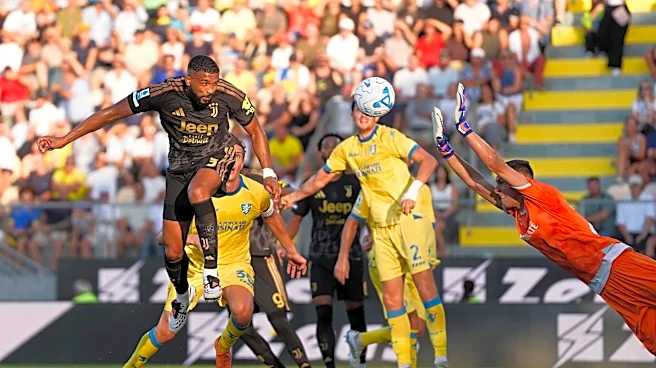
That blend of open-play sequence and set-piece design is where the match truly turned. Bremer capitalized on his big chance by heading home after Conceição and Douglas Luiz worked a clever short-corner routine, giving Juventus a well-earned lead. Juve’s other prime opportunities came from a similar mix: a corner flicked on through traffic to find Kolo Muani at the far post, and Conceição getting slipped cleanly through 1-v-1 following Çelik’s underlapping run.
While Bremer converted, both Conceição and Kolo Muani saw their clear looks sail off target — not saved, not blocked, just missed.
It is easy to look at those miscues and label them purely as player error, but finishing at this level often comes down to micro-fractions of a second: a slight bobble on the pitch, the ball traveling a fraction faster than anticipated, or a minor timing adjustment under pressure. Those fine-margin errors are frustrating, but they can also be a standard feature of single-match variance.
Walking away from a night like this with a sweeping conclusion that Juventus has a systemic finishing problem misses the broader picture. Generating three big chances alongside a steady collection of solid looks — whether through open-play progression or well-designed set pieces — points toward an offensive process that generally delivered on the night. Failing to convert a couple of clean looks in a single 90-minute window is rarely definitive proof of a broken attack — it is simply a night where the process worked, even if the final touch was off by a matter of inches.
When you zoom out from the lingering frustration of a narrow scoreline, the full picture of this match looks fundamentally different than the post-match discourse suggests. Juventus didn’t grind out a lucky result, nor did their attack stall out against a deep block. From build-up stability and half-space penetration to structured set-piece routines, the underlying machinery operated largely as intended.
The gap between dominance and scoreline is where football sentiment gets warped. Winning by a single goal while creating three big chances and holding total territorial control can still leave people feeling like the team underperformed. But evaluating a performance purely through how wide the margin of victory was risks mistaking single-match variance for a lack of quality.
For Juve, the takeaway isn’t that they struggled, but that elite process guarantees control, not blowouts. The tactical framework generated more than enough territory, structure, and high-grade looks to score three on another night. Until those fine-margin finishing miscues become a habit, this match stands less as a cause for concern and more as a reminder that a dominant process doesn’t always show up as a runaway scoreline.