


I’m probably the last person anybody would ever expect to write an article defending Bill Belichick. I have hated him for the last two and a half decades. When I say that, I don’t mean that I have held any actual malice towards the man or hoped for genuine harm. He simply has been my ultimate sports villain. His few and far between professional failures have been glorious for me.
Belichick was supposed to become the Jets’ head coach in January 2000. The line of succession was set. Bill Parcells stepped
down a day after the 1999 season ended. For years there was an understanding that Belichick would ascend to the head coaching job after that happened.
Instead, Belichick resigned at what was supposed to be his introductory press conference. A few weeks later he was announced as the head coach of the New England Patriots, a bitter division rival. From there he built one of the most enduring dynasties in sports history, capturing a record six Super Bowl wins in a span of less than two decades.
As the years have passed I have come to understand and even respect why Belichick passed on the Jets job at a point where the team’s ownership situation was unclear and ended with Woody Johnson buying the team.
Still, Belichick could have handled the whole thing much more professionally. Scribbling out his resignation letter on a napkin? Come on. It also felt like Belichick saved unnecessary venom for the Jets. There was always a passive aggressive shot at a press conference or a deep ball late in the fourth quarter with New England leading the Jets by three or four touchdowns to rub a little extra salt into the wound. Given the Patriots’ position dominating the league and the Jets typically occupying the cellar, it felt a bit like the schoolyard bully picking on the weakest kid on the playground.
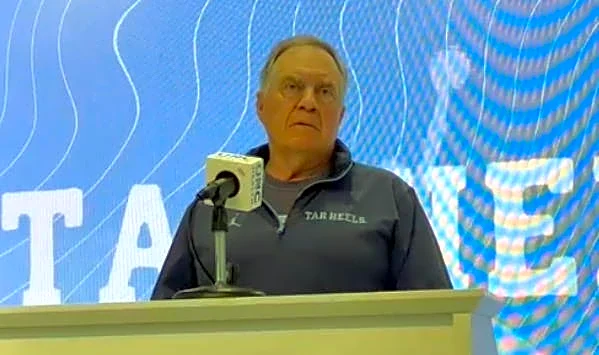
A year ago at this time the eyes of the football world were fixed on Chapel Hill, North Carolina. There was a lot of intrigue about how Belichick would do moving to the college game and taking over as the head coach of the University of North Carolina’s football team.
As the Tar Heels begin a new season tomorrow, I think it is fair to say the program and Belichick have plenty of eyes on them once again. This year, though, it is born out of a grisly curiosity. The Belichick Era at North Carolina veered badly off course from the start, an embarrassing 48-14 loss at home to TCU. The team stumbled to an ugly 4-8 season. The football was bad. The headlines were worse. From Jordon Hudson to Mike Lombardi the North Carolina football program has become as notable for its off field dysfunction as for its on field failures. At this point the biggest question around the program is precisely when UNC will pull the plug on this disaster, and how bad it will get before that happens. Note that I said, “when,” not, “if.”
As if all of this wasn’t enough, Belichick suffered another embarrassment in January as the selection committee of the Pro Football Hall of Fame declined to enshrine him in his first year of eligibility.
The only sign of Belichick during induction weekend in July was a joke his former kicker Adam Vinatieri made at his expense.
This is where I have to draw the line.
I am a Jets fan, yes. I am also passionate about the history of the game. When I was a kid my dad instilled in me that to appreciate the sport as a fan, you have to understand its history. The past explains how we got here.
I cringe whenever I log onto social media these days because inevitably I will see some graphic ranking the “greatest of all-time” at a position. Inevitably the list would make you believe NFL history began in the year 2000. Occasionally one of the lists will at least trace back to players from the 1980s. Once in a blue moon, it will include the entire Super Bowl era.
But there are so many greats that fans never learn about. For whatever reason, this problem is more pronounced in football than any other sport. We don’t treat the history of the game with reverence. The average baseball fan has heard of Ty Cobb, Babe Ruth, and Ted Williams. The average basketball fan has heard of Bill Russell and Wilt Chamberlain.
How many football fans don’t know Sammy Baugh, Bronko Nagurski, Don Hutson, Raymond Berry, Chuck Bednarik, and so many other all-time greats who played before the Super Bowl era? We owe the game we enjoy to the contributions these players made to the sport. Yet they are lost to history.
So I think about fans in the future. I ask myself whether there’s a reasonable way to justify the coach who has the most Super Bowl wins, is tied for the most overall NFL championships, and has the second most wins not being in the Hall of Fame. The answer is a clear no for me.
Many fans don’t agree with that. They argue Belichick was a vastly overrated coach.
I think there are five reasons people make this argument.
- Belichick was at the center of a massive cheating scandal that tarnished his image.
- When he left the Patriots, the franchise was a mess. Within two years of his departure, they were rebuilt into a Super Bowl team.
- Tom Brady departed New England and immediately won a championship with another team. As this happened, the Patriots under Belichick slowly sunk to the bottom of the league. This suggests that Belichick was along for the ride after lucking his way into having arguably the greatest quarterback of all-time.
- The end of Belichick’s career has been hideous. Not only did the Patriots sink to the bottom of the NFL after Brady left. We have the current fiasco at North Carolina.
- People just don’t like Belichick and revel in any chance to knock his legacy and call him a fraud.
If you are in the fifth category, I understand where you are coming from. However, I will warn you right here that if you won’t listen to any arguments that Belichick was a great coach, this article won’t be for you. I harbor no hard feelings if you want to leave right now and check out something else on this site.
For those of you who are willing to engage with a nuanced discussion on the greatest of a complex figure, please join me below.
I fully intend to address each of the five arguments against Belichick’s greatness before we finish. First, however, I think it’s important to establish what actually made him great.
Great coaches come in all shapes and sizes. It always makes me chuckle a bit when a team is conducting a coaching hire, and fans state that inherently an offensive coach is greater than a defensive coach or that running a particular scheme is important.
At the end of the day, no two coaches are alike. All bring something different to the table.
As for Bill Belichick, there are the five things I would argue that set him apart.
Belichick was the greatest defensive mind of his era.
As time passes our memories fade. We have a way of jumbling things in our mind to fit convenient narratives.
When it comes to the Patriots dynasty, we tend to think about the end years when Tom Brady was an unstoppable force. It wasn’t always that way, though. New England was a balanced team through its first three Super Bowl wins.
Tom Brady wasn’t yet TOM BRADY. Now don’t get me wrong. He was still an elite quarterback in this era, arguably still the best in the league. But rather than serving as a wrecking ball to defenses for 60 minutes, his game was more defined by playing efficient football and then delivering the clutch fourth quarter drive to win the game. Brady didn’t finish in the top five in touchdown passes in any of New England’s first three Super Bowl years. He didn’t throw for 30 touchdowns or average 7 yards per attempt until his seventh season as a starter.
I want to emphasize once again that I am not arguing that Brady wasn’t good or even great. Merely that he wasn’t yet lifting teams on his back. New England won because of its balance.
The Patriots finished with the sixth best scoring offense during their first Super Bowl season in 2001. They also finished with the sixth best scoring defense. During their third Super Bowl season in 2004, the addition of Corey Dillon took the offense to another level. The Pats had the number two scoring offense in the league. On the other side of the ball, they were just as dominant with the number two scoring defense. The second championship year in 2003 was a bit of a different story. New England slumped on offense, scoring only the 12th most points. Their title was driven by the league’s top defense.
Through this era, Belichick showed adaptability. Although he was known as a 3-4 coach, the defensive mind who unlocked Lawrence Taylor as defensive coordinator of the Giants in the 1980s, he seamlessly switched between the 3-4 and the 4-3 to adapt to the strengths of the rosters he had. When the Patriots suffered a plethora of injuries at linebacker in 2001, the Patriots moved to a 4-3 front. At other points, he was a 3-4 coach in New England. This was at a point when these distinctions actually meant something.
Often NFL fans will vent about how their coaching staff refuses to adjust its scheme to accommodate the talent it has. Why don’t more coaches do it?
I would argue that most coaches simply don’t have the knowledge base to easily flip from one system to another.
I think about a story legendary coach and broadcaster John Madden once told about a coaching clinic he attended early in his career. Vince Lombardi ran the clinic.
In June of 1963, Vince Lombardi spoke at a coaching clinic in Reno at the University of Nevada. Madden signed up as soon as he heard about the event. Madden thought he knew everything about Lombardi and his offense. For a young coach, Madden thought he had a lot of football knowledge. “But I didn’t know anything, ” Madden later recalled. That day Vince Lombardi talked about the Green Bay sweep play. He talked about the play, showed film, covered the normal defensive adjustments to stop the play, how to counter the adjustments and answered questions. The presentation lasted eight hours! He talked about one play for eight hours.
That might sound extreme, but just think about for a second. There is a reason Lombardi could talk about a single play for eight hours. In order to run it well, he had to know every nook and cranny. This was his signature play. Everything in his system was built around this play working. Lombardi had to understand every conceivable way his opponents would attack it and have answers built.
At the same time, coaches only have so much bandwith. There are responsibilities with the job that pull you in so many directions. A coach can know his own system intimately. Maybe in time he can expand his knowledge base and gain a deep understanding of a few other concepts. But almost no coach will have an encyclopedic knowledge of concepts across the board.
That is unless the coach has been studying the Xs and Os of the game since he was a kid like Belichick. Bill’s father, Steve, was a legendary coach and scout who helped his son attain a deep understanding of concepts from a young age. Chris Brown told the story in a 2015 piece he wrote about Belichick for Grantland, a brilliant sports website which closed up far too soon.
According to Halberstam’s book, a 9-year-old Belichick made a deal with his father: If he finished his homework early, the old scout would give his son a preview of that week’s report, allowing the youngster to gorge himself on play diagrams and digressions on the popular tactics of the era, like the single wing and straight T-formation offenses and the wide-tackle six and gap 8 defenses. Halberstam noted that Belichick quickly became conversant in football arcana, eloquently explaining to one old coach at 10 years old that he should switch to an Oklahoma 5-2 (a predecessor to today’s 3-4 defenses) to better match up against an upcoming opponent.
One of the biggest reasons Belichick became such a brilliant defensive coach is he had more tools at his disposal than his contemporaries. The fact his father allowed and encouraged him to start learning about football schemes (and just as importantly their history) gave Belichick a multi-decade head start on his opponents. By the time his career began, he had intimate knowledge of multiple schemes which in turn gave him more schematic tools than any of his opponents.
Brown mentions Belichick’s most famous game plan in his article. He devised it as Giants defensive coordinator in Super Bowl XXV, which spurred a shocking upset win over a high powered Buffalo Bills.
In the days leading up to Super Bowl XXV, then–New York Giants defensive coordinator Bill Belichick was searching for any weakness the opposing Buffalo Bills might possess. Powered by four future Hall of Famers, Buffalo’s “K-Gun” offense had led the NFL in scoring during the 1990 season and had already posted 44 and 51 points in the playoffs against the Dolphins and Raiders.
But Belichick eventually settled on an edge he thought he could exploit: His first job in the NFL had been under the K-Gun’s architect, Buffalo offensive coordinator Ted Marchibroda. While head coach of the Baltimore Colts in 1975, Marchibroda had hired Belichick for a barely paid gig analyzing game film, and the two remained friendly. But this was business, not personal, and Belichick knew that the old-school Marchibroda, though a great tactician, would have trained his quarterbacks the same way he’d once trained his junior film guy: by filling them up with knowledge and then handing them the reins. Analysts wondered how Buffalo’s no-huddle attack could play so fast, but Belichick knew that Marchibroda was forged in an era when quarterbacks like Bart Starr and Johnny Unitas called their own plays, and that Bills passer Jim Kelly had the same freedom.
That knowledge was all Belichick needed. Later, Belichick would tell David Halberstam he didn’t think Kelly read defenses as well as some other NFL quarterbacks did, which made Belichick confident he could stay one step ahead. While Marchibroda would be able to explain the Giants’ looks to Kelly between series, during them Kelly would have to match wits with Belichick unaided. With each drive, Belichick made sure to appear to show Kelly exactly what he’d seen the prior series, while in reality making subtle but crucial tweaks, such as replacing a defensive back with a linebacker or changing a single defender’s coverage responsibility to set a trap. Belichick amplified the effect by working out of an unusual dime defense featuring six defensive backs, two traditional defensive linemen, and three linebackers (including Lawrence Taylor) to better defend Buffalo’s talented receivers.
Belichick’s intimate knowledge of schemes came to the surface frequently through his career. Another occasion it was evident was in Super Bowl LIII. Facing a high powered Rams offense whose outside run game had confounded opponents all year long, Belichick’s Patriots frequently ran a modified version of a 6-1 front. Having six players down the line of scrimmage prevented Rams runners from getting to the perimeter (along with marrying it to coverage schemes that confounded Jared Goff). The number two scoring offense in the league was held to a field goal.
It’s worth noting that it had been six decades since any team regularly ran a 6-1 defensive front. It isn’t just that no other coach thought of this approach to slow down the Rams before Belichick. It’s that no other coach had such a vast library of knowledge about defensive schemes and their history to even be capable of coming up with this approach.
No coach was better at finding little ways to give his players an advantage.
Coaches can’t execute for players. Ultimately the game comes down to the guys on the field. Coaches can, however, figure out how to put players into positions where they are more likely to succeed.
The stories of Belichick picking up a tell in an offensive lineman’s stance to tip off a run or a pass are now legendary. The biggest advantages Belichick provided came in the biggest games.
Peter King’s 2009 book Sports Illustrated Monday Morning Quarterback: A Fully Caffeinated Guide to Everything You Need to Know About the NFL is full of interesting anecdotes from his decades covering the league.
In Super Bowl XXXVI where Belichick’s Patriots scored a stunning upset over the heavily favored St. Louis Rams. New England’s only offensive touchdown came on an 8 yard second quarter pass from Tom Brady to David Patten. Patten was covered by cornerback Dexter McCleon. He ran an out and up route.
As King tells the story, New England’s playbook called for a simple out route. Why did Patten turn up the field to the corner of the end zone? Belichick changed the play the night before the game after detecting on film that McCleon had a tendency to try and jump the pass on out routes in the red zone, which made him vulnerable when the receiver turned up the field to the back pylon.
Thirteen years later, Belichick won his fourth Super Bowl against the Seattle Seahawks. The decisive play of the game lives on as one of the most controversial play calls in NFL history. Instead of handing the ball from the one yard line to Marshawn Lynch, the best short yardage back of his generation. for a game-winning touchdown, Seattle went to a spread shotgun set and threw. Russell Wilson’s pass was intercepted by Malcolm Butler, clinching the title for New England.
I’m not going to sit here and argue Seattle’s play call was anything other than horrendous. It made no sense as it was happening. If you are going to throw there, you do it off play action, faking a handoff to Lynch in a goal line formation. The Patriots would have sold out to stop him, and a receiver probably could have leaked out uncovered for an easy touchdown.
There are, of course, two parts to every play. The part of the story most focus on is Seattle’s mind-boggling play call. There is another side to it.
Seattle’s play called for a run route. It was something the Patriots were ready to defend as Yahoo’s Jeff Eisenberg noted in a 2025 article.
Only a few days before his improbable Super Bowl-saving interception, Malcolm Butler struggled in practice defending the exact same play.
Bill Belichick lit into the undrafted rookie cornerback after New England’s scout-team offense beat him all too easily for a 5-yard touchdown.
The play was a rub route that the Patriots noticed the Seattle Seahawks went to again and again in must-have situations near the goal line. One receiver set a pick by driving his defender backward. The other took advantage of the free space by running a slant underneath.
Suspecting that Seattle would go back to this concept during Super Bowl XLIX, New England devoted an unusual amount of time preparing to stop it. Butler drew Belichick’s ire for trailing behind the slanting receiver and allowing too much separation rather than fighting over the pick aggressively like he had been taught.
“If you see that formation, you can’t give ground,” Belichick barked at Butler. “You’ve got to be ready to jump that.”
That scolding was still fresh in Butler’s mind as he sprinted onto the field with less than a minute left in Super Bowl XLIX and the Seahawks just a yard shy of a go-ahead touchdown. Butler quickly recognized Seattle’s formation from practice and guessed what might be coming, paving the way for the defining moment of his career, the play that 10 years later remains among the greatest in Super Bowl history.
The fact Butler was on the field in the first place was a credit to Belichick. By the time 2014 hit in the NFL, defenses were facing a challenge in goal line situations. Offenses were increasingly spreading the field with three wide receiver sets. These formations were real challenges for defenses that loaded the box with heavy defenders. The typical 6-2-3 goal line employed against spread formations didn’t seem structurally sound enough against the pass, but if the defense put an extra defensive back on the field, a lighter box was susceptible to being chewed out by power blocking schemes.
Belichick devised a new concept for playing goal line defense. The standard 6-2-3 had three defensive backs. Those defensive backs were two cornerbacks and a safety. A minor tweak led the coach to stick with a 6-2-3 front but replace the safety with a third corner who would have better cover skills. Butler was New England’s third corner on that play. You can never prove a counterfactual, but it seems reasonable to say a safety with inferior cover skills might well have struggled to intercept that pass.
Despite the suspect play call, Seattle may well have scored had Belichick not prepared his team to defend the play and tweaked his formation to strengthen its coverage.
As I said earlier, coaches can’t execute for their players, but they can increase the odds of their players succeeding with subtle moves. Nobody found more than Belichick. How many coaches can you say had this sort of impact on two plays that were decisive in Super Bowl wins?
Belichick adapted as the league changed.

It’s difficult to imagine now, but Jeff Fisher was not always the poster boy of mediocrity. These days your typical NFL fan likely thinks of Fisher as a meme, the face of the 7-9 season from his underwhelming run as head coach of the St. Louis and then Los Angeles Rams.
There was a time, however, when Fisher was one of the most respected coaches in the league. His tenure with the Tennessee Titans brought success to Nashville. Fisher coached his team to the Super Bowl in the 1999 season. Tennessee lost to The Greatest Show on Turf Rams in the most heartbreaking fashion imaginable. Wide receiver Kevin Dyson was tackled at the one yard line as time expired after a reception. A touchdown and the ensuring extra point would have forced overtime.
Fisher made six trips to the Playoffs during his tenure in Tennessee. He led the Titans to the one seed in the AFC on multiple occasions. His teams had a reputation for being tough, disciplined, and physical. You could beat them, but nobody enjoyed facing a Jeff Fisher team. Fisher was known for being one of the best prepared coaches in the league.
It was thus no surprise when upon deciding he wanted to return to coaching in 2012, a year after leaving the Titans, that he was the hottest coach on the market. He had multiple job offers. Fisher chose to coach the Rams, the team that had once handed him the biggest professional heartbreak of his career.
By now you know what happened. Fisher underwhelmed. His teams were never outright awful, but he won 7 games in three of his four full seasons. The only outlier was a season where he won six. What went wrong?
There’s never one simple answer to a question like this, but at least to some extent it’s easy to argue that the game passed him by. The NFL of the 2010s was different from the one where Fisher had previously succeeded. Rule changes incentivized passing the ball on offense, and schematic innovations were making it easier than ever to throw. Suddenly the formula of toughness and physicality while relying on defense wasn’t enough to win.
Fisher wasn’t the first quality coach to see the game pass him by. He won’t be the last.
Most NFL fans know some of the rule changes I mentioned. Around halfway through the decade of the 2000s, the league became much stricter in calling illegal contact and pass interference more than five yards past the line of scrimmage.
One of the biggest driving forces behind these changes was the 2003 AFC Championship Game. The Patriots physical coverage was too much for Colts receivers Marvin Harrison, Reggie Wayne, Dallas Clark, and others to handle. Peyton Manning threw four interceptions, and the Patriots beat Indinapolis to earn a spot in Super Bowl XXXVIII.
Bill Polian was the Colts’ general manager at that time. Polian is deservedly remembered as one of the greatest executives, talent evaluators, and team builders of all-time. His fingerprints are not only on the DNA of the Manning Era Colts but also the Buffalo Bills of the early 1990s which went to four straight Super Bowls. Polian even had a brief stop in Carolina for the expansion Panthers and built a team that made the NFC Championship Game in its second season of existence.
In addition to being one of the league’s greatest executives, Polian was also a world class sore loser. He also happened to be an influential member of the league’s Competition Committee, which sets the standards for how games are officiated.
In the aftermath of Indianapolis’ loss to New England, Polian pushed for stricter enforcement of defensive passing fouls. If you aren’t a fan of the way games are officiated these days where defenders are seemingly flagged for even breathing on receivers, now you know who to thank.
Of course, I’m sure the fact that Polian’s own team with a precision passing attack benefitted more from these changes than any in the league had nothing to do with him pushing them forward.
Three years later the Colts and Patriots met again in the AFC Championship Game. The Colts mounted the biggest comeback in Conference Championship Game history. The Patriots jumped out to a 21-3 lead late in the second quarter. However, New England’s defense wore down in the second half. Many Patriots had battled the flu that week, perhaps creating an insurmountable amount of fatigue. In the years since, there has been some suggestion the Colts artificially raised the temperature in their domed stadium to enhance the effects of the fatigue.
In any event, the Colts mounted a furious comeback and won the game on a Joseph Addai touchdown run with one minute left in the fourth quarter.
To this point, many had assumed the Colts were too soft to ever win a Super Bowl. Football was a game of toughness, and leaning on their precision passing attack left them with a reputation (unfair I would argue) of being a finesse team. To that point they had always fallen short in the Playoffs as a result (or so the story went).
That game didn’t just show that the Colts had a championship mettle. It showed that the league had changed. The era of the high flying offense had arrived.
Belichick took the lessons of that game to heart. That offseason New England traded for Randy Moss, Wes Welker, and Donte Stallworth. A year later New England posted a perfect 17-0 regular season as their newly rebuilt aerial attack set records. Suddenly the offense and the team were completely in Tom Brady’s hands. It stayed that way for the rest of Brady’s time in New England. Although Moss, Welker, and Stallworth would all eventually leave, Rob Gronkowski was drafted a few years later, and a explosive offense directed by Brady became synoymous with the Patriots’ success.
Belichick was a defensive coach who favored a balanced approach, but unlike Fisher he could see where the game was headed and was willing to coach to where football was going.
I singled Fisher out here, but the defensive head coach who refuses to embrace modern times is a meme in and of itself these days. So many of them want to lean on their defense to win and just ask their offense to avoid a mistake. That method has been outdated for some time.
Many coaches were left behind. Belichick wasn’t.
Nobody understood the big picture better.
One aspect of modern football that I find a bit silly is the idea that coaches should be completely siloed either as offensive or defensive guys. I’m not saying I would hire Sean McVay, Andy Reid, or Kyle Shanahan to call plays for my defense or anything, but clearly these guys know quite a bit about how defenses function. They need to. They wouldn’t know how to attack defenses without this inherent understanding.
Shanahan himself spoke about this in a recent interview.
Still if you look across the league, you will hear head coaches with defensive backgrounds tell you they have nothing to do with their team’s offense and vice versa.
It sounds great in theory. Then you get to a situation when Adam Gase has no idea that Gregg Williams is calling a zero blitz in a Hail Mary situation because Gase only deals with the offense.
When you are the head coach, you are responsible for the entire team. That means making sure both sides of the ball are maximizing the odds of victory.
The Patriots entered the 2018 AFC Championship Game with a difficult task. They were on the road facing a Chiefs team that had scored over 35 points per game in the regular season. The offense was a juggernaut. Patrick Mahomes had thrown for 50 touchdowns in his first year as a starter. The team had explosive pass catches up and down the lineup from Tyreek Hill to Travis Kelce to Sammy Watkins.
Belichick realized that even with Tom Brady, his team had little chance if this game turned into a four quarter shootout. The Patriots just didn’t have the offensive firepower.
The Patriots came out with a different strategy in the AFC Championship Game. They decided to play keepaway. The focus was on moderate gains to hold the ball, run the clock, and keep the Chiefs offenses on the sidelines on a frigid day at Arrowhead.
In the first half of the game the Patriots ran 24 times against 17 throws. Brady had a single completion that went for more than 15 yards and only four that went for more than 10.
The Patriots led 14-0 at halftime. The mighty Chiefs were held without a point. A big contributor was New England’s 21:07-8:53 domination of time of possession. Kansas City only ran 16 total plays in the first half.
Imagine having Tom Brady in a Conference Championship Game, and deciding to essentially take the ball out of his hands for a full half of football. That’s what New England did. It happened because Belichick knew that the team couldn’t run with Kansas City for 60 minutes. His strategy was to hold the Chiefs down for as long as he could and hope to hang around long enough that Brady would have a chance to execute a game-winning drive.
An offense like Kansas City’s that year couldn’t be contained for a full game. They came out and dropped 31 points in the second half, including an incredible 24 in the fourth quarter. The game went to overtime where Brady did get the ball and executed a Conference Championship winning touchdown drive.
A coach who was only focused on offense would have built a game plan that maximized the number of points his team scored. In that scenario, the Patriots likely would have been a more productive offense on that day. But they almost certainly would have lost. Despite being tethered to the sideline for a full half of football, those Chiefs put up over 30 points. The only winning game plan required the offense to play ball control. You may not be able to win playing that way full-time the way the Jeff Fisher’s of the world want, but there are still indivdual moments where that strategy is necessary to attain victory.
This speaks to Belichick’s understanding of the big picture. Every strategy a coach chooses has strengths and weaknesses. In this case, he gambled that minimizing Brady’s role for a half gave his team a better shot of winning.
It is true on more of a micro level as well. Any scheme you run has vulnerabilities. Blitzing leaves a team exposed in the secondary. Using the shotgun makes the downhill run game more difficult to execute. There is no such thing as a perfect scheme. What you choose is ultimately a question of which tradeoffs you are willing to make.
Many coaches don’t think this through, however. They have a plan to try and eliminate their opponent’s weakness but back away from it at the first sign of trouble. A defense might be facing an opponent with a powerful run attack but a mediocre quarterback. At the start of the game the defense will almost always stack the box and dare the quarterback to beat them throwing. If the quarterback hits a few passes, the coach frequently panics and changes the approach. The team plays more coverage, leaving the defense vulnerable to the run. Now the offense can play to its strength.
Belichick didn’t worry about such things. He understood the trade offs. If the opponent could execute leaning into its weakness for 60 minutes, he would tip his cap and congratulate them. But he forced them to earn it. He didn’t change his plan based on a few plays.
Moving back to Brown’s Grantland piece on Belichick, his Super Bowl XXV strategy against the Bills had one additonal component.
Belichick amplified the effect by working out of an unusual dime defense featuring six defensive backs, two traditional defensive linemen, and three linebackers (including Lawrence Taylor) to better defend Buffalo’s talented receivers.
Playing six defensive backs leaves a defense light and vulnerable to the run even in the NFL of 2026. By the standards of 1990, it was akin to a team running out seven defensive backs full-time. Belichick knew that the Bills would have the ability to gash his defense on the ground all game. He just believed Kelly was too stubborn to take what the defense was giving him and hand the ball to star running back Thurman Thomas.
Indeed, Thomas averaged a ridiculous 9 yards per rushing attempt, but the Bills only gave him the ball 15 times against 30 Kelly passes. A lesser coach might have scrapped his strategy after Thomas broke a big run or two, but Belichick understood it was a trade off to achieve a great good. He would gain more by shutting down the Bills’ passing than he would lose by allowing them to run at will.
He doesn’t get enough credit for nailing the most important decision of his career.
Sometimes a critical decision works so well that in hindsight we remember it as obvious.
As any football fan in 2026 whether Belichick should have chosen Tom Brady or Drew Bledsoe as his starter in 2001, and the answer will be easier to decipher than adding 2+2.
It wasn’t that way in the moment. Mo Lewis’ hit that sidelined Drew Bledsoe with a collapsed lung in 2001 is now etched into football history. Backup quarterback Tom Brady entered the lineup and launched a dynasty.
That’s how the story goes at least. The path wasn’t quite so clean. By midseason, Bledsoe had healed and was ready to return to the lineup.
A loss on Sunday Night Football to the St. Louis Rams dropped New England’s record to 5-5.
At the time, Brady was a second year backup who had been drafted in the sixth round. He had done an admirable job keeping the Patriots afloat, posting a 5-3 record as starter, but now the real starter was ready to return.
That week Belichick named Brady the starter for the rest of the season.
Keep in mind the context. Bledsoe had been New England’s starting quarterback for eight years. He had been to three Pro Bowls (in an era where that actually meant something) and had led New England to a Super Bowl. He was also months removed from signing a contract extension that made him the highest paid player in the league. On top of all of this, owner Robert Kraft said that he viewed Bledsoe like a son.
It’s easy to look back on Brady morphing into a GOAT contender and viewing the decision through that lens. Let me quickly summarize the decision to stick with him in the moment it was made.
Brady
- Second year player
- Sixth round pick
- Backup quarterback
- 5-3 record
Bledsoe
- 9th year starting quarterback
- Led team to Super Bowl
- 3 (meaningful) Pro Bowls
- Months removed from signing record contract extension
- Viewed by the owner as an adopted son
The context of the decision is a bit more nuanced than that. Bledsoe’s career had plateaued a bit by this point. Many fans were ready to move on as the team had hit a multi-year patch of struggles. And Belichick by this point had reportedly questioned whether Bledsoe had the skillset effectively run his offense. Brady looked like a better fit.
Still there’s no way you can look at this and conclude that it was an obvious decision in the moment to pick Brady. In fact if you pick him and are wrong, it’s a career-ending decision. You get fired, and the fanbase ridicules you for decades as the coach who benched the Super Bowl starting quarterback for a sixth round pick.
Add to this Belichick’s personal history. In his first head coaching job the fanbase and his owner soured on him because he released popular long-time starting quarterback Bernie Kosar after the two butted heads.
Did Belichick realize Brady would end up going down as arguably the best quarterback ever when he made the decision in 2001? I doubt it, but you must realize that in the moment this was an incredibly gutsy call.
So now that we have the five things that set Belichick apart, let’s return to those arguments against Belichick.
Let’s start with the easiest one to debunk. The fact the Patriots rebuilt themselves quickly into a Super Bowl team within two years of his departure is irrelevant. How a team performs after a coach leaves has nothing to do with that coach’s legacy. Nobody has ever argued Tom Landry is diminished because Jimmy Johnson won a Super Bowl four years after he was fired or that Chuck Noll’s legacy took a hit when Bill Cowher took the Steelers to the Super Bowl four years after his retirement. I think if you are making this particular argument, you are just looking to take a cheap shot at Belichick.
The cheating is a much tougher topic to navigate. In 2007 the Patriots were caught filming Jets defensive signals in a Week 1 game. The NFL handed out a then-unprecedented punishment, fining the Patriots $250,000, stripping the team of its next first round pick in the NFL Draft, and personally fining Belichick $500,000 (the maximum amount a coach could be fined at that point in time). Evidence emerged in the immediate aftermath that New England’s activities were likely not a one off event. This was systemic cheating.
That leads to a natural question. How much does this diminish Belichick’s legacy. For this I can’t give a concrete answer. This is a values question. What I can do is offer my perspective.
Like so many others, when this story broke I was outraged by New England’s cheating. But as the years have passed, and temperatures have cooled I started to wonder how much of the outrage was just based on the fact that Belichick was a hated division rival and perhaps my team’s biggest antagonist. It’s tough to deny that on some level at least the reason this story became so big is that the Patriots were the most discussed team in the league by 2007. They had become a legitimate dynasty and were right at the point where they were winning too much. Most of us wanted to see them dropped down a couple of pegs. Belichick himself was never a warm and fuzzy character. Many around the league found him pretty unlikeable.
So how much of the outrage was legitimate? Undoubtedly quite a bit. The Patriots were indeed caught cheating red handed. There isn’t much grey area on this. The league had put out a memo warning teams that this sort of behavior was not allowed so Belichick’s excuse that he “misinterpreted the rules,” doesn’t have much credibility. I’ll add that a guy who is caught cheating and doesn’t take accountability isn’t a very sympathetic figure.
But how much should this damage his legacy? If we think it completely destroys his legacy, is that because what he did is so bad that it legitimately deserves to tarnish it, or is that we want it to be that way because we don’t like Belichick?
There’s no way to definitively answer this, but to get as close to the answer as possible, I asked myself a simple question. If a legendary coach I am neutral on were caught in the same scandal, would I think it tarnishes their legacy in a way that should prevent them from being remembered as a Hall of Fame coach? What if Chuck Noll or Bill Walsh was fined after being caught filming opponents? I have to be honest. In my mind it wouldn’t impact their legacy one bit. They were great coaches. And I just named five things that set Belichick apart as a legend. I don’t think it’s easy to connect any of those five with Spygate.
I don’t like it, but Belichick isn’t the first coach to cheat.
Hall of Fame coach Jimmy Johnson has noted that Belichick wasn’t the only coach to do this. In fact, Johnson himself admits he tried it. Furthermore, he suggested it didn’t provide a tangible advantage.
That doesn’t excuse Belichick. He still was breaking the rules. Unlike others, he was caught. It tough to say he didn’t deserve the punishment he got. But I’m just not really convinced this offense this deserves to be remembered as the legacy-crushing scandal it’s made out as.
Ask any NFL fan what they know about George Halas, and they’ll probably tell you he was a great coach for the Bears a long time ago. That is accurate. While Halas coached mostly in the pre-Super Bowl era, he is one of two coaches in league history to match Belichick’s six NFL Championships. Belichick sits second on the all-time wins list with 333. Halas is third with 324.
Halas also had a reputation for bending if not outright breaking the rules to gets his team an advantage.
You might be surprised to learn that one of the reasons the NFL formed in 1920 (then called the American Professional Football Association) was to set rules on how players could change teams. Professional football had become the Wild West. There were rampant bidding wars for talent. A player could play for your team one week, and against your team the next. The way pro football operated made modern college football look orderly by comparison. The league set rules to outlaw rampant player poaching.
The rules didn’t stop Halas from illegally signing Paddy Driscoll, one of the league’s biggest stars, right before the final game of that 1920 season. Halas’ Decatur Staleys, the team that would eventually move to Chicago and change its name to the Bears, were playing for the league championship, and wanted to give his team every advantage.
This move wasn’t just against the spirit of the rules. One of the biggest reason the league was founded was to create rules outlawing this sort of craziness. But there was no enforcement mechanism. That first season, everybody was on the honor system. The league couldn’t stop Halas from brazenly breaking such a critical rule in such a critical spot. The Bears ended up tying, which lost them the league championship to Akron, but it’s tough to say Halas did anything other than cheat and rather blatantly to try and win that game. Soon after the league wrote a constitution which included mechanisms to enforce those rules.
Through his career, allegations of cheating followed Halas. He was accused of infractions small and large. A few years back, I read his autobiography, Halas by Halas in part because I was interested in hearing how he viewed the accusations. I was surprised to find that he reveled in breaking the rules. He didn’t deny the things he was accused of doing. He bragged about doing them. At one point Halas even bragged about nudging the ball with his foot when nobody was looking to give his team a more favorable spot by a few inches.
In his era, Halas annoyed people to no end with his rule breaking the way Belichick does today. With the benefit of a few decades of distance, these things don’t diminish his legacy. They almost add a degree of charm in my view.
Still, the scandal remains, and it likely played a role in Belichick’s 2026 Hall of Fame snub. Our old friend, Bill Polian, might have been at the center of it. According to a report from ESPN Don Van Natta, Jr. and Seth Wickersham, Polian, a member of the selection committee, lobbied members to “make Belichick wait a year,” as a punishment for Spygate.
You can have your own values. If you want to view Spygate as a massive mark against Belichick, I think you are entitled to that. This is where I have to draw the line, though. I don’t think people like Bill Polian have any right to appoint themselves judge, jury, and executioner on behalf of the Pro Football Hall of Fame.
People who support holding Belichick out of the Hall of Fame over Spygate ask whether it makes sense to punish Belichick for cheating. Well, he was punished. He was personally fined. His team was fined and stripped a Draft pick. Some fans might have wanted the league to come down harder on him, but by the standards of NFL punishments, it was quite stiff.
A true profile in courage, instead of standing by whatever principles he purported to be professing, Polian incredibly claimed he didn’t remember whether he voted for Belichick after this report was published and he faced backlash.
What I really don’t like about this saga is how it resembles the Baseball Hall of Fame’s actions over the last decade plus. Baseball faced an era of rampant cheating from the late 1980s through the 2000s as numerous high profile players took steroids, and the league took a blind eye. Voters for the Hall of Fame have responded to the era with complete inconsistency. Some steroid users have been voted in. Others haven’t. The end result is the all-time homerun leader (Barry Bonds), the pitcher with the most Cy Young Awards (Roger Clemens), and arguably the greatest player of the era (Alex Rodriguez) have been denied entry. Meanwhile many of their contemporaries who used performance enhancing drugs are in.
I’m a firm believer that the Hall of Fame is supposed to tell the history of a sport. You can’t tell the history of baseball without the key players of the steroid era, and you can’t tell the history of professional football without Bill Belichick.
So how do we balance the need to encourage fair play with honoring greats who broke the rules? I like the suggestion made by Tony Kornheiser of Washington Post and Pardon the Interruption fame. Kornheiser advocates for steroid users to be inducted but also for a line to be included on the plaque each Hall of Famer gets summarizing their career that the player used steroids. You can honor the greatness while still acknowledging the bad.
The Pro Football Hall of Fame doesn’t provide its members with a plaque containing a biography. They receive a gold jacket and a bust resembling their face. But I think we can view Belichick’s legacy the same way. We can honor his greatness while still keeping that blemish in mind.
I would argue that Belichick’s biggest obstacle to the Hall of Fame is that he just doesn’t care enough about how he’s viewed to fight back. Normally as the legendary but polarizing player coach nears the end of his career, he starts cultivating relationships with prominent members of his sport’s national media. These are the people who largely shape the narrative. The legend gets on friendly terms with the media member. They are able to explain their philosophies for public consumption, and fans get a greater appreciation for what they brought to the table. There’s no sign that Belichick did any of this.
Let me put it this way. We are about to discuss the dynamics of Belichick’s relationship with Tom Brady. Brady himself had a high profile scandal where he broke league rules that ended in an actual suspension. If you think anybody is going to take the Polian stance that Brady’s rule breaking should result in a one year Hall of Fame wait, this is the point I would like mention that I own a real estate company specializing in selling Everglades swampland and giant bridges in Brooklyn. Nobody would ever tolerate Brady because he took care of the optics governing the perceptions of his legacy. Belichick didn’t. There’s nobody to stick up for his accomplishments, and that’s why the job has fallen to me.
Frankly, for an institution that purportedly exists to share the history of the game, keeping Belichick out does more to make the Hall of Fame look ridiculous than it does to hurt Belichick.
That brings us to the argument that Tom Brady’s subsequent success and Belichick’s struggles after Brady’s departure make it clear the quarterback was the real engine driving the Patriots, and the head coach just lucked into a situation where an all-time great quarterback made him look smarter than he was.
I’ll admit this is an appealing argument on the surface. Brady leaves New England and wins a Super Bowl in his first year with his new team. Belichick’s performance slowly declines. He leaves the Patriots as one of the league’s worst teams and slowly devolves into a punchline at a mid-tier college football school.
As sports fans, we love narratives this clean. It makes analysis easy.
Here’s the thing. It never is this easy. We spoke a bit earlier about the role Belichick had in the success of those Patriots teams that supported Brady. But there’s are deeper things to unpack here.
If you were to argue that Brady was more important to the Patriots, my response would be, “Of course he was. That isn’t news.”
Coaches can’t go on the field and execute. Players are always more important than coaches. There is a long list of quarterbacks who performed at an elite level without a great coach. Almost no great coach succeeded without a great quarterback. Joe Gibbs and Bill Parcells are the only two exceptions that come to mind. (And both benefitted from a non-great quarterback providing them with an all-time great Super Bowl performance. Gibbs also got some great individual seasons from non-Hall of Fame caliber quarterbacks. Two of his three Super Bowl wins came with a quarterback who finished top four in the MVP voting.)
The narrative that Brady’s Super Bowl win settles once and for all is just a little too easy. For starters, Brady went to a team loaded with talent and which possessed an excellent coach in his own right in Bruce Arians.
Beyond that, the foundation of narratives like this aren’t always as firm as they seem.
In Tampa Bay’s Super Bowl season, the Bucs started the Playoffs on the road against a 7-9 Washington team, a team that backed its way into the Playoffs by winning a subpar division.
Washington was more competitive than many pundits expected. The Bucs won 31-23. Washington had the ball late in the fourth quarter with a chance to tie the game if they scored a touchdown and hit a two point conversion. The final drive actually hit midfield. It isn’t that hard to imagine that game playing out differently. A Bucs defender could have slipped in coverage, leading to a touchdown. If Washington hit the two point conversion, the game would have gone to overtime. Imagine a scenario where Washington wins the coin toss and goes down the field for another touchdown, which by the rules at the time would have ended the game.
Literally nothing from Brady’s performance that night would be different. The failures here would all be on Tampa Bay’s defense.
Yet the narrative would change very quickly. Suddenly Brady couldn’t even beat a 7-9 team in the Playoffs without Belichick.
The point here is that Brady and Belichick accomplished what they accomplished together. It is well-documented that both had a role in New England’s success. Yes, Brady was more important, but his Tampa Bay Super Bowl doesn’t retroactively strip Belichick of his genius. We should avoid easy looking narratives.
That brings us to the final blemish for Belichick, and it’s a big one. The end of his career has been ugly. His departure from the Patriots came after a 4-13 season. Then came his tenure at North Carolina, which has been a circus. Surely this final chapter will be a massive hit to his legacy.
The reality is the greats seldom have the best timing when they decide to wrap their careers. NBA fans are well-versed in the memes that are Celtics Shaq and Michael Jordan on the Wizards.
Part of what makes great athletes and coaches great is that they are competitive and believe they can surmount any challenge. This helps them achieve unthinkable feats in their primes, but it also leads them to stay past their expiration date.
I’m not here to defend Belichick’s North Carolina job performance. It speaks for itself. The football on the field has been awful. The sideshows off the field have been embarrassing. A big part of the reason I am writing this piece in the first place is that I can see the Tar Heels are likely to become even more of a fiasco and that it will be weaponized against Belichick as an argument to keep him out of the Hall of Fame.
Sometimes a coach just stays around for too long. After a lot of success, it’s easy to surround yourself with the wrong people, hangers on who tell you what you want to hear instead of people who will tell you hard truths. I imagine the Belichick of 20 years ago would privately mock a coach who got so results and made people like Jordon Hudson synonymous with their team.
If Belichick’s career ends with a poor final chapter, just know that he won’t be alone. Tom Landry was fired at the end of the 29 year run off a 3-13 season. Bill Parcells never won a Playoff game in his final four year head coaching chapter with the Dallas Cowboys. Joe Gibbs finished under .500 in his four year return to the sideline from 2004 through 2007. Chuck Noll made the Playoffs once in his final seven seasons in Pittsburgh.
You might note that while those are uninspiring, there is a special sort of humiliation that goes with struggling at a lower level in college to end a career.
Well, then maybe Belichick’s final chapter best resembles that of Bill Walsh. Like Belichick, Walsh built a dynasty and is permanently tied to a quarterback with a legitimate claim to the GOAT role.
Few remember that Walsh’s final foray into coaching was a three year stint at Stanford where he finished 17-17-1.
Walsh’s tenure had a clear downward trajectory. After a 10-3 opening season, led by a defensive performance that Walsh admitted he had little to do with, the Cardinal posted 4-7 and 3-7-1 campaigns to close out the legendary coach’s career.
Nobody remembers those Stanford years for Walsh. They remember his work as the architect for a revolutionary offense winning three Super Bowls in the 1980s (and leaving the pieces in place for a fourth the year after he departed).
I imagine that years from now, I won’t remember this ugly UNC chapter when I think of Belichick. When I think of him, I’ll visualize a smug smirk on the sideline late in the fourth quarter as his team is dominating the Jets. I’ll be disgusted. But begrudgingly I’ll respect him and wish the Jets had a coach with his vision.
More than anything, I’ll think of a man who belongs in the Hall of Fame.