
Even though the last week of Steelers football has once again left us all with some heartburn and a bad taste in our mouths, we at Read & React hope that everyone has had an enjoyable holiday season and New
Year’s all the same. We certainly took advantage of our week away from writing this column to reset and recharge with family and friends, and hope you were able to do the same.
This week, we’ll answer some questions from our readership, then give some updated matchup notes for the Ravens as the Steelers prepare for a win-and-in contest against their most bitter rival.
Mailbag: How will the Steelers handle some upcoming contract decisions?

Earlier this week, we put out a call in The Feed for mailbag question submissions. We’ll be examining two questions we thought paired well together for a bigger conversation.
First from Blkgldtom:
2026 is the final season of the rookie contracts for Porter, Benton, Herbig, Washington, and Anderson. Who would you try to extend? Who will the Steelers try to extend? Who actually signs an extension?
And then from NHSteelersFan:
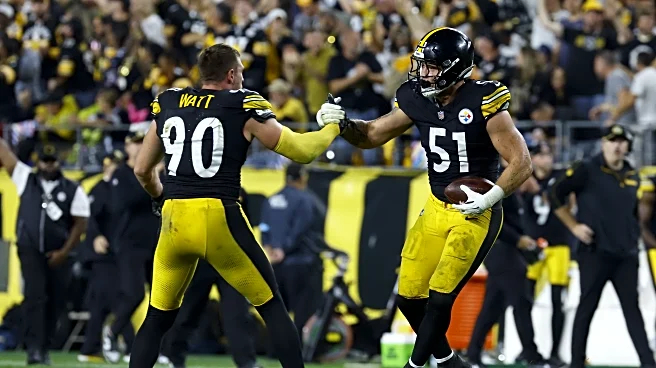
There was a lot of discussion/debate here last offseason about whether to trade or extend T.J. Watt. The Front Office obviously extended Watt. They also drafted Jack Sawyer, who’s looking like he has some serious potential. Herbig has one more year on his contract, and Highsmith has two more years on his contract. Do you think the FO will extend, cut, or trade either Herbig or Highsmith? While I love having all four of these EDGE players, the FO cannot afford three large contracts for EDGE players, can they?
With those two questions in mind, let’s discuss.
RP: I know there has been a lot of pessimism present in the fan base at varying points this season. The missed opportunity to clinch the playoffs against a three-win Browns squad has done nothing to alleviate those frustrations. I’m certainly not excluded from the voices calling for dramatic changes to the leadership structure of the organization this offseason.
But even with all of that, I do think it’s encouraging that the five players Blkgldtom highlighted are all players I believe are worthy of a second contract with the Steelers. Whether or not the Steelers will actually extend all five remains to be seen, but they presently have the ninth-most projected cap space ($17.3 million) in the NFL. I’ll save any discussion for how the Steelers could create more cap space for the annual “Offseason Blueprint” articles Ryland and I put together. All that to say, I’ll be speaking more generally about these contracts.
I’ll start with Herbig as he is present in both questions. I’ll let Ryland handle the specifics of how the Steelers should approach their pass rush room moving forward, but it feels prudent to contextualize where Herbig stands in his career and how that could play out for him on the open market.
Poll any Steelers fan — and likely general manager Omar Khan — and they’ll tell you they want to retain Herbig if we’re solely considering talent. The real crux of the question, and what NHSteelersFan alludes to, is whether or not they can afford to. I don’t pretend to be an expert or insider on what a player’s actual market value will be, but we can look at a collection of similar players and formulate an educated guess.
Below is a collection of pass rushers who recently signed contract extensions at a comparable age and career juncture to Herbig. Like Herbig, none of these players were first-round picks, and a handful of them started as backups or situational pass rushers.
Herbig’s value is somewhat clouded by the fact that he has the fewest snaps of this subset of players, and thus one of the lower sack totals. However, this plays both ways, in that Herbig and his reps will likely highlight how efficient he has been at generating pressures and sacks when he has played. I don’t see Herbig commanding the $26.5 million Bonitto secured, but things could get interesting if Herbig’s reps compare his production against the likes of Greenard, Cooper, and Granderson. Would it be shocking if his price tag fell somewhere between $13-19 million? I don’t really think so. If the Steelers can sign him for anything less than that without having to tag him, then we’ll need to talk about Khan as one of the shrewdest general managers in the NFL.
As for the other Steelers highlighted by Blkgldtom:
- Joey Porter Jr. is having a phenomenal season in man coverage, even if he still has room to grow in zone coverage and as a tackler. He’ll likely be one of the most expensive extensions. Consider the annual salaries of some recent second-contract cornerbacks whom I think many would consider lesser corners than Porter Jr: Daron Bland ($22.5 million), Tyson Campbell ($19 million), and Paulson Adebo ($18 million).
- Darnell Washington is integral to the Steelers as a blocker and has leveled up as a pass catcher this season. I think there is a reasonable argument he has been more valuable to the Steelers than Pat Friermuth and Jonnu Smith this season, and each of them makes a little more than $12 million. The Bills recently gave Dawson Knox, their TE2 who primarily serves as a blocker, $9 million per year.
- Keeanu Benton has been up and down this year, but he seems to still be trending positively in his development. The Ravens recently gave nose tackle Travis Jones an extension, where he makes roughly $13.5 million a year. The Broncos gave Malcolm Roach —whose production compares well to Benton in pressures, sacks, and stops — for $9.2 million. His contract should fall along those lines.
- Spencer Anderson is a potential replacement for Isaac Seumalo. If not, he’s at worst a useful depth piece who has seized a role as the Steelers’ sixth offensive lineman in the jumbo packages they’ve embraced this season. His market is the hardest to gauge, but I think he’s better than both the Chargers’ guards, Mekhi Becton ($10 million) and Trey Pimpkin ($7.25 million). If he were to sign a short contract, think a year or two at most, I could see him signing for somewhere between $3.5-5 million based on what others have received around the NFL.
For me, I would prioritize those players in the falling order, from most important to least: Porter Jr., Herbig, Washington, Benton, Anderson.
In my opinion, Porter Jr. is a cornerback I see as a foundational piece of this defense as the Steelers move forward, even if Pittsburgh eventually signs or drafts another corner to alleviate Porter Jr. from some of the pressure of being a CB1. I also prioritize the trenches and pass rush, especially if the Steelers continue to put together a patchwork secondary.
I personally think the Steelers need to dump Jonnu Smith this offseason, and Darnell Washington feels like an ascending and unique player they shouldn’t let walk out the door. In a perfect world, I’d like to retain Benton because I think his best football is still ahead of him, and I think there is a value in maintaining some continuity in the Steelers’ young defensive interior once Heyward retires.
That said, this year is another strong draft class for interior defensive linemen, which could make him the easiest to replace of the bunch. I also feel like retaining Anderson would be a smart move. Quality offensive linemen don’t grow on trees, and every year we seem to see teams with shallow offensive line depth reap the consequences of that choice. However, if the Steelers don’t view Anderson as worth starter money, I could easily see him departing.
RB: I largely agree, Ryan. I’d probably order my list of priorities the same way, and while I’m not quite as bullish on Spencer Anderson’s market value, I would generally agree with the predicted contracts as well.
One interesting discussion point I’ll add is whether or not the Steelers should consider extending any of those players a year early to get ahead of the market.
In my opinion, potential Washington, Benton, and Anderson extensions could all certainly wait until the 2027 offseason, given they won’t be demanding massive contracts and there are still some unknowns regarding their play. Washington had some longevity concerns when he was drafted, and only recently became a top contributor on offense. Benton’s play has been up and down his entire career, and Anderson’s Steelers future remains undefined.
As we learned following Calvin Austin III’s slight breakout in 2024, followed by a disappointing 2025, sometimes it’s best to give players on the verge of earning an extension an extra year before making a sizable investment. For what it’s worth, Pittsburgh could still extend Austin, but his market value has decreased in a big way since last offseason.
Porter and Herbig, however, fit the mold of players who have proved to be quality contributors and are still flying slightly under the radar ahead of inevitable big paydays. As Ryan mentioned, Porter looks like a building block of the defense, even if he has been overshadowed by bigger names and storylines in the secondary this season. If I’m Omar Khan, I’d consider extending Porter this season to get ahead of the cornerback market and any potential future Pro Bowls. Lock up your young players early.
Herbig is also deserving, but to segue to the second mailbag question, an extension for him would mean the Steelers would be spending big on three edge rushers.
Herbig is going to get a sizable, starting-caliber deal when he eventually signs his second contract (see Ryan’s segment), and frankly, the Steelers would be unwise to pay him that kind of money with both Watt and Highsmith still on the roster. The Jack Sawyer pick in the fourth round this year also seemed to indicate the Steelers don’t expect the trio to last forever.
Per Over the Cap, the Steelers had the NFL’s highest-paid defense in 2025. And as we’ve already written in plenty of columns, Pittsburgh’s lopsided spending on defense hasn’t yielded winning results for the team. And even though Cam Heyward — the unit’s second-largest cap hit at the moment — will be off the books in the next year or so, the team’s two highest defensive cap hits next year will both be at the edge position: Watt and Highsmith.
The Steelers’ three-headed monster at outside linebacker is both incredibly valuable to the team and fun to watch at the moment — don’t get me wrong. But barring some unprecedented pay cuts, market value makes it irresponsible for the team to be paying all three starting-level money at once.
You can’t over-invest in a single position, especially when all three players will rarely be on the field at the same time.
So what’s the move? For one, I’d keep Herbig on his affordable rookie contract ($1.3 million cap hit) through its final season in 2026 and enjoy the Watt-Highsmith-Herbig combination for as long as possible. But in the 2027 offseason, the team will have to make a choice.
My gut reaction, based on current play and the ages of all three players, would be to keep Herbig (26 years old in 2027) and Highsmith (30 in 2027 and currently playing at the highest level of any Steelers pass rusher), while cutting ties with the highly-paid Watt (33 in 2027) as he enters the twilight of his career.
However, Watt’s contract is massive and near-impossible to get out of. Pittsburgh would be dealing with a ridiculous $52 million in dead cap if they cut ties with the former Defensive Player of the Year before 2028. And while his play has declined in 2025, he’s hardly dead weight; Watt might not be putting up Pro Bowl sack numbers two years from now, but he’ll almost certainly be a quality starter.
Highsmith, on the other hand, would have just a $5.6 million dead cap hit in 2027 while being four years older than Herbig. While there’s a lot of time between now and then, it makes sense to move on from Highsmith and go with the significantly younger option.
I like Highsmith more as a player, but Herbig is a much better run defender than most give him credit for, and 26 versus 30 is a big deal on a team that desperately needs to get younger. Again, a lot could change, but moving forward with Watt and Herbig ahead of the 2027 season seems to be the most plausible outcome for Pittsburgh.
But there’s also a way Omar Khan could extend this saga out another year. Because yearly cap hits are determined by base salary plus a pro-rated signing bonus, players often have surprisingly low cap hits in the first year of a big extension because of a low first-year salary. For instance, T.J. Watt had just an $8 million cap hit in 2021, the first year of his initial extension in Pittsburgh, thanks to a $1 million base salary.
So, Pittsburgh could extend Herbig in 2027 with a low first-year salary, leading to something affordable like Highsmith’s $4.4 million cap hit in 2023, the first year of his first extension in Pittsburgh. Of course, Herbig would be locked in long-term with Pittsburgh at that point, but in the 2028 offseason, Highsmith would be a free agent and Watt would have just $10 million in dead cap if the Steelers moved on from his contract with one season remaining.
Then, Pittsburgh could either re-sign Highsmith and move on from Watt, or let Highsmith walk and finish out Watt’s contract/extend him again depending on how he’s playing at age 34.
Either way, a few things become clear: Pittsburgh can easily keep its talented outside linebacker group intact through next season. Maybe even the season after that. But it’ll be tough for all three to retire as Steelers.
However, there’s a lot of time until then. There are a lot of hypotheticals, but there’s no way of knowing what Watt, Highsmith, Herbig, and even Sawyer will be playing like in two years.
Game notes: Ravens vs. Steelers
Read & React already previewed the Baltimore Ravens this season — you can read that article HERE. As a result, we’ll be providing some up-to-date thoughts on the Steelers’ upcoming opponent instead of another preview, showing what’s changed since the last time the two teams met.
Offense

RB: The Ravens have gone 2-1 since their first meeting with Pittsburgh, scoring 24, 24, and 41 points, respectively, in those games. Now, Baltimore is up to 11th in the NFL in terms of points per game this season (they were 24th in Week 14), although playing the Bengals and the Micah Parsons-less Packers certainly helped.
Of course, the biggest story for Baltimore lately has been the status of two-time MVP quarterback Lamar Jackson. He was clearly playing injured earlier in the season and missed the Ravens’ Week 17 game against the Packers with a back injury he suffered against the Patriots the week before.
In Jackson’s stead, backup Tyler Huntley put together a solid effort, completing 16 of 20 passes for 107 yards and a touchdown against Green Bay. He’s serviceable as a passer, but his mobility was a big part of the Ravens’ success on offense, with Huntley rushing for 60 yards and only being sacked once.
Huntley’s performance left the Ravens feeling good about their chances Sunday night if he has to go against Pittsburgh – in fact, he arguably showed more mobility than the banged-up Jackson has lately.
However, Jackson practiced in full on Wednesday, a positive sign for his health ahead of the game. His ability to be dynamic in both the passing game and as a runner killed the Steelers late last season, but it’s a big question if he can do it again on Sunday.
More worrying for the Steelers is veteran Baltimore running back Derrick Henry, who showed he still hasn’t succumbed to Father Time yet with a whopping 216 rushing yards and four touchdowns against the Packers. At age 31, he’s still a big play threat, and even his “down year” in 2025 has yielded 1,469 rushing yards and 16 touchdowns with one game remaining.
The Ravens have been mixing in more heavy personnel lately, and it helped Henry have one of the best nights of his storied career in Week 17.
Baltimore’s run game, whether Jackson plays or not, will have two rushing threats in the backfield on Sunday. The Pittsburgh defense has excelled stopping the run over the last few weeks, but this upcoming game will be an especially tough test – and a playoff spot is on the line.
Outside of a potential quarterback change, this offense isn’t all that different from the version the Steelers faced in early December. However, following Baltimore’s big win in Green Bay, the Ravens have a lot more momentum heading into this week’s matchup.
Defense

RP: Since surrendering 27 points in a loss to Pittsburgh on December 7, Baltimore’s defense has been on a heater. In the three games since that contest, the Ravens are:
- Allowing an average of 17.3 points per game
- 86.0 rushing yards a game
- Had two or more sacks each game (nine total)
- Generated two turnovers a game (six total, four interceptions and two fumbles recovered)
This hasn’t exactly come against the NFL’s doormats either. The Bengals (12th in scoring), Patriots (5th), and Packers (13th) are all top-half offenses we consider among the league’s best. The Ravens did face a backup quarterback against the Packers, but it seems notable that Malik Willis is generating buzz already as a quarterback a team might take a shot at acquiring and starting in 2026.
During this stretch, the Ravens have capitalized on splash plays (sacks and turnovers) and have used it to suffocate these top offenses, including pitching a shutout against the Bengals. However, Baltimore’s defense still has many of the same strengths (run defense) and flaws (inconsistent pass rush pressure) as it did when these teams first met.
Unfortunately for the Steelers, they aren’t primed to take advantage of the Ravens’ current weaknesses, especially if they execute similarly to how they played the Browns. While the Pittsburgh offensive line seems well-positioned to help against the Ravens’ lackluster pass rush, they don’t have many inspiring pass-catching options to win the necessary matchups in coverage. There will be no DK Metcalf (7-148 last meeting), thanks to his suspension, nor Darnell Washington, who has been shut down for the year.
The timing of this reality is terrible for a Steelers offense that managed 34 yards on just 15 attempts in the first matchup. The Ravens’ defense was so effective against the run, the Steelers all but abandoned it despite a favorable early game script that saw the Steelers build a 20-9 lead early in the third quarter.
Pat Freiermuth and Kenneth Gainwell will likely be the Steelers’ best bets to attack the Ravens in the passing game, but will the Steelers deploy them effectively? Pittsburgh has criminally underutilized Freiermuth this season, and it’s hard to consistently funnel a passing attack through a running back.
The Ravens’ coverage hasn’t shifted much since their last meeting. Baltimore is using slightly less man coverage, but I think it’s fair to wonder if they might be tempted to utilize it more against the likes of Marquez-Valdes Scantling, Calvin Austin III, and crew.
The answer could provide pivotal in deciding which of these teams advances to the playoffs.
Join in on Steelers R&R by sharing your takes on this week’s topics. Feel free to pitch future questions in the comment section or on Twitter/X: tag @_Ryland_B or @RyanParishMedia, or email us at steelersreadnreact@gmail.com.