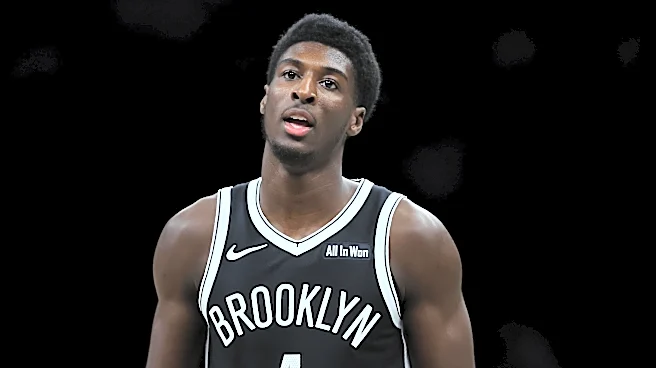






The trade the Brooklyn Nets made to acquire the #22 overall pick in the 2025 NBA Draft, which they used to select Drake Powell, was a smart move. In addition to Powell, the Nets received Terance Mann in the deal, or more accurately, they relieved the Atlanta Hawks of his contract.
Mann is owed roughly $32 million over the next two seasons, positioned as a salary-matching trade chip for whatever deal Sean Marks elects to make in the intermediate future to improve the roster. As it stands, Nic Claxton
is the only other player on the roster owed between $8-$35 million moving forward. Combine Mann and Claxton and that’s around $38 million in tradable salary for two players whose contracts expire in two seasons. If Marks isn’t keen on making a big splash in this summer’s trade market, there’s always 2027, when Mann/Claxton will be on expiring deals. Also, people seem to really like T-Mann.
Among the many complaints about Brooklyn’s 2025 draft class, redundancy was frequently mentioned. By putting so many ball-handlers on the same timeline, in the same development context, their individual opportunities for growth will be limited, the thinking went.
I would argue not only that this complaint was slightly overblown, but that Powell doesn’t fit into this conundrum. If regular-season lineups with, say, Nolan Traore, Egor Dëmin, and Drake Powell don’t work, it won’t be because of harmful overlap.
All told, I liked Brooklyn buying the #22 pick for the price of Mann’s contract, which should come in handy soon enough. Separately, Drake Powell had a disappointing rookie season. He played 63 games with Brooklyn and a handful more for the G League’s Long Island Nets — on the NBA side, he averaged 7/2/1 on a commendable 53% shooting from two, a worrisome 28% from deep, and 89.6% from the line.
He took just 77 total free-throws, but the percentage really exemplifies the sell for Powell: a plus-athlete with real touch, skills that make him playable will he expands the rest of his game. Nets fans can attest that it felt like every single middy or floater Powell took before the calendar flipped to 2026 was cash. Alas, he finished this season shooting 39% on non-rim twos.
This kind of exemplifies the Powell experience so far. You’ve probably heard about the historically low usage rate for Powell at UNC, but the 20-year-old posted some serious scoring highlights as a rookie…
Some assists too, though as I note in the tweet, they mostly come in rigid pick-and-roll structure. Still, Powell navigates drop coverage and sees the low-man tagging the roller, then sees the wing defender sinking to the corner, and fires it back toward the top of the key in this play…
That’s not nothing!! If you’re highlight-scouting and nothing else, Powell had a pretty impressive offensive season.
Alas, there was no consistent production to speak of. Whatever touch he displayed from the free-throw line did not translate to his three-ball, which you might call “unorthodox” when it goes in and “wonky” when it doesn’t; beyond spot-up shooting there was no avenue for Powell to explore consistently, particularly because the Nets rarely got out in transition.
Take a look at this turnover…
He doesn’t always have a clear (or calm) plan-of-attack on offense, exacerbated by a loose handle, a scary combination responsible for that turnover. Whatever the case was at UNC Powell’s lack of usage as a rookie was not a function of coaching, but rather his own shortcomings. Different players, of course, but late-season tank-tests where Malachi Smith and E.J. Liddell were getting their games off while Powell faded into the background are particularly worrisome.
“ I don’t really pay much attention into the stretches. You guys are saying, well, his month has been better, it’s been worse. At the end of the day for me it’s the bigger sample size. I’m not going to get caught in you made a couple shots, you missed a couple shots. I buy into how good they are in the day to day, and then in the long run they’re going to be very good for us. That’s why we, in this case, drafted them. High-character people, very good teammates, and that’s what matters right now. Finish the season, finish strong, see obviously how all his tendencies, numbers, everything has worked out and see how we plan the summer for him.
Given his profile, Powell’s offense was expected to lag behind his defense. It did. His best defensive game of the year was likely an early road contest vs. the Orlando Magic, where he bugged the hell out of Desmond Bane as a pesky point-of-attack defender…
That activity, though, infrequently translated to other areas. Like many rookies, Powell was not a hyper-aware off-ball defender, which sapped his impact but also his defensive counting stats…
With steal, block, and deflection rates well below league-average, the early returns on Powell’s defense are a bit worrisome too. Those numbers are certainly not the be-all, end-all measure of defense, and given his athletic traits plus some of the flashes he showed guarding the ball, it’s too early to discount the possibility he becomes a positive defender.
But this gets us to the main question with Powell on both ends of the floor: Where is the athleticism going to shine? I’m not taking about the rare play where he gets a runway the size of Manhattan…
He’ll add more muscle over the next couple years, enabling him to play with a bit more force. But the hype around Powell, post-draft, was around his athleticism, a kind the Brooklyn Nets have not rostered in a long while. Outside of the occasional hang-in-the-air finish or dunk, we just didn’t feel it much this season. Why? In my opinion:
- Some ball-handling deficiencies prevented him from turning corners or attacking driving lanes and exploding through contract.
- As the season went on, defenses outright refused to close out on Powell and his 28% mark from deep.
- Defensively, Powell was just a step slow on many rotations and didn’t have a great feel for taking risks in the passing lanes.
- That combined with a lack of muscle/lower body strength really suppressed his rebounding numbers on both ends of the court.
Though Powell may have had a subpar rookie season, he will be just 21 years old in his sophomore campaign, and it’s not likely that the Nets will be contending for a championship. He won’t be an outright positive player next season, but the former Tar Heel should still get plenty of run. Shooting in the low-to-mid 30s from deep while maintaining positive finishing numbers is a reasonable offensive goal, especially if his usage ticks up juuuust a tad. Defensively, marginal improvements to the rebounding and steal rates seem feasible, especially if there’s just a bit more awareness on that end.
Is Drake Powell making all these improvements at once likely? No, but it’s not impossible either. There’s still a chance he becomes a useful rotation player given his athletic tools and moments of offensive dynamism, but the early returns aren’t too inspiring.
“This summer is the most important. If you think about it, [the rookies] had a part of the summer or a very small part of the summer, some of them. Or no summer like Drake, because he was dealing with the patellar tendon, whatever the case was. But right now I’m excited because he’s got the whole summer to work, and work with us. And he knows us and we know him. So it’s very exciting.” — Jordi Fernández