



The Los Angeles Dodgers are making a farce of the league. After winning back-to-back championships on the back of impossibly stacked rosters, they gave the best free agent on the market almost as much guaranteed money over the next four years than the White Sox, Guardians, and Marlins’ entire 2026 team payrolls combined. It is now a forgone conclusion that the Dodgers will capture their third consecutive World Series title in 2026. When – not if – that happens, expect Major League Baseball to suffer
the same consequence that followed the crowning of its last three-peat champions; fans of the other 29 teams, driven to apathy, will simply walk away from the sport, in droves, and nothing will bring them back. Rob Manfred must choose one of two paths. He can stand idly by while baseball dies a slow death, or he can take decisive action to curtail —
Hold on, I’m getting a phone call from my editor. Yes? What’s that? Yeah, I was just writing about how the Yankees ruined baseball with their three-peat. That mass exodus of fans after 2000 was really something, right? Wait, what do you mean that never happened? People kept on watching baseball? 1998-2000 isn’t remembered as a black mark on the game’s history?
Oh. Well, I guess I can still submit this story to the Post.
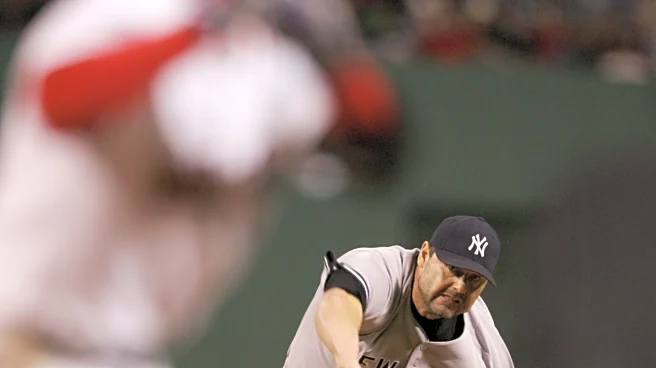
Overwrought intro skit aside, my actual take is this: the Dodgers aren’t “ruining baseball”. Yes, it is groan-worthy to see the game’s leading financial juggernaut, possessing an already elite roster which just won the World Series, take on even more payroll to acquire a top-tier player. But pretending like it’s an affront to the integrity and health of the game itself is pretty rich, especially if you’re a fan of the Yankees. After all, our beloved team did just that in the 1998-1999 offseason, when they celebrated their historic 114-win championship year by trading for literally Roger Clemens. They won the World Series that year, and the year after that too – and then what happened?
I’ll tell you what didn’t happen – baseball didn’t die. Fans kept showing up to games. In 1998, a total of 70.37 million fans attended MLB games, coming out to an average of 29,285 per game. In 1999, those figures dropped all the way to…70.13 million total and 29,152 per game. I’m sure many non-Yankees fans were disgusted with Clemens being traded to the Yankees, but by and large, that disgust did not translate into a marked decrease in attendance. Likewise, the Yankees repeating as champions in 1999 also did not result in MLB attendance suffering in 2000. If anything, total attendance increased to 72.74 million that season, with the per-game average exceeding the 30,000 mark. It was the first 162-game season to accomplish that feat since the 1994 strike.
TV ratings for the World Series in those years also bear this out. The 1998 World Series garnered a Nielsen rating of 14.1 (meaning that an estimated 14.1% of all households with a TV were tuned in), with total viewership estimated at 20.34 million. In 1999, those figures actually improved to 16.0 and 23.73 million, respectively. And while 2000 did see a marked decrease (12.4 Nielsen rating, 18.08 million viewers), those figures rebounded strongly in 2001 (15.7 Nielsen rating, 24.52 million viewers). If fans of the other 29 teams were sick and tired of having to watch the Yankees play in the World Series year after year, they sure didn’t show it by tuning in to something else.
Now, you may argue that my comparison is flawed, because I’m ignoring the magnitude by which the Dodgers currently outspend the rest of MLB. It’s not just the fact that they have two rings in the bag and are going for their third – it’s that they’re going about it by flexing their financial muscles in a way that few other teams can compete with.
The raw figures seem to support this argument. The Yankees did have the highest payroll in baseball in 1999, but their $88.1 million figure only bested the second-highest spenders (the Texas Rangers) by $7 million or so. They led MLB again with a $92.9 million payroll in 2000, but this time, their lead over the second-place Dodgers was only $2 million. Compared to the Dodgers’ 2026 projected Opening Day payroll of $397 million, which clears the runner-up New York Mets’ payroll by a good $30 million, the 1999-2000 Yankees seem like small fries.
However, such a view ignores both inflation and the staggering increase of spending in MLB as a whole. Relative to their peers, the 1999-2000 Yankees outspent the league on a scale comparable to the current Dodgers. To wit: the 1999 Yankees’ payroll was 8.3% bigger than the next-highest spending Rangers, and 583% bigger than the last place Marlins’ $15.1 million mark. In 2000, the Yankees’ lead over the second-place Dodgers shrunk to 2.4%, but their $92.9 million payroll represented a 593% increase from the cellar-dwelling Twins’ $15.6 million total. Meanwhile, the 2026 Dodgers’ projected payroll is 9% bigger than the second place Mets, and only 543% bigger than the last place Marlins’ $73 million tally. Believe it or not, when adjusted for their respective eras, the scale of the Yankees’ spending during their three-peat years isn’t far apart from what the Dodgers are doing now.
The turn-of-the-millennium Yankees were every bit as villainous as the Dodgers are now, in terms of both their success and the ruthless spending by which they pursued it. And yet, despite the bad guys winning three consecutive World Series (and nearly winning a fourth!), fans kept showing up and tuning in, and MLB did not wane into irrelevance. So, I hope you can see why I’m a wee bit skeptical towards the claim that the Dodgers are ruining the game. This isn’t to say that what the Yankees did and what the Dodgers are doing is necessarily good for baseball. I do believe that a more level playing field would benefit the game (although I vehemently disagree with the idea that a salary cap would solve the issue). I do believe that fans of small and mid-market franchises do have a legitimate gripe against the Dodgers. But Yankees fans? The only sports team in America who was compared to U.S. Steel in their prime, and not as hyperbole? I think it’s best for us to sit this one out.
Attendance figures from AP News, TV ratings from Baseball Almanac, Historical payroll data from the Baseball Cube, 2026 projected payroll data from RosterResource