


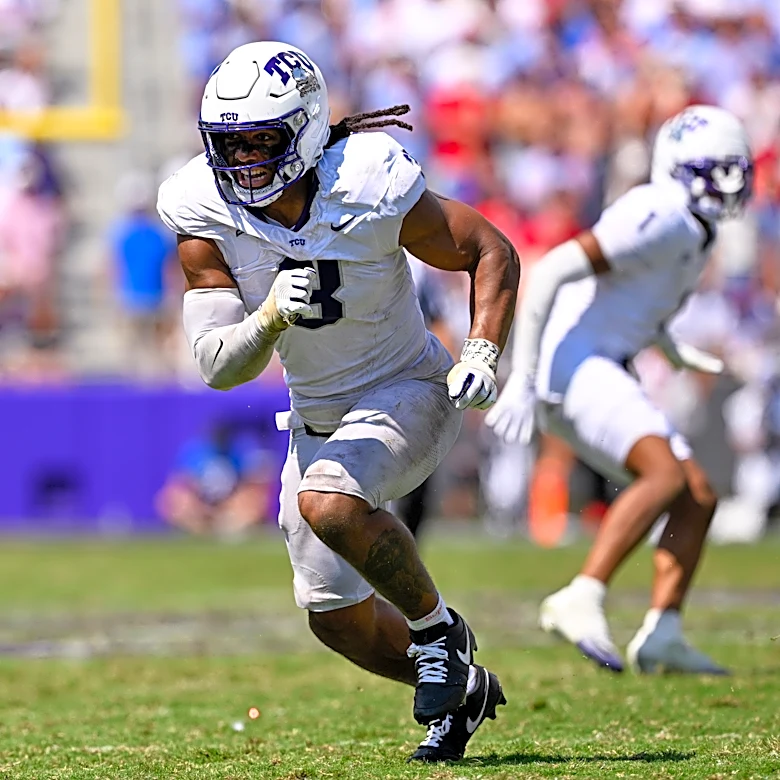


In Week 15 this past season, the Green Bay Packers’ defense suffered its most brutal loss of the season to that point. No, it wasn’t that they lost a 34-26 game to Denver, but rather the loss of Micah Parsons for a team that was sitting at 9-3-1 heading into the game.
The loss of Parsons was at least partly responsible for the four-game losing streak at the end of the season, starting with that game in Denver (though to be fair, Week 18 was a wash).
Even with the addition of Parsons, the Packers’ defense
hovered around the middle of the league in EPA per play for most of the season. Using RBSDM EPA data, I filtered the win probability to 10-90%, eliminating garbage time scenarios to get a better look at the defense from a higher level.
In Weeks 1-4, they ranked 18th. Through Week 8, they ranked 13th, through Week 12, they ranked 17th, and through Week 16, they fell to 20th, and finished the season 24th (23rd through Week 17).
Broken out by phase, they finished 22nd in EPA versus the pass and 13th in success rate. Versus the run, they finished 18th in EPA and 28th in success rate. The run defense was suspect all season long against teams that could actually run the ball with any kind of efficiency.
On early down run plays (1st and 2nd down), the Packers finished 19th in EPA/play and 28th in rushing success rate, nearly the same as their overall season ranking. On first and second down, they ranked 15th in yards per attempt (YPA) at 4.3 per Sports Info Solutions.
Broken out by down, on first down, they finished 17th in YPA at 4.4, and on second down were ranked 15th at 4.1. They were a very basic, average run defense, and in critical games and situations, it bit them.
Nowhere was this more exemplified than in a home game against Carolina, where the Packers’ defense struggled significantly against the Panthers’ ground attack, yielding nearly five yards per carry.
A prime example was the 29-yard toss play to Rico Dowdle in the second quarter, which set up the Panthers’ first score. This big gain resulted from a combination of effective offensive scheme and poor defensive execution, specifically “bad assignment football.”
The Panthers ran a pin-and-pull toss to the right, utilizing motion to shift the defense and create favorable blocking angles. They employed crack blocks to pin perimeter defenders Rashan Gary and Javon Bullard inside, effectively moving the running gaps.
In the run fit, next-level defenders must “crack replace” those pinned perimeter players. However, safety Evan Williams failed to replace Gary on the edge as required. Instead, Williams leveraged the run back inside, which created a massive running lane for Dowdle.
While cornerback Keisean Nixon correctly came downhill to replace the pinned Bullard and turned the runner back inside, the lack of alley support from Williams left the interior wide open.
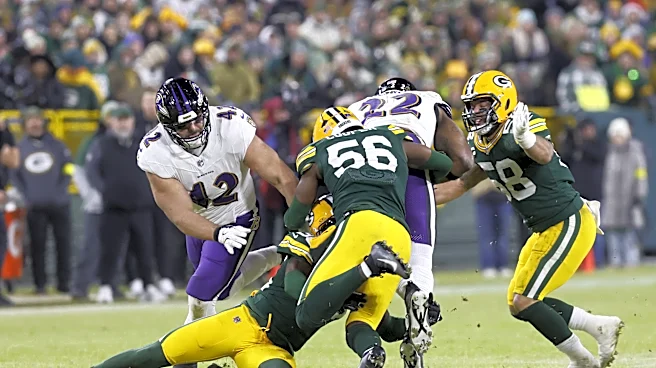
Perhaps their worst game of the season, though, came late in the year versus the Ravens. The Ravens clinched a late victory against the Packers in week 17 with two crucial outside zone runs, showcasing a strategic shift in their offensive game plan when the game was on the line.
The two decisive plays not only moved the chains on the defense but also demonstrated the Packers’ inability to execute against complex running schemes under pressure. The emphasis the Ravens put on the perimeter run attack proved to be the nail, the primary reason the defense broke in this one.
The first of these game-changing plays was a 30-yard gain when the game was still well within reach for the Packers. In the third quarter, when these runs were broken off, it was still 27-24.
This first play, a strong-side outside zone, was a change-up by the Ravens’ earlier reliance on inside runs, aiming to exploit the defense’s concentration in the interior.
By utilizing a fullback as an extra blocker, the Ravens successfully ran away from the most congested areas, creating an advantage on the edge. Running back Derrick Henry capitalized on this perfectly, breaking free after safety Javon Bullard failed to secure the tackle, a momentum-shifting error by the Packers’ secondary.
The second pivotal run, a 25-yard touchdown with just two minutes remaining in the game, sealed the 41-24 win. The play, a weak-side outside zone run, was a clever two-back call directed toward the open side of the field, a move that effectively neutralized the defense by forcing them to cover more ground.
Exceptional blocking by the offensive line created a massive running lane for Henry, and a critical missed assignment by an edge defender, combined with a successful sealing block on cornerback Carrington Valentine, cleared the way for the decisive, game-ending score.
It’s too early to tell how the Packers will prioritize the defensive line this year, as a return to a more Fangio-based defense is in the works under new defensive coordinator Jonathan Gannon. Here at Acme Packing Company, we’ll be looking later at how some of the current personnel fit the new defensive scheme along the defensive front.