



Whilst Sunderland’s form at the start of the 1947-48 season was poor there was money in the coffers for team strengthening, and so manager Bill Murray was working overtime in order to track down suitable reinforcements. The Lads were playing at Blackpool on this day and the boss arrived on the coast having gone the long way, spending most of the week on the road in an attempt to push through some deals, yet by the end of the afternoon it was the current crop that had given him some satisfaction,
winning at Bloomfield Road to halt a run of four defeats in their previous five outings.
The points were well received but even in victory it was clear why Murray was so keen to strengthen the squad. Neither side had played well and the common consensus afterwards was that at this pace Sunderland would have struggled massively against almost any other side in the division, even though the hosts themselves were a distance off being full strength. Both Stanley Matthews and Stan Mortensen were away on England international duty in Belgium, and whilst their replacements started promisingly enough, the absences proved to be very telling for a team that were unable to sustain any prolonged spells of pressure.
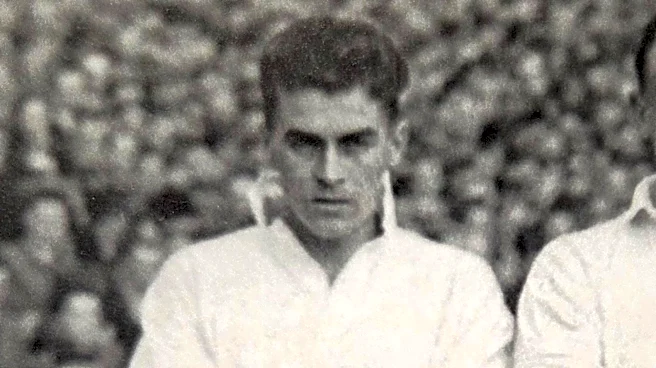
In an attempt to catch Sunderland out the Seasiders had immediately gone for goal from the kick off, only to find that Bill Walsh was fully switched on and able to react swiftly. Johnny Mapson then dealt smartly with a dangerous ball into the box to take the sting out of Blackpool, and with Walsh continuing to stay alert thereafter the Sunderland defence was able to keep their opponents at arm’s length. A wicked Len Duns corner at the other end signalled that the team were aiming to do more than simply contain also, and after twenty three minutes another flag kick, only partially cleared, led to Reg Scotson smashing in what proved to be the only goal of the game.
Blackpool’s attempts at getting an equaliser became increasingly desperate at as the clock wound down, and whilst they did get the ball into the net at one stage the attempt was ruled out due to an offside call. Most other exchanges proved scrappy, and whilst there was no faulting the effort on show from Sunderland a lot of their attacking output in particular was poor, and it was no surprise that in the days that followed the attention soon moved away from the performance and back onto the ongoing transfer attempts.
It transpired that director Laurie Evans had not been at the Blackpool game as he had instead gone to Port Vale, where he had taken in their Division Three South encounter with Torquay United. The score had been 1-1 and Evans was thought to have been scouting one of the home team’s strikers, whereas Murray had been rumoured to have been concentrating on more established forward options. Whilst on his travels he had supposedly made approaches for Coventry City’s George Lowrie and Aston Villa’s Trevor Ford, both of whom were Welsh internationals, plus Arsenal’s Ian McPherson, only to be rebuffed and instantly sent on his way.
There was one potential move however that did appear to have some legs. Earlier in the week Murray had set off on his tour of the country and was believed to have been somewhere in the Midlands when he heard the news that Chelsea’s big name centre forward Tommy Lawton was open to offers, prompting the boss to rush back to Wearside. The Blues had been scheduled to play against Sunderland at Roker Park on the Wednesday night, but Murray was not going to be there, only changing his mind once he knew there would be the possibility of speaking to this target face to face. Lawton, who would then feature alongside Matthews and Mortensen in Brussels and scored in a 5-2 win, grabbed a late winner over the Lads and was subsequently invited to have an informal chat with the Roker hierarchy, and whilst he politely declined, possibly as a courtesy to his existing employers, a formal bid was then placed anyway.

Chelsea advised that they would consider the proposal alongside other bids already received. In the end, Murray had to wait a little longer before he could open the chequebook, and that was for Dundee’s Ronnie Turnbull at £9,000. Lawton meanwhile opted later in the year for a surprise move to third tier Notts County; the Magpies must have been flush with silver as they paid out a record British transfer fee of £20,000, only for it to be broken when Sunderland re-entered the market in February and brought in Len Shackleton from Newcastle United. Even with the expensive arrivals though Murray saw his side struggle; Blackpool improved as the campaign wore on yet Sunderland’s win there proved to be a rather isolated high, and it was going to need more than a bit of money throwing at it if Sunderland were going to become a consistent force.
*Tommy Lawton and an unnamed Port Vale player were not the only ones whose future was undecided at the point Reg Scotson was scoring what proved to be his only Sunderland goal. Popular trainer George Gray, who was from the town originally but had moved away to play for clubs including Gillingham, Hartlepools United and Swansea Town before returning home, was reportedly a target of Bury following the departure of their own trainer GW Day. There were questions also about half-back Tommy McLain, who had been detained in Monkwearmouth Hospital for several days under the care of Stanley Ritson, who was a consultant there as well as being a shareholder/director of the club. McLain was suffering from severe concussion and showing unusual symptoms, but did make a return to the side the following month, with Gray remaining as trainer until 1951 before taking on other roles within the club.
——————————————————————————————————————————–
Saturday 20 September 1947
Football League Division One
Blackpool 0
Sunderland 1 (Scotson 24’)
Sunderland: Mapson; Stelling, Walsh; Scotson, Hall, Wright; Duns, Lloyd, Davis, Robinson, Reynolds.
Bloomfield Road, attendance 25,343
*Bill Walsh was making his second appearance of the season on this day. For more information on his Sunderland career, keep a look out for an upcoming edition of Ha’way the Podcast’s Sunder Years series, when we cover 1923 and the year he was born…