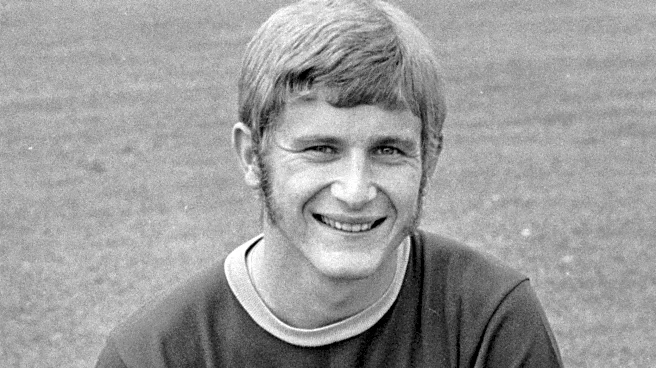




I was completely underwhelmed by the £10,000 signing of full-back come midfielder Mick Docherty from Man City on the last day of 1976.
We were in dire straits at the bottom of the First Division and looking like we were going straight back down to the second tier, having fought so long and hard under Bob Stokoe to get promoted.
The resignation of Stokoe due to ill health had generally shocked the fanbase despite our difficulties. The appointment of Adamson had not been universally welcomed, and results
as well as performances had not improved.
I felt the often publicly dour Ashington-born but steeped in Burnley FC man needed a marquee signing to get us all believing again. A bargain-basement journeyman who could not get a game at his previous club was hardly the signing to get us off our seats!
It would not take too long for Mick Docherty to change my and many others in the fanbase’s opinion, with his combative, hard-working performances allied to a really sharp sense of the game and a natural ability to lead. By the time he had to retire from playing because of injury he would arguably sit in the top five pound-for-pound best-ever signings I have ever seen in coming up to sixty years of watching Sunderland AFC!
Mick Docherty started his career at Chelsea as an apprentice in 1966. His father, the legendary Tommy Docherty, was the manager and surprised – maybe even shocked – Mick at the time by arranging an “apprentice transfer” to Burnley. Two hundred miles away from the family home, young Docherty wondered what he had done to deserve to be “sent to Burnley”. However, at this period the Clarets had a premier reputation for fashioning and moulding young players through such coaches as Alan Brown, Harry Potts, and Jimmy Adamson.

Docherty would quickly make his mark, becoming the first-ever Burnley Youth-team captain to lift the FA Youth Cup in the 1967/68 season. Burnley’s victory in this season interrupted a run by Sunderland whose Youth team were beaten finalists in 1965/66, winners in 1966/67 and 1968/69. Alan Brown is hugely credited with being the architect of Sunderland’s successes during this period in bringing through so many good young players.
Former Burnley player Jimmy Adamson was a coach at Burnley when Mick Docherty joined the club. He was a coach with a huge reputation in the game, having assisted England manager Walter Winterbottom in the 1962 World Cup and been the preferred choice of the FA in front of Alf Ramsey to take the national team forward to the 1966 World Cup tournament. Adamson had declined the offer, preferring to concentrate on developing his career in the club game.
At this point in his career Docherty was a hard-working ball-winner and midfielder who won four England Youth caps before making his debut for Burnley in December 1968.
Initially playing in midfield, Docherty went on to make one hundred and fifty-three appearances for the Clarets between 1968 and May 1976. Jimmy Adamson had taken over as first-team manager from February 1970, and Docherty was a trusted player and became an on-field leader in his Burnley team over this period.
Docherty was a key part of the Burnley squad who won the Second Division championship in 1973 led by Jimmy Adamson. By this point Adamson had converted Docherty into a very good right-back. Unfortunately “young Doc” sustained torn knee ligaments coming into the closing stages of that campaign. He rehabbed well and was fit for the start of the next season in the top tier. But in the very first game he was stretchered off with cruciate and medial ligament injury in the same knee. Despite once again rehabbing well and regaining his place in the team, this injury would come back to plague him and eventually force his premature retirement from playing.

The dismissal of Jimmy Adamson from his post at Burnley in January 1976 also quickly saw Docherty lose his place in the first team as new manager Joe Brown cleared out a lot of the previous regime’s players. Man City manager Tony Book snapped Docherty up for the start of the 1976/77 campaign.
Jimmy Adamson meanwhile had gone to Sparta Rotterdam as their manager for the 1976/77 season but was offered the Sunderland post in November 1976 and found the lure of managing back in the English top tier and back in his native North-East too hard to resist.
Docherty had only played eleven games for Man City when his former boss came in for him to renew their working relationship.
Signed too late to play in the New Year’s Day game at Liverpool (which was a shame as I travelled to that game and saw us well beaten by two goals to nil), Doc makes his debut for Sunderland three days later in a bottom-of-the-table clash at Roker Park against Coventry.
Playing at right-back and made captain his impact was immediate. Snapping into tackles and using the ball sharply, his presence appeared to bring a bit of confidence to a team on a seven-game losing run who had not scored a goal for six games.
Despite his impact we lost that game to a 90th-minute goal which was to a degree how the season had been going!
A loss in our next league game at Leicester saw youngsters Kevin Arnott and Shaun Elliott join Gary Rowell in the team, with another young player Alan Brown on the bench. Elliott had to leave the field injured on fifty-six minutes and with our sub already on we played the game a man down for the last thirty-four minutes, but the improved performance continued.
Two hard-fought 0-0 draws at Arsenal and home to Stoke City followed. The team was fighting, and Docherty was right at the heart of this, leading from the front!
Then on a dark, cold, and wet Friday night in February we scrapped a 1-0 victory with a Mel Holden goal against Bristol City. This ended an eleven-game run in the league without a win and ten league games without scoring a goal.
What followed was almost unbelievable given what had preceded it as we scored sixteen goals in three games and went on a run to the end of the season that saw us lose only three games, drawing five and winning nine. It was one of my favourite periods supporting the Lads as we almost did the impossible and saved ourselves from what had been certain relegation at the end of January. The three youngsters who had come into the team known as “Charlie’s Angels” (after the scout Charlie Ferguson who had brought all three into the club) were a massive part of this turnaround and earned rave reviews for their performances. Quietly, almost subtly in the background, Mick Docherty was working his oracle – cajoling and supporting, leading and performing.
Mick Docherty brought simplicity to his game. He was tigerish in just about any tackle and had a good knack of staying on his feet. He was pacey and had a sharp turn. His passing was uncomplicated and accurate, and he matched all of this with a very good engine that played ninety-plus minutes every game. He also led from the front; he was in every sense a guy to go to war with!
He started season 1977/78 at right-back, but early on into the season a recurrence of his knee injury means he did not get back till 31st December for a tough 0-0 draw at his previous club Burnley. Apart from the game being extremely hard-fought, the other noticeable feature is he starts the game in midfield alongside Bobby Kerr, Kevin Arnott, and Wilf Rostron and puts in a man-of-the-match performance.
The difficult start to the season with Adamson moving on many of Bob Stokoe’s team put paid to any chances of promotion that campaign, but there is enough to suggest in a sixth-place finish that the following season could bear fruit if we have a better run of injuries.
The 1978/79 campaign had some memorable moments in it, and Doc played twenty-eight games scoring six goals in the centre of midfield.
A game that I will always remember and associate with him in particular was the match that came to be called “the Battle of Turf Moor”. Everything that Mick Docherty brought to a team was on display in this game. With both full-backs unjustly sent off in my opinion, we go in at half-time drawing 0-0 but facing the prospect of playing the second half with just nine men!
Ex-Burnley manager, coach, and player Jimmy Adamson appears to have found this all too much, bursting into the dressing room and telling his team they were a “disgrace” and that they now “had their excuse for losing the game” before storming out slamming the door.
It is Mick Docherty that breaks the silence saying “I am not having that” as he leads the plan to surprise Burnley by attacking for the first fifteen minutes of the second half.
The plan works with two Gary Rowell goals (including one penalty). However it is the performance of the nine players on the pitch in a game Sunderland legend Gary Rowell described as the most violent he ever played in that stands out. I was at that game and Mick Docherty along with Shaun Elliott and Barry Siddall were out of this world, with the other six Sunderland players being simply brilliant!
Unfortunately this season too saw Docherty miss much of the season from November to March as the knee injury impacted.
Jimmy Adamson had left four games after the “Battle of Turf Moor” to manage Leeds. Long-serving Billy Elliott was in temporary charge with Ken Knighton his coach. Docherty was an important conduit and influence both on and off the pitch this season as he played twenty-eight games scoring six goals again from midfield. The season went down to the final game with Sunderland winning at Wrexham. I stood on the Wrexham terrace waiting on the Stoke result to come through. If we had bettered their result (at Notts County) we were promoted. They had scored a late winner and it was a major disappointment and a very long journey home for us. Few of us knew that in the dressing room a once-again injured Mick Docherty had played his last competitive game. He had poured everything into that match and given his all for the cause, but the medial and cruciate ligament injury was not going to allow him to play again at the age of twenty-nine!
Season 1979/80 surprisingly saw Ken Knighton and not Billy Elliott given the manager’s post. Docherty, already qualified as a coach, was given a role within the club and played his part behind the scenes in a fantastic promotion to the top tier.
The following season (1980/81) was difficult for Knighton, especially given his relationship with chairman Tom Cowie. With results not going their way and fears of relegation, Cowie sacks Knighton and places Docherty in charge for the last four games. He manages to steer the team to two wins including an amazing 1-0 victory at Anfield courtesy of a Stan Cummins goal as relegation is avoided.
He became part of Alan Durban’s coaching team for the next two seasons before trying his hand in the manager’s role at Hartlepool for eighteen months. His pedigree though is as a coach, and he enjoys spells at Burnley, Huddersfield, and Hull to name but three in a coaching career of almost forty years.
I always thought Sunderland as a club suited him. He was everything we like in a player – committed, skilful, hard, and clever. His record of seventy-nine games and eight goals was eventful as well as hard-won. I firmly believe that but for injury Mick Docherty would have built an even more obvious legacy at Sunderland.
Every team needs a Mick Docherty!