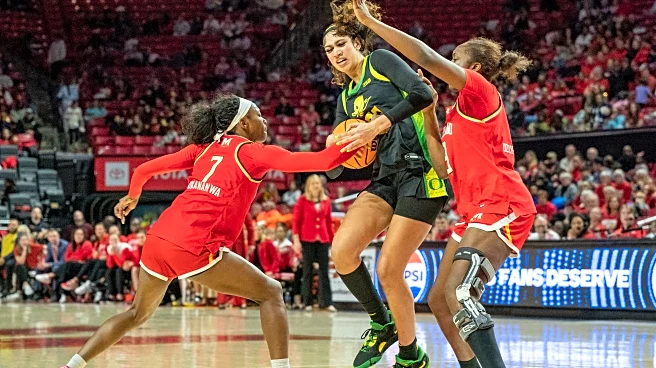



No. 16 Maryland women’s basketball headed into the fourth quarter against Oregon with a five point lead. It seemed like the Terps had weathered the storm of their offensive struggles and could end their three-game losing skid.
Instead, their offense went ice cold, and they lost the fourth quarter by 13 points en route to a 68-61 defeat. The collapse resulted in Maryland’s fourth straight loss and its fifth in six games.
Here are three takeaways from Saturday’s action.
Maryland’s halfcourt offense was unreliable
Maryland’s offense is most comfortable
when it can get out and run, using the athleticism of players like Oluchi Okananwa to get down the court before opponents can set up their defense.
While this has remained a strength of Maryland’s — it scored 14 of its points in transition against Oregon — its halfcourt offense has not been as consistently reliable lately, and it was as bad as it has been this season against the Ducks.
Things started well offensively for Maryland. Okananwa scored nine straight points to open the game and blew by her defenders, getting to the heart of Oregon’s defense for layups. Then, the offense hit a long stretch of struggles.
“Obviously, I have my spots that I want to get to and they were open, so I was getting to them,” Okananwa said of her early success.
She suddenly saw less of the ball, while Addi Mack and Saylor Poffenbarger tried — largely unsuccessfully — to get isolation buckets. This pattern persisted throughout the game, where the Terps would put together quick runs of points before hitting a wall.
Unfortunately for Maryland, one of those walls was hit in the fourth quarter, a period it entered with a six-point lead. The Terps managed just four points through a roughly 7:30 span to open the quarter, allowing Oregon to slowly regain control of the game.
The Terps had two real threats on offense to that point: Okananwa, who scored 23 of her 27 in the first half, and Addi Mack, who finished with an inefficient 17 points on under 30% shooting from the floor. Maryland shot 36.5% as a team and just 2-of-15 from three.
Injuries have severely cut into Maryland’s offensive options, but Poffenbarger and Yarden Garzon were always going to be big parts of Maryland’s offensive plans. Yet, the two managed just five combined points.
“We have a small margin for error,” head coach Brenda Frese said. “These are the healthy pieces we have left…. but it’s not going away.”
For large stretches of the game, it would have been easy to forget that Garzon, who was brought in to be Maryland’s best shooter, was even on the floor. She attempted just two 3-pointers, making one in the second quarter and missing a second when Maryland was down four late.
Ehis Etute had a career-best performance
When Maryland and Oregon played in Eugene for their first Big Ten meeting last season, the Terps won handily. But then-freshman post player Etute managed a career-high 14 points, taking advantage of Maryland’s lack of a defensive post presence.
Etute once again broke her career-high Saturday, putting up 26 points and 11 rebounds and feasting on the interior of Maryland’s defense.
“She was really, really good,” Frese said. “She had her way with us, she got Isi [Ozzy-Momodu] in foul trouble, which was really impactful.”
Ozzy-Momodu is normally Maryland’s best rim protector and a force on the offensive glass. However, she was limited to just 18 minutes, thanks to Etute forcing her into four fouls before the fourth quarter even started.
Frese didn’t like what she saw in the matchup from Mir McLean and Marya Boiko in three minutes of playing time, respectively, so she opted instead for the bigger Breanna Williams, who tried to match Etute’s physicality.
Still, Etute managed to continually catch the ball too close to Maryland’s basket, where she would reliably finish her layups — or, on a few occasions, kick out to one of Oregon’s dangerous perimeter shooters.
“I thought we weren’t aggressive enough. I thought we kind of went on an island to guard, versus what the scout was,” Frese said. “When you decide to play behind in the post or you’re too low in your gaps, teams are going to make you pay.”
Maryland’s execution faltered late again
Those who have been regular observers of Maryland women’s basketball in the Frese era have grown accustomed to her teams coming through when it matters most.
Starting with the team’s 2006 run to the National Championship, when they coined the phrase “overtime is our time” as a team motto, her teams have had a way of pulling out close victories. In 2026, it has been a different story.
During Maryland’s recent struggles, it has lost five out of its past six games — in four of those five losses, the Terps were either leading or in a competitive state in the fourth quarter. Two of those losses came in overtime.
“It’s a plethora of things that have happened late in games,” Okananwa said. “Being in the Big Ten playing these really good teams, they’re going to capitalize… so it’s just trying to reduce those mental mistakes late game as much as we can.”
There hasn’t been a singular issue that has plagued the Terps in clutch time. In their loss to Ohio State, their defense shut down completely. In the double overtime loss to Washington, they failed to secure rebounds and make free throws that could have secured the win. In this game, their offense went dormant.
Frese has seen the nature of the losses as a sign that her team is not far off from where they need to be.
“We’re right there,” Frese said. “All these games, we’re learning how to compete in close games.”
The Terps will hope to apply those lessons on a two-game road trip to No. 13 Michigan State and a talented Nebraska squad.