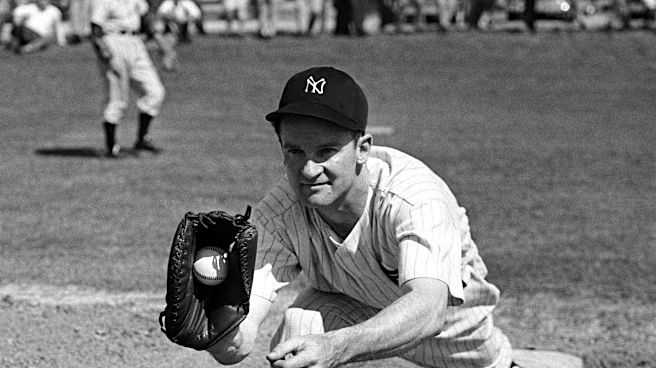


After Babe Ruth made the No. 3 jersey famous, Bud Metheny would become the last New York Yankee to wear the number before it was retired. Outside of being a fun trivia question answer, Metheny would go on to build a legacy far greater than simply being another person to wear a jersey number.
Arthur Beauregard “Bud” Metheny
Born: June 1, 1915 (St. Louis, MO)
Died: January 2, 2003 (Virginia Beach, VA)
Yankees Tenure: 1943-1946
Metheny was born and lived in St. Louis through his childhood. His family would
move to Virginia as he entered his teenage years, and it was there he would star on the baseball team at Calverton High School. Ironically enough, this move was a bit of a homecoming for Metheny as his mother’s family claimed to be descendants of Pocahontas.
After high school Metheny attended college at William & Mary. While playing for William & Mary, the Yankees signed Metheny to a contract that came with an agreement to allow him to finish his degree. Metheny earned his teaching degree in 1939 and would later earn his master’s in education in 1952. His reputation as a good person and star athlete while in college would open doors later in life as well as earn him a spot in the William & Mary Hall of Fame.
Upon graduating, Metheny headed to Kansas City to play in the American Association professional league that summer. A left-handed hitter and outfielder, Metheny impressed to the tune of a .315 average in 95 games. However, this success came at a cost as Metheny injured his knee sliding and missed two months of the season, later requiring surgery in the offseason. This injury would turn out to be the biggest blessing in disguise that Metheny could receive — though it would take some time for that to be realized.
Metheny added some weight during the recovery period from his surgery and used his extra force to have another solid season in 1940, this time for the Newark Bears of the International League. The Bears would win the Junior World Series that season. After the season ended, Metheny made an effort to shed those pounds from the last offseason and was able to lose around thirty pounds.
However, losing weight would have negative effects on the diamond. In 1941, back with Kansas City, Metheny struggled and saw his batting average drop over 60 points and only hit three home runs which dropped his slugging from .451 in 1940 to .307.
Following the worst season of his baseball life Metheny was able to turn things around in 1942. Now 27 years old and married to his college sweetheart, Frances Davis, Metheny slashed .296/.363/.460 which was good for a .823 OPS. The eighteen home runs that season launched him onto the Yankees’ radar, and they picked him up for the next season.

The 1943 season would prove to be the year that Metheny’s baseball dream would come true. Metheny played sparingly over the first two months of the season, but at the start of the summer he found himself right in the middle of the regulars playing a lot of right field as several of his teammates were selected for service in World War II. Metheny was rejected for military service due to the knee surgery he had a few years prior.
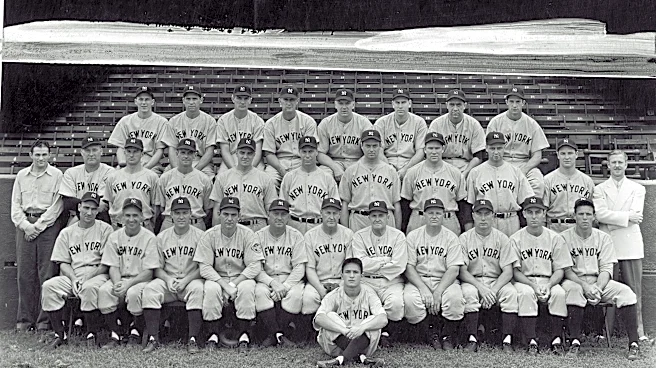
Making the most of his opportunity, Metheny played in 103 games, making 86 starts, while batting .261 with nine home runs. The Yankees would win the pennant and face the St. Louis Cardinals in the World Series. Metheny played in two games and got one hit as the Yankees won the series in five games.

Next year would not be as kind to Metheny or the Yankees. Metheny started 128 games between right and left field but saw his average fall to .239. Although he hit a career-high 14 home runs, he also led all American League outfielders with 11 errors.
Metheny held his role heading into the 1945 season and started 126 games, this time all in right field. In his age-30 season, Metheny hit .248 with eight home runs. The Yankees finished fourth in American League, and the writing was on the wall for Metheny heading towards the 1946 season as the Yankees were set to welcome back Joe DiMaggio and others following their service time.
When the club left spring training in 1946 Metheny was with them. However, it did not last long as after three pinch hit appearances the last man to wear No. 3 for the Yankees was sent down to the minors. Metheny would never play at the highest level again. His final career numbers, all with the Yankees, include 344 hits, 31 home runs, and 12 stolen bases.
Back in the minors Metheny would spend the rest of the 1946 season through the 1950 season as a player and then a player manager. While still playing in 1947, Metheny was recruited a second time by his old college coach to a teaching and coaching position at Old Dominion University.
It was at Old Dominion that Metheny would build his legacy. Metheny coached the baseball team to a 423-363-6 record in 32 seasons at the helm. He was named the NCAA Eastern Regional Coach of the Year in 1963 and 1964, and in 1980 led the Monarchs over the University of Virginia to win the Virginia State Championship. Additionally, Metheny coached the basketball team to 16 winning seasons and a 198-163 record and served as the athletic director for a time.
After such a long career, Metheny was honored with the baseball complex named after him. This changed in 2024, but the field is still named in his memory. Additionally, Metheny was inducted into the Old Dominion University Sports Hall of Fame in 1983. The baseball team to this day still wears pinstripes at home as a nod to Metheny and his tenure with the Yankees.
When it was all said and done, Metheny was a member of the William & Mary Hall of Fame, the Old Dominion University Hall of Fame, the Virginia Sports Hall of Fame, and the American Association of College Baseball Coaches Hall of Fame. On January 2, 2003, Matheny passed away in the afternoon just a few hours after his wife of 61 years passed in the morning.
Happy birthday Bud!